A new deck costs $25 to $50 per square foot installed. A 12 by 12 foot deck runs about $3,600 to $7,200. A 20 by 20 lands around $10,000 to $20,000. Replacing an old deck costs a little more than building new, at $30 to $55 per square foot, because somebody has to tear the old one out first.
That is the short answer. The rest of this is what actually moves the number, which parts get left off quotes, and when Metro Nashville makes you pull a permit.
The short version
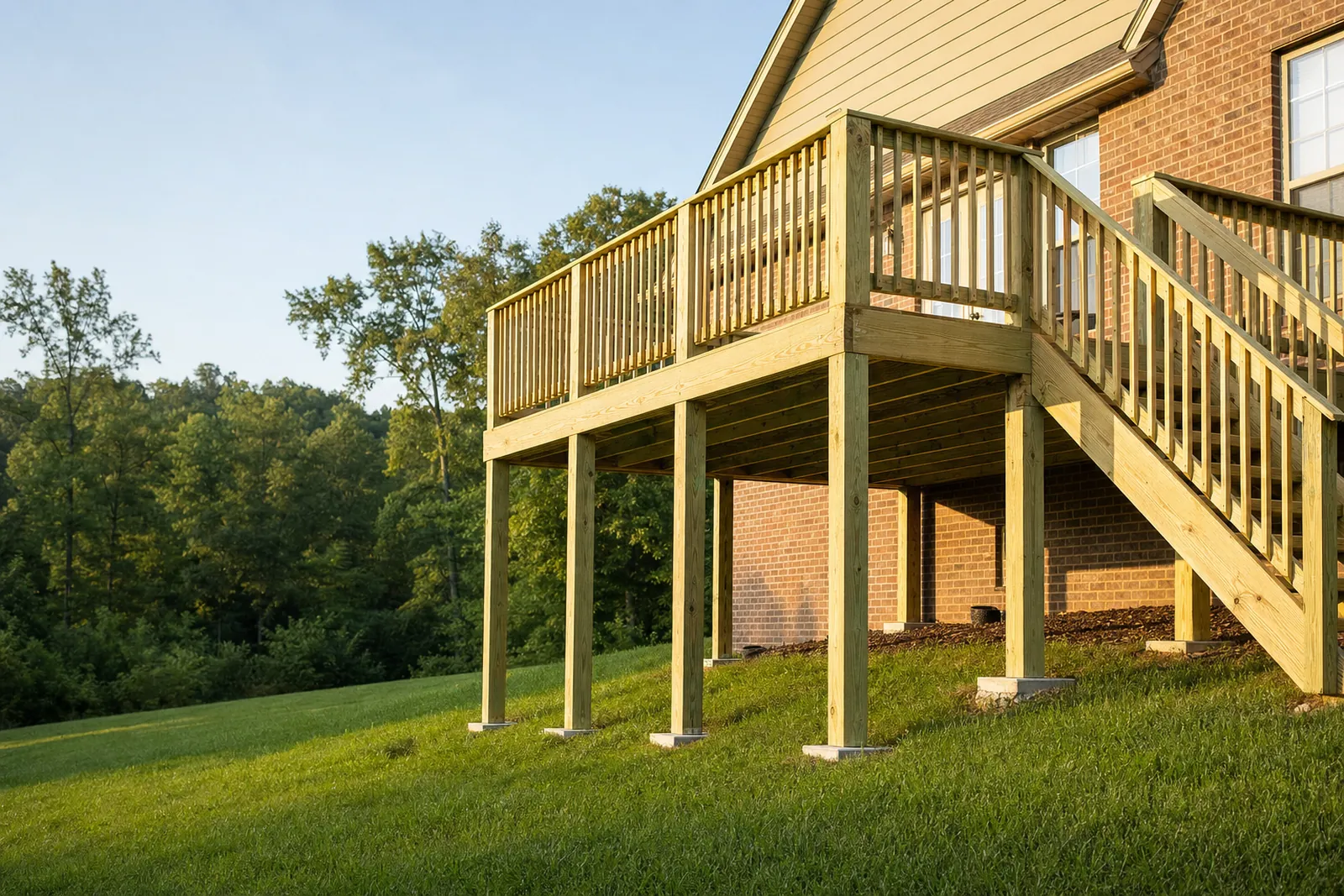
Size is not the biggest factor. Height is. A deck sitting near the ground costs $25 to $30 a square foot. The same deck on the second storey costs $50 to $60.
Material is the second biggest. Pressure-treated pine starts at $25 a square foot. Composite starts at $40.
Stairs and railings are separate and are the two things most often missing from a cheap quote.
In Nashville, building or replacing a deck needs a permit. So does replacing more than 100 square feet of deck boards.
What it costs by size
These are for pressure-treated pine, attached to a one-storey house. That is the most common deck built around here.
Installed cost by deck size. Each bar is a range because the real number depends on height, material and access.
Notice the ranges are wide. A 20 by 20 deck can cost $10,000 or $20,000, and that is the same deck in square feet. The difference is everything below.
What actually moves the price
How high off the ground it sits
This is the one most people do not expect. Height matters more than size.
Installed cost per square foot by deck type
Type of deck
Per square foot
Floating or detached, no rails or stairs
$20 to $25
Ground level, attached
$25 to $30
Raised, attached
$30 to $50
Second storey, attached
$50 to $60
Multi-level
$60 to $100
A second-storey deck costs roughly twice what a ground-level one does. The reason is simple. It needs big posts, a deeper concrete foundation to hold it up, railings by code, stairs down to the yard, and a crew working off ladders and scaffolding instead of standing on the grass.
If your budget is tight and your yard allows it, building low is the single biggest saving available.
This bites hardest in the hillier, newer subdivisions. A walkout basement means the back of the house sits well above the yard, so the deck off the kitchen is a raised or second-storey build whether you wanted one or not. That is common in Nolensville, Spring Hill and parts of Green Hills, and it is why two neighbours with identical square footage can get quotes thousands apart.
What it is made of
Installed cost per square foot by material. Pressure-treated pine is cheapest to buy. It is not cheapest to keep.
Pressure-treated pine is the default and the cheapest, at $25 to $50 a square foot. It is wood soaked with chemicals so bugs and rot leave it alone. The catch is maintenance: it wants staining and sealing every year, and a wood deck lasts 10 to 25 years.
Cedar runs $30 to $47. It resists weather and bugs on its own with no chemicals, and it takes stain nicely. It is soft, though, so it dents and scratches, and it still needs resealing every year.
Composite runs $40 to $80, and Trex, the best-known brand, runs $45 to $70. Composite is recycled wood and plastic pressed together. It costs more up front and it does not need resealing every year. A composite deck lasts 25 to 50 years, which is roughly double a wood one. Most Trex products carry a 20 to 25 year warranty.
Here is the trade in plain terms. Composite costs about $15 more per square foot than pine. On a 12 by 12 deck that is roughly $2,200 more at the start. In exchange you skip a yearly staining job and the deck lasts about twice as long.
Aluminium is the outlier at $100 to $125. Almost nobody builds a whole deck from it here. It does not rot, burn or feed insects, but the price keeps it rare.
The parts people forget
These are genuinely separate line items. If a quote looks cheap, check whether it includes them.
Stairs: $1,400 to $2,600 installed.
Railings: $20 to $60 per linear foot for wood or vinyl. A raised deck must have them by code, so this is not optional.
Tear-out of the old deck: the reason replacement costs $30 to $55 a square foot instead of $25 to $50.
Levelling the yard first: $500 to $1,000.
A roof over it: $10 to $60 per square foot.
Staining or sealing: $1.50 to $4.00 per square foot, and it comes round again every year or two on a wood deck.
The permit: $50 to $150.
Drainage, which matters more here than in drier places
Middle Tennessee is wet. Water pooling under a deck rots the posts holding it up, and that is a structural problem rather than a cosmetic one.
If your yard holds water where the deck is going, deal with it before the deck goes on top. A drainage system starts around $1,000. That is real money, but it is far less than rebuilding a deck whose supports rotted out in eight years.
One thing to ask about directly: posts should not be buried straight in the ground. They sit on concrete footings. A crew that buries posts in dirt is building you a deck with a short clock on it.
When Nashville makes you pull a permit
This part is local and worth getting right, because work done without a permit can have to come back off.
Metro Nashville’s Department of Codes and Building Safety is clear about it:
Building a new deck needs a permit.
Replacing a deck needs a permit.
Replacing more than 100 square feet of deck boards needs a permit, even though you are only swapping boards.
Replacing any footings or framing needs a permit.
Tearing a deck down and not replacing it does not need one.
There are also rules about where the deck can sit on your lot. It cannot cross your setbacks or utility easements. An uncovered deck can come within 10 feet of the rear line but has to meet the full side setback. A covered deck has to meet the full rear and side setbacks both.
Outside Davidson County the rules are different. Williamson County, which covers Franklin and Brentwood, sets its own. So do Rutherford County for Murfreesboro and Smyrna, Wilson County for Mt. Juliet, and Sumner County for Hendersonville and Gallatin. Ring your own county before you order materials. The thresholds are not the same.
If you live in a historic district, there may be more to it. Properties in a Neighborhood Conservation Overlay or Historic Preservation Overlay have their own rules, and the Historic Commission is the one to ask. Our Middle Tennessee siding guide covers how those overlays work in more detail.
Can you pull the permit yourself? If you live in the house, or plan to, yes. If the house is owned by an LLC or a trust, or it is a rental or investment property, you can only self-permit work under $25,000. The affidavits have to be notarised.
One more, and it is free: call Tennessee 811 at least three working days before anyone digs. They mark the underground utility lines. Deck footings mean digging holes, and hitting a gas line is a very bad day.
The Codes building division is on 615-862-6550.
Should you repair or replace?
A reasonable rule: replace if the deck is more than 20 years old, or if the repair quote is more than half the price of a new one.
Most deck repairs run $750 to $2,500. Replacing a 20 by 20 deck runs $12,000 to $22,000.
What matters is which part is bad. Boards are the cheap part and they are easy to swap. The frame, the posts and the footings are the expensive part. If the boards are tired but the structure is sound, you are looking at a repair. If the posts are soft at the bottom or the whole thing moves when you walk on it, that is a replacement, and no amount of new decking fixes it.
Is it worth doing yourself?
Materials alone for a 12 by 12 deck run $2,000 to $4,000, against $3,600 to $7,200 to have it built. So you would save somewhere around a third.
A small floating deck close to the ground is the realistic DIY project. It carries less load, usually needs no railings, and a mistake is less dangerous.
Anything attached to the house is a different job. The connection where the deck meets your wall is the part that fails and hurts people when it is done wrong. Height, railings and stairs all have code requirements. And you still need the permit and the inspections either way.
How long will it take?
A simple ground-level deck of 100 to 300 square feet takes about 5 to 7 days of building. A larger raised deck runs 2 to 4 weeks. Add a day or two for tearing out an old one.
Then add the permit, which takes a week or more on its own, and any ground work. If you want the deck for summer, start asking in late winter.
Does it add value?
A wood deck returns about 45 to 55 percent of what it cost when you sell. Composite returns slightly less as a percentage but raises the property value more.
Worth knowing: a deck does not add square footage to your house. It will not show up as extra floor area. It may well raise your property taxes, since it raises what the house is worth.
Common questions
How much does a 20×20 deck cost?
About $10,000 to $20,000 installed in pressure-treated pine on a one-storey house. The spread is that wide because of height and material. Ground level in pine sits near the bottom. Raised, or built in composite, pushes toward the top or past it. Replacing an existing 20 by 20 runs $12,000 to $22,000, because tear-out is extra.
What is the cheapest way to build a deck?
Build it low and build it in pressure-treated pine. A floating deck with no railings or stairs is $20 to $25 a square foot, against $50 to $60 for the same deck on the second storey. Material choice saves less than height does. Keeping the shape a simple rectangle also helps, because every corner and angle is labour.
Do I need a permit to build a deck in Nashville?
Yes for a new deck and yes for replacing one. You also need one to replace more than 100 square feet of deck boards, or to replace any footings or framing. You do not need one to tear a deck down if you are not replacing it. The deck also has to sit inside your setbacks and off your utility easements. Metro Codes is on 615-862-6550.
Is composite decking worth the extra money?
It depends how long you are staying. Composite costs roughly $15 more per square foot, about $2,200 more on a 12 by 12. For that you skip staining and sealing every year, and the deck lasts 25 to 50 years against 10 to 25 for wood. If you are staying more than about a decade, the maintenance you avoid tends to cover the difference. If you are selling in two years, it will not.
How long does a deck last in Tennessee?
A wood deck lasts 10 to 25 years and a composite one 25 to 50. Decks do worse in wet climates, and Middle Tennessee is wet. The two things that decide which end of the range you land on are whether water drains away from underneath and whether the posts sit on proper concrete footings instead of being buried in dirt.
Can I build a deck right on the ground?
Not a wood or composite one. It needs posts or risers underneath so air can move and the timber can dry. Decking left sitting on soil soaks up water and rots. If you genuinely want something at ground level, a patio is the better answer.
Getting it quoted
Compare at least three quotes, and make sure they are quoting the same deck. Questions worth asking:
Does this include stairs and railings? They are separate items and they are what makes a cheap quote cheap.
Does it include tearing out and hauling away the old deck?
What are the footings, and how deep? Posts sit on concrete. They are not buried in soil.
Who pulls the permit? Get this in writing.
What happens if the ground needs work? Ask the rate before anyone starts digging.
Check the license too. Our Middle Tennessee deck builder directory lists every company we track with its state license number and expiry date, so you can check it against the state register yourself rather than taking our word for it. You can also request a free quote from our sponsor, a licensed Nashville contractor, or start with deck builders in Nashville.
Sources
HomeGuide cost to build a deck, updated 10 February 2026, for the per-square-foot ranges, the cost-by-size table, cost by material, cost by deck type, the labour and materials split, stairs, railings, levelling, drainage, staining and permit costs, build times, deck lifespans, repair against replacement, DIY materials cost and resale return. Retrieved 5 October 2026.
Metro Nashville Department of Codes and Building Safety, adding a deck or patio to a residence, for what needs a permit and what does not, the 100 square foot deck board threshold, footing and framing replacement, setback and easement rules, the reduced rear setback for uncovered decks, historic overlay referrals, self-permit eligibility and the $25,000 limit for LLC, trust and investment properties, and the Tennessee 811 notice. Page last updated 17 January 2025, retrieved 5 October 2026.
This article is general information, not construction, engineering or legal advice. Permit rules are set by your local jurisdiction and change over time: the rules above are Metro Nashville and Davidson County, and Williamson, Rutherford, Wilson and Sumner counties set their own. Confirm the requirements for your address before you build. Cost figures are national installed ranges and will vary with your yard, your access and your design. Last updated 5 October 2026.
Hardie board is siding made out of cement. People call it Hardie, Hardie board, Hardy board, or HardiePlank. They all mean the same thing. James Hardie is the company that makes it. The material itself is called fiber cement, and other companies make it too.
It is the most common upgrade on Middle Tennessee homes right now. This guide covers what it is made of, which houses have it, how long it lasts, how to check your own walls, and which fixes you can do yourself.
The short version
It is cement, sand, and wood fiber baked together with steam. That is why bugs and rot leave it alone.
The boards last 50 to 75 years. The paint does not. Plan to repaint every 7 to 15 years.
Most problems are install problems, not board problems. The boards outlive bad work.
The big one to check: there must be a 6 inch gap between the bottom of your siding and the dirt.
Small fixes are fine to do yourself. Putting up a whole wall is not a weekend job.
What Hardie board is made of
Fiber cement has four ingredients. That is all.
Portland cement. The same cement used in sidewalks.
Sand. Ground fine.
Cellulose fiber. This is wood fiber, broken down into tiny strands.
Water.
Here is the part that matters. The wood fiber is not there to make the board look like wood. It is there to stop the board from cracking. Cement on its own is brittle. Mix in wood fiber and the board can flex a little instead of snapping.
How it gets made
The four ingredients get mixed with water into a slurry. Think of thin pancake batter.
That slurry gets spread into thin layers. The layers stack up and press together into one sheet, about as thick as a finger. While the sheet is still soft, a roller can press a wood grain pattern into the face. If the maker wants a smooth board instead, they skip that step.
Then comes the step that makes the whole thing work. The sheets go into an autoclave. An autoclave is a big sealed oven that cooks with high-pressure steam. The steam curing makes the board much stronger, and it makes the board hold its shape. A cured board does not swell in summer and shrink in winter the way wood does.
Last, the sheets get cut into planks and painted at the factory.
A cut end tells you what it is. Solid grey cement the whole way through, with a thin coat of paint on the face.
What that gets you
Because it is basically a thin slab of cement, a few things follow:
It does not rot. There is nothing in it for rot to eat.
Bugs leave it alone. Termites cannot chew cement.
Woodpeckers cannot get through it.
It does not burn. Fiber cement carries a Class A fire rating, the best one.
It holds paint for a long time. The surface is stable, so the paint on top stays put.
It is heavy. This is the trade-off. A plank is much heavier than vinyl, and it takes two people and the right tools to hang it well.
Two kinds: ColorPlus and primed
You can buy Hardie board two ways, and the difference matters later when something needs fixing.
ColorPlus comes painted from the factory. The color is baked on in a controlled room. It looks even, and it lasts well.
Primed comes with a base coat only. A painter puts the real color on after the boards are on your wall.
Neither one is wrong. But remember which one you have, because you can patch a primed board yourself and you are not supposed to patch a ColorPlus board the same way. More on that below.
Which houses have it
Hardie board shows up on two kinds of homes around here.
Newer houses. Builders started using fiber cement heavily in the 2000s. If your house went up after about 2005 and the siding is not vinyl, there is a good chance it is fiber cement.
Older houses that got re-sided. This is the bigger group. When a 1990s house with failing hardboard finally gets stripped, fiber cement is usually what goes back on. Same for older homes with tired wood siding.
It also turns up as an accent. Many brick houses here have fiber cement in the gables, on dormers, or across the back of the house where the brick stops.
How to tell if you have it
Four checks, none of which take long:
Knock on it. Fiber cement feels solid and sounds dull. Vinyl sounds hollow and gives under your knuckle.
Push on it. Vinyl flexes. Fiber cement does not move at all.
Look at a vertical seam. Vinyl panels lap over each other and leave an obvious overlap every few feet. Fiber cement boards meet end to end, and the seam is either caulked or covered by a thin strip of trim.
Look at the bottom edge of a board. Fiber cement edges stay crisp and square. Hardboard swells and goes soft and furry.
These are patterns based on when each area was built. They are not a survey of every house, so treat them as what to expect.
Franklin, Brentwood, and the rest of Williamson County. This is the heaviest concentration. Newer neighborhoods here used fiber cement from the start, often mixed with brick or stone on the front.
Nolensville, Spring Hill, and Mt. Juliet. Fast-growing areas built mostly after 2000. Lots of fiber cement, lots of board and batten gables.
East Nashville and the older close-in neighborhoods. Here it shows up as a replacement on older homes. In the strict historic districts, the smooth version is the one that gets approved. The version with wood grain stamped into it usually does not.
Antioch, Hermitage, Smyrna, and outer Murfreesboro. These areas are full of 1980s and 1990s homes with failing hardboard. Fiber cement is the usual replacement, so it is spreading street by street as houses get re-sided.
Green Hills and Belle Meade. Mostly brick, with fiber cement on gables, dormers, and additions.
A note on the HZ10 version
James Hardie makes its boards in two recipes for two kinds of weather. HZ5 is built for cold places with freezing and snow. HZ10 is built for the hot, wet South, and the company says it is made to resist cracking, rotting, and swelling in humid heat.
Middle Tennessee siding contractors specify the HZ10 line for homes here. James Hardie assigns the zone by ZIP code, so if it matters to you, check your own address on their zone tool or ask your contractor which line they are quoting.
How long it lasts
The boards themselves last a long time. Here is how fiber cement compares to the other siding you will find on Middle Tennessee homes.
Published service life. Each bar is a range, not one number, because that is how the figures are published.
Fiber cement sits furthest to the right. Only brick beats it, and brick is left off the chart because its published life has no upper limit.
But the boards are only half the story. The paint on top wears out long before the board does, and the caulk in the joints wears out faster still. A Hardie wall is not a thing you install and forget for 60 years. It is a thing you check once a year and repaint a few times.
What a Hardie wall asks of you, measured in years after it goes up.
The warranties, in plain words
James Hardie publishes two warranties, and they cover different things.
The board warranty runs 30 years. It is non-prorated, which means it does not shrink as the years pass. A claim in year 29 is treated the same as a claim in year 2. It also transfers, so it follows the house if you sell.
The ColorPlus paint warranty runs 15 years and covers peeling, cracking, and chipping. This one also covers the labor to put it right, which is unusual and worth knowing.
Both are limited warranties with conditions attached. The most important condition is that the siding was installed the way the manufacturer says. That brings us to the real issue.
What to look for on your house
Here is the thing almost nobody tells homeowners: when Hardie siding fails early, the board is usually fine. The installation was wrong.
Water is the enemy, and these rules exist to keep water off the boards and out of the wall. All of them come straight from James Hardie’s own installation guide. You can check most of them from your yard.
The gap checks
6 inches from the ground. This is the big one. The bottom of your siding must sit at least 6 inches above the dirt. Mulch counts as dirt. Garden beds get topped up year after year, and eventually the soil touches the siding. Once that happens, the wall stays wet.
2 inches from anything solid. Where siding meets a roof, a deck, a walkway, steps, or a driveway, there must be a 2 inch gap. This one catches people adding a deck later: the new deck gets built up tight against the wall and the gap disappears. If that is on your list, we cover it in what a deck costs to build here.
A quarter inch above flashing. Where siding sits on top of metal flashing, leave a quarter inch gap so water can run off instead of sitting there.
1 inch from the gutter end. Gutters should not jam up against the siding.
Never sitting in standing water. If a puddle forms against your wall after rain, that is a problem to fix.
The most common fault we see. The mulch bed crept up over the years and now the bottom board never dries out.
The water checks
Kickout flashing. Where a roof edge runs into a wall, there should be a small angled piece of metal that throws water out into the gutter. Without it, every rain dumps water straight down behind your siding. Look up at the spot where a roofline meets a wall. If there is no little metal flap there, that is worth asking about.
Stains running down the wall. A dark streak below a joint, a window corner, or a light fixture means water is getting in above it.
Caulk that has pulled away. Look at the vertical joints between boards, and around windows and doors. Old caulk shrinks, hardens, and pulls off one side, leaving a gap.
Caulk that has let go at a joint. The boards are fine. The gap is the problem, and it is a cheap fix if you catch it.
Signs on the boards themselves
Paint peeling or chalking across whole boards. Usually means the paint is simply due, not that the board is bad.
Cracks running from nail heads. Often means the nails were driven too hard when it went up.
A wavy, uneven wall. Usually means the nails were overdriven into soft sheathing underneath.
Soft or crumbling board edges. This is the one that actually means the board is finished. It is rare, and it almost always shows up where one of the gap rules above was broken.
The rule of thumb: damage in one spot is a repair. Damage in the same spot on every wall is an installation problem, and fixing a few boards will not solve it.
Repairs you can do yourself
Let us be straight about this. Installing fiber cement siding is not a DIY job. The NAHB says plainly that fiber cement installations are typically not suited to do-it-yourself projects, because they need special tools and expertise. The boards are heavy, they crack if you handle them wrong, and cutting them makes dust you do not want in your lungs.
But upkeep and small repairs are a different matter. These are reasonable to take on.
Re-caulking a joint
This is the most useful thing you can do for your siding, and it is genuinely easy.
Dig the old caulk out of the joint. A putty knife works.
Brush the joint clean and let it dry.
Run a new bead in and smooth it with a wet finger.
Re-caulking a joint. This is the highest-value thing a homeowner can do for a Hardie wall.
Use a caulk that stays flexible. Look for the words permanently flexible on the tube. James Hardie asks for a sealant meeting ASTM C920 Grade NS, Class 25 or higher, or a latex sealant meeting ASTM C834. Those code numbers are printed on the tube, so you can match them in the store.
Washing it
Dirt and spider nests come off with a garden hose and a soft brush. Keep the pressure low and point the water down, not up. Spraying up under the boards pushes water behind them, which is exactly what you spent all this effort preventing.
Fixing a small chip or dent
This one depends on which kind of board you have, and the difference is important.
If your siding is primed and painted on site: you can fill small dents, chips, and cracks with a cementitious patching compound, then prime and paint over the repair.
If your siding is ColorPlus: do not do that. James Hardie specifically does not approve filling nail heads, holes, dents, or cracks with caulk or patching compound on ColorPlus boards. The factory finish will not match, and you may affect the finish warranty. Touch-up pens exist, but the manufacturer says to use them only on an area smaller than a dime. Anything bigger means replacing the board.
Painting it
You can repaint fiber cement yourself. Three rules from the manufacturer:
Use exterior acrylic paint. Not stain. Not oil-based paint. Not alkyd. Those can cause the surface to roughen, crack, chalk, or let go entirely.
Never paint a wet board. Let it dry fully first.
If boards went up primed, they need their real paint within 180 days. Primer is not a finish and will not protect the board on its own for long.
What to leave alone
Cutting boards. Cutting fiber cement releases silica dust, which damages lungs over time. OSHA’s rule for professionals is a saw with a blade 8 inches or smaller fitted with a dust collector and a filter that catches 99 percent or more. If you are not set up like that, do not cut it.
Anything above the first floor. The boards are heavy and awkward. Ladder work with a 12 foot plank is how people get hurt.
Replacing boards in the middle of a wall. Boards overlap and are nailed through the course above. Pulling one out without damaging its neighbors takes practice.
Anything involving flashing. Flashing is what keeps water out of the wall itself. Getting it wrong is expensive and you will not see the damage for years.
Repair or replace?
A simple way to think about it:
Paint is failing but boards are sound. Repaint. You are not replacing anything.
A few damaged boards, rest of the wall fine. Replace those boards.
Caulk gone at most joints. Re-caulk the house. This is maintenance, not failure.
Damage concentrated low on every wall. Check the ground clearance first. You may be able to fix the cause by lowering the grade instead of replacing siding.
Soft, crumbling boards in several places, plus stains inside the house. Get it looked at properly. Water has been getting into the wall and the siding may be the smallest part of the problem.
What it costs
Fiber cement runs $6 to $15 per square foot installed, or about $15,000 to $37,500 for a 2,500 square foot house. James Hardie branded product installed runs higher, at $16 to $40 per square foot.
Two things that are often left out of a quote:
Tearing off the old siding adds $0.70 to $2.00 per square foot. This is the single most commonly missing line on a cheap estimate.
Rotten sheathing underneath. On anything over about 25 years old here, expect some. Ask what the rate is before work starts, not after.
Hardie, with an ie. It is named after James Hardie, the company that makes it. Plenty of people say and spell it Hardy, and contractors will know exactly what you mean either way.
How long does Hardie board siding last?
The boards have a published service life of 50 to 75 years, and James Hardie backs them with a 30-year non-prorated warranty that transfers to the next owner. The paint is a different story and needs redoing every 7 to 15 years. Caulk at the joints goes sooner than that and should be checked yearly.
Can I install Hardie board myself?
Realistically, no. The NAHB says fiber cement installation is typically not suited to do-it-yourself work because of the tools and expertise needed. The boards are heavy, they crack when mishandled, and cutting them releases silica dust that needs a dust-collecting saw. Re-caulking, washing, and repainting are all reasonable to do yourself.
Why is my Hardie siding rotting at the bottom?
Fiber cement does not rot, so something else is going on. The usual cause is that the bottom of the siding is too close to the ground. The manufacturer requires at least 6 inches of clearance between the siding and the dirt, and garden beds and mulch creep up over the years until they touch. Once the board cannot dry out, the paint blisters and the edge softens. Check the clearance before you replace anything.
Can I pressure wash Hardie siding?
Gently, if at all. A garden hose and a soft brush are safer. Keep any pressure low and aim the water downward. Spraying upward forces water up behind the boards and into the wall, which causes the damage you are trying to avoid.
Can I paint Hardie board a different color?
Yes. Use a high-quality exterior acrylic paint. Do not use stain, oil-based paint, alkyd paint, or powder coating, because those can roughen the surface, crack, chalk, or stop sticking. Never paint a board that is still wet. If your siding is ColorPlus, repainting it is allowed but may affect the finish warranty, so check first.
What is the difference between fiber cement and Hardie board?
Fiber cement is the material. Hardie board is one brand of it, made by James Hardie, and it is the best known. Allura, Nichiha, and CertainTeed make fiber cement too. They are similar products, but warranties and installation details differ by brand, so do not assume what applies to one applies to another.
Getting it quoted
Three questions separate a real quote from a cheap one.
Does the price include tearing off and hauling away the old siding?
What is the rate if rotten sheathing turns up underneath? It usually does on older homes.
What goes behind the boards? The drainage layer and flashing are what actually keep water out. A crew that cannot answer this is a crew to pass on.
One more worth asking: who is physically doing the work. Most siding here is sold by exterior companies that also roof and fit windows, and siding is sometimes subcontracted. Either answer is fine. Not getting a straight answer is the signal.
James Hardie and its published FAQ, for the 30-year non-prorated transferable substrate warranty and the 15-year ColorPlus finish warranty covering paint and labour. Retrieved 5 October 2026.
The Hardie Zone System, for the HZ5 and HZ10 product lines and what each is engineered for. The zone for a given address is assigned by ZIP code through James Hardie’s own tool. Retrieved 5 October 2026.
James Hardie General Installation Requirements, for the 6 inch ground clearance, the 2 inch clearance to roofs, decks, paths, steps and driveways, the quarter inch clearance above horizontal flashing, the 1 inch gutter clearance, kickout flashing, the 180 day painting window, approved and prohibited paint types, caulk standards ASTM C920 and C834, and the repair patching rules including the ColorPlus exception. Retrieved 5 October 2026.
NAHB and Portland Cement Association, Concrete Homes Technology Brief No. 15: Fiber Cement Siding, for the cement, sand and cellulose composition, autoclave steam curing, the role of cellulose fibre in preventing cracking, the Class A fire rating, annual caulk inspection, repainting every 7 to 15 years, and the statement that fiber cement installation is typically not suited to do-it-yourself projects. Retrieved 5 October 2026.
James Hardie silica safety resources and OSHA 29 CFR 1926.1153, for the Table 1 control method when cutting fiber cement with a handheld power saw: a blade 8 inches or smaller with a commercially available dust collection system and a filter of 99 percent or greater efficiency. Retrieved 5 October 2026.
HomeGuide house siding cost guide, updated 29 October 2025, for installed cost ranges, whole-house totals, service life figures and tear-off cost. Retrieved 5 October 2026.
This article is general information, not construction or engineering advice. Warranty terms are summaries of published limited warranties that carry conditions and exclusions; read the current warranty document for your product before relying on it. Confirm your Hardie Zone and product line with James Hardie or your contractor. Cost figures are national installed ranges and will vary with your house. Last updated 5 October 2026.
Your house almost certainly has the siding it has because of the year it was built. Builders used whatever was cheap, available and fashionable at the time, street by street and subdivision by subdivision. That is why a whole cul-de-sac in Antioch has the same swelling hardboard, and why half of Lockeland Springs has painted wood. This guide works through every siding type you will find around Nashville, Franklin and Murfreesboro: what it is, what it is made of, which houses have it, and what is good and bad about living with it.
Start here
Find your build decade first. It narrows the answer faster than looking at the wall does.
Built 1980 to 1998 and the bottom edges look swollen? That is probably hardboard, and there is a well-documented reason it is failing.
Built before about 1980 with small, brittle, chalky shingles? Read the asbestos section before anyone touches it.
In a historic district? The rules may decide your material for you. Vinyl is often not allowed.
Four checks at the wall
The decade table below narrows it down. These four checks confirm it, and none of them takes more than a minute.
Knock on it. Fiber cement and brick ring solid and feel heavy. Vinyl sounds hollow and gives a little under your knuckle. Aluminium sounds tinny and thin.
Run your hand down it. Chalky powder on your palm means aluminium, or vinyl old enough to have oxidised.
Look at the bottom edge of a board. Swollen, soft and furry means hardboard. Split, checked and flaking means real wood. Crisp and unchanged means vinyl, fiber cement or engineered wood.
Find a vertical joint. Vinyl panels lap over one another and leave an obvious vertical seam every few feet. Fiber cement and engineered wood meet in a butt joint that is caulked or covered by a trim strip. Brick has no vertical joints of that kind at all.
Small brittle shingles with a wavy bottom edge and thick chalky paint are a separate case. That is possibly asbestos-cement, and the right check is to stop and have it tested rather than handle it.
Find your house by its decade
What is probably on your walls, by when the house was built
Built
Most likely siding
Watch for
Before 1900
Wood clapboard, brick
Later layers hiding the original wood
1900 to 1940
Wood clapboard, wood shingle, brick
Asbestos or aluminium added later
1940 to 1970
Brick veneer, asbestos-cement, aluminium, wood
Asbestos shingles
1970 to 1980
Aluminium, early vinyl, hardboard, brick
The start of the hardboard era
1980 to 1998
Hardboard (Masonite), vinyl, brick fronts
Swelling and rot at the bottom edge
1998 to 2010
Vinyl, brick fronts, early fiber cement
Faded, brittle vinyl now at end of life
2010 to now
Fiber cement, engineered wood, vinyl, brick
Installation quality more than material
How Middle Tennessee got built
The siding on your house is a fossil of a building era. It helps to know which one.
1779 to 1860: founding and the first permanent houses
Nashville starts as Fort Nashborough in 1779, settled by a group led by James Robertson and John Donelson. It is renamed Nashville in 1784 and becomes a city in 1806. Franklin is founded on 26 October 1799 by Abram Maury Jr, the same day Williamson County is created. Murfreesboro is chartered in 1811 and serves as the state capital of Tennessee from 1818 until 1826, when the assembly left for good. Nashville became the permanent capital in 1843.
Houses from this period are log, brick, or heavy timber clad in wide wood boards. Almost nothing from this era survives as ordinary housing stock, but the brick tradition it started never really stopped here.
1870 to 1900: the Victorian city
This is the cottage-and-gingerbread era: steep roofs, decorative trim, tall narrow windows, and narrow painted wood clapboard almost universally. The surviving pockets are what later became Nashville’s historic districts.
1890 to 1935: streetcars make the first suburbs
This period built most of the old neighbourhoods people love now. By 1890 electric streetcar lines could run well beyond downtown, cheap land near the lines opened up, and middle-class neighbourhoods appeared on lots that had been estates.
East Nashville was platted by the East Edgefield Land Company and served by electric lines down Woodland, Shelby and Fatherland, with East End among the first of many subdivisions. Inglewood Place was first laid out in 1909, expanded in 1919 and again in 1933, with its big building boom through the 1920s and 1930s. Belmont-Hillsboro was subdivided from the Acklen and Montgomery estates in 1890 and 1891, got its streetcar line on Belmont Boulevard in 1901, and did most of its building between 1905 and 1920.
Siding here is wood: clapboard on the body, often wood shingle in the gables. Bungalows and four-squares dominate.
1945 to 1970: the ranch boom
Returning veterans with GI Bill mortgages drove a national building boom, and Nashville spread. Green Hills had seen small-scale building in the 1930s but filled in after the war, mostly brick-veneer ranch houses on large lots. Donelson developed right after the war. Marlin Meadows in Madison was built out mainly between 1952 and 1959. The Federal Aid Highway Act of 1956 and the arrival of the interstates pushed growth further out; I-65 through Williamson County was finished in the late 1960s, which is the beginning of Brentwood and Franklin as commuter towns.
The ranch is the defining house: one storey, low-pitched roof, wide eaves, carport, picture window. Brick veneer is the default, with wood, aluminium or asbestos-cement on the gable ends and secondary walls.
1970 to 2000: subdivisions, and the problem materials
This is where most of the metro’s housing stock actually comes from, and where the siding problems concentrate. Vinyl became mainstream in the 1970s. Hardboard siding was installed heavily through the 1980s and 1990s. The brick-front-with-siding-on-the-sides pattern becomes the standard builder detail across Antioch, Smyrna, La Vergne, Hermitage and outer Murfreesboro.
2000 to now
Fiber cement and engineered wood take a growing share, especially in Williamson County and the newer parts of Mt. Juliet, Nolensville and Spring Hill. Vinyl is still widely used. Board and batten returns as a styling choice on gables and farmhouse-look builds.
Every siding type, one at a time
The photographs below are illustrations of what each material typically looks like, not identification references. Siding varies by manufacturer, age and how many times it has been painted. Use them to narrow down what you are looking at, then confirm it properly, and in the case of suspected asbestos have it tested rather than judged by eye.
Wood clapboard (also called lap or weatherboard)
Painted wood clapboard. Narrow boards, each lapping the one below.
What it is: long horizontal boards, each overlapping the one below, painted. The oldest exterior, and still the most authentic one for a historic house.
Made of: solid timber, historically poplar, pine or cypress here.
Found on: anything built before about 1940. East Nashville, Germantown, Edgefield, Belmont-Hillsboro, downtown Franklin, older parts of Murfreesboro.
Good: it can be repaired board by board rather than replaced wholesale, it takes paint well, and it is the only material that looks right on a Victorian or a bungalow. It is also what historic districts want to see. Properly maintained wood lasts a very long time.
Bad: it needs painting roughly every 7 to 10 years in this climate, and that is the real cost of owning it. It rots where water sits, especially at the bottom course and where boards meet trim. It burns. Insects eat it. Expect $5 to $15 per square foot installed, and a 20 to 40 year life if maintenance slips.
Wood shingle and shake
Cedar shingle. Note the algae on the lower, shaded courses, which is the usual Middle Tennessee maintenance problem.
What it is: small overlapping pieces rather than long boards. Shingles are sawn and smooth; shakes are split and rough.
Made of: usually cedar.
Found on: gable ends and dormers of bungalows and Tudor-style houses, and as a full wall treatment on some upper-tier homes in Green Hills and Belle Meade.
Good: excellent texture, and the correct detail for certain house styles. Cedar naturally resists insects.
Bad: the most maintenance-hungry option on this list. In Middle Tennessee humidity, shaded north-facing cedar grows algae and holds moisture. Expect to clean and re-treat on a cycle, and to replace individual pieces regularly. $6 to $16 per square foot.
Asbestos-cement shingle
Asbestos-cement shingle. The scalloped bottom edge and chalky surface are typical. Illustration only: suspected asbestos must be tested, never identified by eye.
What it is: small, hard, brittle shingles, usually around 12 by 24 inches, often with a slightly wavy bottom edge and many layers of old paint.
Made of: cement mixed with asbestos fibre, pressed into thin sheets. First made in 1907 and installed into the early 1980s.
Found on: houses built or re-clad roughly 1930 to 1975. Very common on modest post-war houses across Davidson County, and frequently installed straight over original wood clapboard, which means the wood may still be underneath.
Good: genuinely durable, fireproof, and it does not rot or feed insects. Intact asbestos siding sitting on your wall is not hurting you.
Bad: brittle, cracks easily, cannot be nailed through, and matching replacement pieces is close to impossible. The serious issue is removal. Breaking, sanding, cutting or power-washing it releases fibres. Do not test it by snapping a piece off. Get it tested, and if it comes back positive, removal is a specialist job with its own disposal rules.
One more thing on older houses: any paid renovation work on a home built before 1978 falls under the federal lead-paint rule, which requires the firm to be EPA lead-certified. That applies to siding exactly as it applies to windows. We covered that rule in what drives window replacement cost.
Aluminium
Aluminium. The dent is the giveaway, and it cannot be pushed back out.
What it is: thin painted metal panels, usually in a horizontal lap profile.
Made of: rolled aluminium with a baked finish. It arrived in the late 1930s and 1940s and was a mainstream choice through the post-war decades.
Found on: post-war houses, and as a retrofit over wood on older houses in the 1960s and 1970s. Madison, Donelson, Inglewood, older Murfreesboro.
Good: does not rot, burn or feed insects, and it is light. Old aluminium can be repainted, which is often the cheapest way to deal with it.
Bad: it dents permanently, from hail, ladders, mowers and baseballs, and dents cannot be popped out. The finish chalks as it ages, leaving powdery residue on your hand. It conducts heat, so it insulates poorly, and it can be noisy in wind and rain. $6 to $10 per square foot.
Hardboard, usually called Masonite
Failing hardboard. The swollen, delaminating bottom edge is the signature, and it usually appears across a whole street at once.
This is the one most people come looking for, so it gets the longest entry.
What it is: boards that look like painted wood lap siding but are a manufactured composite. Masonite is a brand name that became the general term, the way people say Hoover for a vacuum cleaner.
Made of: wood fibres, wax and resin, pressed under heat into dense boards. It is wood, but shredded and reconstituted, which matters enormously for how it fails.
Found on: houses built roughly 1980 to 1998, which in this metro means a very large share of Antioch, Hermitage, Smyrna, La Vergne, Old Hickory and the outer rings of Murfreesboro. Entire subdivisions went up with it, which is why whole streets have the same problem at the same time.
How to identify it: look at the bottom edge of the boards, particularly on the north side and anywhere near the ground, gutters or a splash zone. Failing hardboard swells like a wafer: the bottom edge thickens, softens and goes furry. You may also see swelling rings around nail heads, cracking along edges, and a dark waxy bleed on the surface.
The part worth knowing: this is not just your house. A nationwide class action, Naef v. Masonite Corp., was filed in 1994 on behalf of owners of property with Masonite hardboard siding installed between 1 January 1980 and 15 January 1998. A month-long jury trial in 1996 established that the siding was defective under the laws of most states, and the court approved a settlement in 1998 worth more than $1 billion, covering an estimated 4 million homeowners. The agreed damage signatures read like a checklist of what to look for: swelling around nail holes, buckling of more than a quarter inch between studs, edge cracking, thickness swelling over 15 percent, fungal degradation, and wax bleed.
What that means for you now: the claims programme ran through 2008 and is closed, so you cannot file today. The history is still useful for two reasons. It tells you the failure is a known product defect rather than neglect on your part, and it gives you the exact language to point at when you get quotes.
Good: cheap, $4 to $8 per square foot, and it did take paint well.
Bad: it absorbs water at any unsealed cut, edge or nail hole, and in this humidity it stays wet long enough to swell and rot. Painting slows that down but does not stop it once moisture is inside the board. It is the only material on this list we would say plainly: do not install it new.
Vinyl
Vinyl. The vertical butt joint where panels overlap is the easiest way to spot it.
What it is: moulded plastic panels that hook together and hang loose on the wall.
Made of: PVC plastic, with the colour running through the whole thickness rather than painted on. Produced from the 1950s, mainstream from the 1970s.
Found on: the single most common siding in the metro. Everywhere built from about 1975 onward outside the upper tier, and widely used as a replacement on older houses.
Good: cheapest practical option at $4 to $12 per square foot, never needs painting, does not rot or feed insects, and comes in a huge range of colours and profiles. A 30 to 40 year life is realistic.
Bad: it expands and contracts a lot with temperature, which is why it must hang loose rather than be nailed tight. A crew that nails it home leaves you with buckled walls by the first hot August. It cracks on impact, especially when cold, so hail and stray baseballs do real damage. Colour fades in strong sun, and faded panels are very hard to match for a later repair. Dark colours absorb heat and can warp, which matters more here than in cooler states. It is also not permitted in Nashville’s stricter historic districts.
Engineered wood (LP SmartSide and similar)
Engineered wood. The grain is convincing but repeats, because it is pressed rather than sawn.
What it is: the modern, properly engineered answer to what hardboard was trying to be.
Made of: wood strands and fibres bonded with resins, treated with zinc borate against rot and termites, and factory-coated.
Found on: newer builds from roughly 2005 onward, and increasingly used in renovations.
Good: real wood texture, lighter and easier to cut than fiber cement, holds paint well, and far more rot-resistant than the hardboard it replaced. $7 to $12 per square foot, 30 to 50 year life.
Bad: it is still a wood product, so cut ends must be sealed and ground clearance matters. It needs repainting eventually, unlike vinyl. And it carries the reputational shadow of hardboard, which makes some buyers suspicious even though the product is genuinely different.
Fiber cement (Hardie and others)
Fiber cement in its smooth form. This is the version Nashville’s historic districts will approve; the woodgrain-embossed version is not.
What it is: the most popular upgrade material in the metro right now.
Made of: cement, sand, water and cellulose fibre. Developed by James Hardie in the mid-1980s.
Found on: newer Williamson County construction, renovations across the board, and it is the material historic districts will approve in its smooth form.
Good: does not rot, burn or feed insects, holds paint for a long time, and carries a 50 to 75 year service life. In a humid climate it is the strongest all-round performer.
Bad: heavy and brittle to work with, so installation labour costs more and poor installers do real damage. Cutting it produces silica dust that needs proper control. It still needs repainting eventually. $6 to $15 per square foot generally, and $16 to $40 for James Hardie branded product installed.
Brick veneer. Those small gaps in the bottom mortar course are weep holes, and they drain the whole wall. Do not let anyone seal them.
What it is: on almost every house here it is brick veneer, a single decorative layer tied to a wood-framed wall, not structural brick.
Found on: the regional default. Full brick on upper-tier houses in Brentwood, Green Hills and Franklin; brick fronts with siding on the sides across the mid-market.
Good: outlasts everything else, needs essentially no maintenance, does not burn or rot, and holds value.
Bad: most expensive common option at $8 to $18 per square foot, cannot be changed without a major job, and mortar joints eventually need repointing. The weak points are the flashing and the weep holes at the bottom, which people caulk shut without realising those holes are the drainage for the entire wall.
Stucco
Stucco. Hairline cracks like this one need attention promptly in a wet climate.
What it is: a cement-based plaster applied in layers over the wall.
Good: long-lived at 50 to 80 years, seamless appearance, fire resistant.
Bad: unforgiving of water getting behind it, and this is a wet climate. Cracks need prompt attention. It is also the material most dependent on the installer getting the hidden drainage layer right, which you cannot inspect once it is finished. $7 to $17 per square foot.
Stone and manufactured stone
Manufactured stone. Most failures happen where it meets the ground or lacks a drainage gap behind.
What it is: natural stone or a moulded cement product that imitates it, almost always used as an accent rather than a whole wall.
Good: appearance and durability.
Bad: by far the most expensive at $10 to $45 per square foot. Manufactured stone in particular fails where it meets the ground or lacks a proper drainage gap, and badly installed stone traps water against the wall behind it.
Steel
Steel. Uncommon on houses here, so fewer local crews install it well.
What it is: the tougher descendant of aluminium siding.
Good: resists dents far better than aluminium, 40 to 70 year life, does not burn or rot.
Bad: uncommon on houses here, so fewer local crews install it well, and it can rust at cut edges and scratches. $7 to $16 per square foot.
A note on profiles: shiplap, board and batten, Dutch lap
These are shapes, not materials, and the difference causes a lot of confusion when people are comparing quotes. Any of them can be made in wood, vinyl, fiber cement or engineered wood. The material decides durability; the profile decides looks.
Lap or clapboard: plain horizontal overlapping boards. The default.
Dutch lap: lap siding with a decorative groove along the top of each board. Common on mid-century houses and on vinyl.
Shiplap: boards with a rebated edge so they sit flush against each other instead of overlapping, leaving a neat groove. Interior shiplap is a decorating trend. Exterior shiplap is a different and more demanding thing. Because the boards meet flush rather than shedding water over a lap, the joint relies entirely on the gap, the sealant and the drainage layer behind it. On a wet wall in this climate that is a real risk, and horizontal exterior shiplap is the profile most likely to trap water if it is fitted tight or caulked solid. If you want the look, the safe version leaves a ventilated gap behind the boards so the wall can dry. Ask any contractor proposing it exactly how the wall drains.
Board and batten: wide vertical boards with narrow strips covering the seams. Sheds water well because it runs vertically. Currently fashionable on gables and farmhouse-style builds.
Board and batten. Vertical boards shed water well, which is why the profile holds up.Exterior shiplap. The boards meet flush instead of overlapping, so the wall behind has to do the draining.
Which is best value over time
The sticker price per square foot is the wrong number to compare, because these materials do not last the same length of time. Divide installed cost by expected service life and the order changes.
Installed cost divided by expected service life. Source: HomeGuide, updated 29 October 2025.
Two warnings about reading that chart. Hardboard looks reasonable on it only because the sum assumes a material reaches its rated life, which is exactly the assumption hardboard is famous for failing. And wood and cedar look expensive partly because their figures assume ordinary maintenance; a well-kept wood house can outlast the number shown by decades.
What it costs to do a whole house
Per-square-foot pricing is how contractors quote, but it is not the number you actually want. Siding a house runs $4 to $13 per square foot installed, which comes to $10,000 to $32,500 for a 2,500 square foot home.
Typical installed cost by house size, all materials
House size
Installed cost
1,000 sq ft
$4,000 to $13,000
1,200 sq ft
$4,800 to $15,600
1,500 sq ft
$6,000 to $19,500
1,800 sq ft
$7,200 to $23,400
2,000 sq ft
$8,000 to $26,000
2,500 sq ft
$10,000 to $32,500
3,000 sq ft
$12,000 to $39,000
3,500 sq ft
$14,000 to $45,500
Read that as a bracket, not a quote. It applies the per-square-foot rate to floor area, which stands in roughly for wall area without actually measuring it. A two-storey house carries more wall per square foot of floor than a ranch does, and a house with several gables, dormers and corners takes longer to cut and fit than a plain rectangle. Your real number comes from someone measuring your walls.
Broken out by material, for that same 2,500 square foot house. The last column is the figure from the chart above: what each material costs you per square foot for every year it stays on the wall.
Installed cost, lifespan and cost per year by material, cheapest to own first
Material
Per sq ft
2,500 sq ft house
Lifespan
Per sq ft per year
Brick
$8 to $18
$20,000 to $45,000
100+ yrs (real brick)
$0.13
Fiber cement
$6 to $15
$15,000 to $37,500
50 to 75 yrs
$0.17
Stucco
$7 to $17
$17,500 to $42,500
50 to 80 yrs
$0.18
Hardboard (Masonite)
$4 to $8
$10,000 to $20,000
20 to 40 yrs
$0.20
Steel
$7 to $16
$17,500 to $40,000
40 to 70 yrs
$0.21
Vinyl
$4 to $12
$10,000 to $30,000
30 to 40 yrs
$0.23
Engineered wood
$7 to $12
$12,500 to $37,500
30 to 50 yrs
$0.24
Aluminium
$6 to $10
$15,000 to $25,000
25 to 40 yrs
$0.25
Wood and log
$5 to $15
$12,500 to $37,500
20 to 40 yrs
$0.33
Cedar
$6 to $16
$15,000 to $40,000
20 to 40 yrs
$0.37
Stone
$10 to $45
$10,000 to $25,000 as an accent
30 to 75 yrs
$0.52
Stone is the odd row there. Its total looks low because that figure is for stone used as an accent on the front of a house, which is how it is almost always used around here. Cladding a whole house in it costs a great deal more.
A few other things move the final figure:
Materials are only about half the job. Materials and supplies run $2 to $7 per square foot and labour $2 to $6, so labour is 45 to 50 percent of what you pay. Crews charge $40 to $80 an hour.
Tear-off is extra, and it is the line most often left off a quote. Removing and hauling the old siding adds $0.70 to $2.00 per square foot.
Two storeys costs more than one, because of the scaffolding and fall protection.
Permits run $30 to $200 where your jurisdiction requires one.
You get a good share of it back. New siding returns roughly 75 to 85 percent of its cost in home value.
These are patterns based on when each area was built, not a survey of individual houses, so treat them as what to expect rather than a promise.
East Nashville, Germantown, Belmont-Hillsboro, Hillsboro-West End: painted wood clapboard, some wood shingle in gables, plus whatever was added over the top in the 1960s and 1970s.
Madison, Donelson, Inglewood, older Murfreesboro: post-war brick ranch with aluminium, wood or asbestos-cement on secondary walls.
Green Hills, Belle Meade, Brentwood, established Franklin: brick veneer, with cedar or fiber cement on gables and dormers.
Antioch, Hermitage, Smyrna, La Vergne, outer Murfreesboro: the brick-front-and-siding-sides pattern. Hardboard if built in the 80s or 90s, vinyl if later.
This is simpler than it sounds, and it matters because getting it wrong means taking the siding back off at your own cost.
Nashville has two kinds of historic district, and they work differently.
In the stricter kind, you need permission before you change the outside of your house, including re-siding.
In the looser kind, you generally do not need permission to re-side an existing house. Those rules only cover new buildings, additions, demolitions and moving a structure.
Where permission is required, the rules are specific about materials. Metro’s guidelines say plainly that vinyl and aluminium are not appropriate. What they will approve is smooth fiber cement, with no more than 5 inches of each board showing. The woodgrain-embossed version most crews carry as standard is not accepted. Work is also not reviewed at all if it cannot be seen from the street.
Franklin is stricter. There you need a certificate before you change the outside of your house, and where original wood is uncovered the expectation is to match what was there and replace only the damaged part rather than the whole board.
The simplest move is a phone call before you order anything. The Metro Historic Zoning Commission is on 615-862-7970, the permit itself is free, and routine work is often approved within a couple of days.
A note on accuracy: we checked the two district types, what each one reviews, the material wording and the enforcement rule against Metro’s published Historic Zoning Handbook and a Metro staff report. Each district adopts its own guidelines, so confirm yours before buying materials.
Common questions
How do I tell what siding I have?
Start with the build year, which narrows it fast, then look at an edge. Wood and hardboard look similar once painted, but hardboard swells and softens at the bottom edge while wood splits and rots. Vinyl is light, slightly flexible and hangs loose, so it rattles if you push it. Aluminium is rigid, dents, and leaves chalky residue on your hand. Fiber cement is heavy and rings solid when tapped. Asbestos shingles are small, brittle and chalky, and should not be snapped off to test.
Why is my siding swelling at the bottom?
That is the classic signature of hardboard siding absorbing water. It was installed widely between 1980 and 1998, and a 1996 jury trial found the product defective under the laws of most states. Swelling around nail heads, buckling between studs, edge cracking and a dark waxy bleed are the other signs. The compensation programme closed in 2008, so the practical path now is replacement.
How much does it cost to side a 2,000 square foot house?
Expect roughly $8,000 to $26,000 installed, depending almost entirely on the material. Vinyl sits at the bottom of that range and brick, stucco and steel at the top. Treat it as a bracket rather than a quote: it applies an average per-square-foot rate to floor area, and your real wall area depends on how many storeys, gables and corners the house has. Removing the old siding is extra, at $0.70 to $2.00 per square foot, and it is the line most often missing from a cheap estimate.
Can I just paint over old siding instead of replacing it?
Often yes, and it is much cheaper: $1.00 to $3.00 per square foot to paint against $4 to $12 to replace. Painting works well on aluminium, wood and fiber cement. It does not fix hardboard that has already taken on water, because the damage is inside the board. Two cautions: paint on siding lasts 10 to 15 years, and painting may void a manufacturer warranty. On vinyl, going darker than the original colour risks heat absorption and warping.
Is asbestos siding dangerous?
Intact asbestos-cement siding sitting on a wall is not releasing fibres. The risk comes from disturbing it: breaking, cutting, sanding or power-washing. If you suspect it, have it tested rather than snapping a piece off, and treat removal as a specialist job with its own handling and disposal rules.
What is the difference between shiplap and lap siding?
Lap siding overlaps, so each board sheds water onto the one below. Shiplap has rebated edges so boards sit flush with a neat groove between them. Outside, that makes shiplap more demanding: the joint cannot shed water on its own and depends on the gap and the drainage layer behind it. In a humid climate it is the profile most likely to trap moisture if fitted tight. If you want the look, ask the contractor how the wall drains behind it.
Can I put vinyl siding on a house in East Nashville?
It depends which kind of historic district you are in, and the two are easy to confuse. In the stricter kind, re-siding needs permission and vinyl is not accepted. In the looser kind, re-siding an existing house generally is not reviewed at all. Call the Metro Historic Zoning Commission on 615-862-7970 and ask about your specific address before buying anything.
Getting it quoted
Whatever you have, three questions separate good quotes from cheap ones. Does the price include tearing off and hauling away the old siding, which runs $0.70 to $2.00 per square foot and is the most commonly omitted line? What is the rate if rotten sheathing turns up underneath, which it usually does on anything over about 25 years old here? And what goes behind the panel, meaning the drainage layer and the flashing, which is what actually keeps water out?
Also worth knowing: most reputable contractors will not install new siding over old siding, because any rot underneath carries on where nobody can see it. A quote that is cheap because it skips the tear-off is cheap for that reason.
Founding dates and early history: City of Franklin and Williamson County (founded 26 October 1799), City of Murfreesboro and Rutherford County (chartered 1811, state capital 1818 to 1826), and published histories of Nashville (Fort Nashborough 1779, renamed 1784, city 1806, permanent state capital 1843).
Streetcar-suburb and neighbourhood development history for East Nashville, Inglewood Place and Belmont-Hillsboro, from National Register nomination materials and Nashville neighbourhood histories.
Post-war development of Green Hills, Donelson and Madison, and the effect of the 1956 Federal Aid Highway Act, from Metro Historical Commission post-war housing material.
Naef v. Masonite Corp.: class period 1 January 1980 to 15 January 1998, the 1996 trial finding, the 1998 settlement, the agreed damage signatures, and the 2008 close of the claims programme. Retrieved 4 October 2026.
HomeGuide house siding cost guide, updated 29 October 2025, for installed cost ranges, service life, whole-house totals by house size and by material, the materials and labour split, hourly labour rates, tear-off cost, permit cost, resale return and painting costs. Retrieved 4 October 2026.
Material introduction dates come from industry histories and should be read as approximate: asbestos-cement from 1907 into the early 1980s, aluminium from the late 1930s, vinyl produced from the 1950s and mainstream from the 1970s, fiber cement developed by James Hardie in the mid-1980s.
This article is general information, not legal, engineering or construction advice. Historic district rules are adopted district by district and change over time; confirm the rules for your address before ordering materials. Suspected asbestos should be tested by a qualified professional rather than sampled by hand. Cost figures are national installed ranges and will vary with your house. Last updated 4 October 2026.
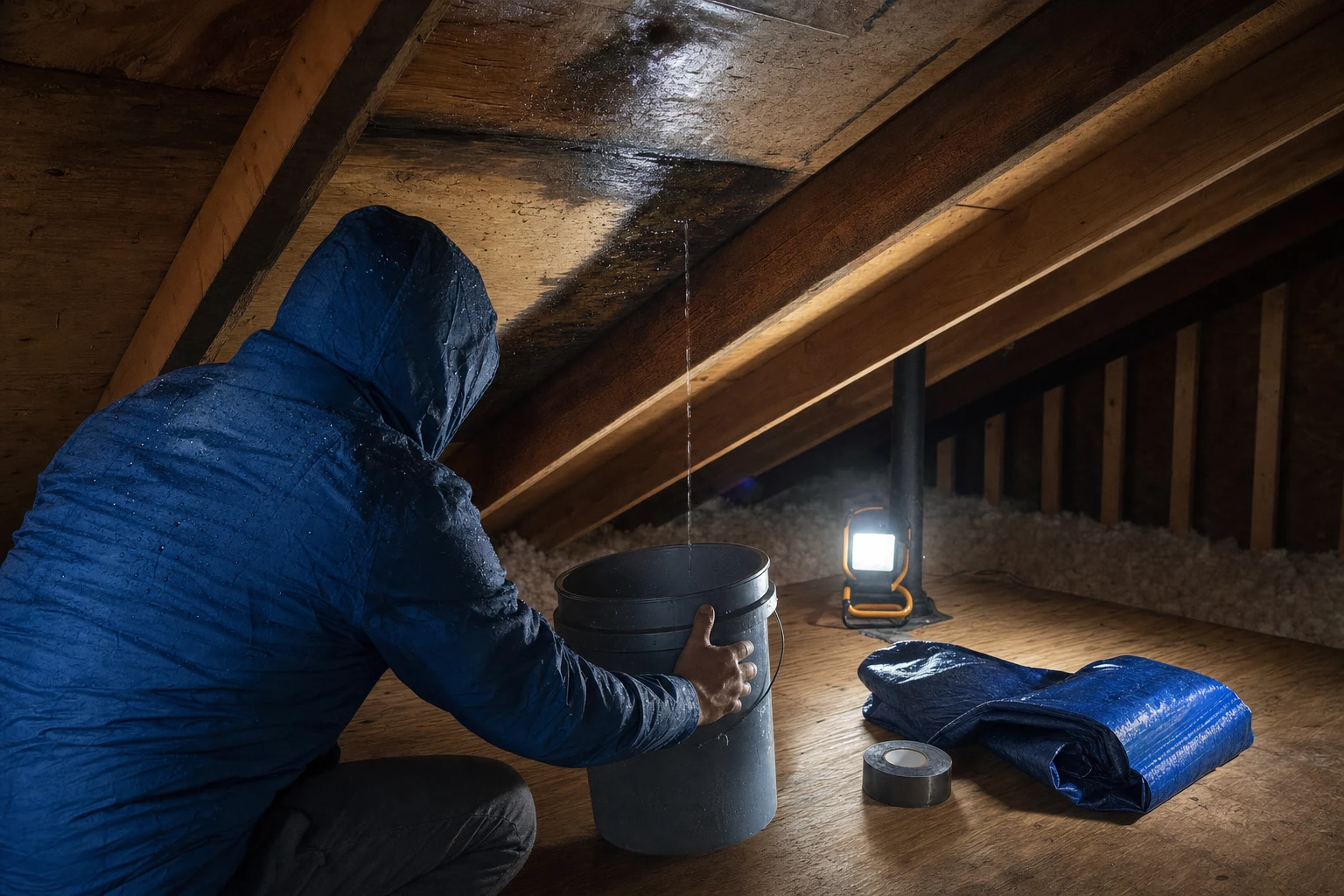
If your roof is leaking right now, work from the inside first. Put a container under the drip, relieve any bulging ceiling with a small hole, move what matters out of the way, and photograph everything before you touch it. Climbing onto a wet roof in the dark is how a $600 repair becomes a hospital visit. Tape, sealant and a tarp are all daylight jobs, done on a dry surface, and every one of them is a way to buy time rather than a repair.
The short version
Inside beats outside. Containing water and documenting damage does more for you tonight than anything you can do on the roof in the rain.
Flex Seal is not a gimmick, but it is not a repair. Its maker says so in writing: the products “are not a permanent fix for significant structural damage or full-roof repairs.” Used as a stopgap on a dry surface, that is a fair description of what it does.
Nearly all of these products want a clean, dry surface, which a leaking roof in a rainstorm is not. That single conflict is why most DIY patches fail.
The warranty story you have read is probably wrong. GAF’s current shingle warranty says it “remains in effect” even after improper work. The real risk is different, and we quote it below.
For hail, stop and photograph. Hail damage is an insurance matter, not a warranty one, and a sealed-over hole is a weaker claim.
The first hour, in order
The order matters more than the materials.
Contain it. A bucket, a bin, a cooler. Put an old towel in the bottom so the drip stops drumming and splashing.
Relieve a bulging ceiling. A sagging, heavy patch of drywall is holding pooled water. Puncture the low point with a screwdriver and catch it in the bucket. This feels wrong and is right: a controlled hole you can patch is better than a ceiling that lets go all at once.
Photograph before you clean up. Wide shot of the room, close-up of the stain, a photo of the bucket filling. Date-stamped photos are what an adjuster wants, and the mess is the evidence.
Get into the attic with a torch. Water travels along rafters and sheathing before it drops, so the wet spot on the ceiling is often not under the hole. Trace the water uphill to the highest wet point.
Mark the spot. A nail pushed up through the decking, or a chalk circle, tells a roofer in thirty seconds what might otherwise take an hour to find.
That last step is worth more than any product in this article. The reason DIY roof patches so often fail is not bad sealant; it is sealing the wrong place, because the leak entered the roof several feet uphill of where it appeared.
Does Flex Seal actually work on a roof?
This is the question everyone asks, because you can buy it at any hardware store in Middle Tennessee on the way home. The fair answer is: yes, as a temporary measure, within limits the manufacturer states plainly on its own website.
Flex Seal’s own product pages say Flex Seal products “can be used to seal minor roof leaks, especially for temporary or quick fixes,” and that Flex Tape “can help temporarily stop roof leaks.” They also say this, in a note on the same page:
“Flex Seal products are not a permanent fix for significant structural damage or full-roof repairs. If your roof has significant wear or ongoing leaks, have a roofing professional assess the damage.”
And on Flex Tape specifically: “While it’s a quick and effective solution, it’s recommended to follow up with a more permanent repair for long-term protection.”
That is the manufacturer setting the expectation, not a roofer talking down a rival product. Read it that way and the product does exactly what this article is about: it buys you time. What it will not do is fix a roof.
The catch nobody mentions: dry surfaces
Here is the practical problem. Flex Seal says its spray “works best on clean, dry surfaces, but can be used on wet surfaces in emergency situations,” and that Flex Tape should be applied “to a clean, dry area” and pressed down firmly. Every adhesive product on that shelf says something similar.
A roof leak announces itself during a rainstorm. The surface is wet, the shingles are slick, and the granules are loose. Applying tape or sealant to a wet, dirty, cold shingle is a common reason these products get blamed for failing: the product is being used outside the conditions its own label sets.
So the honest sequence is: contain the water tonight, and put the patch on tomorrow when the surface is dry, if you can safely reach it at all.
What about a hail hole?
For hail, the calculation changes completely, and not because of the product. Hail damage is an insurance claim, and your claim rests on an adjuster being able to see what the hail did. Sealing a punctured or bruised shingle with black rubberised paste before anyone has documented it makes the damage harder to assess and the claim harder to argue.
If hail has holed your roof: photograph it, cover it (a tarp over the area, not sealant into the hole), and file the claim. Our guide to handling a storm damage insurance claim covers the order of operations, and the storm-chasing crews that follow every Middle Tennessee hail event are worth reading about before you answer the door.
What the shingle warranty actually says
You will read everywhere that a DIY sealant “voids your roof warranty.” We went and read the current GAF Shingle & Accessory Limited Warranty, the document itself, effective for products installed after 1 January 2025. It does not say that. Under What Is Not Covered, it opens:
“Even if your GAF Products were not properly installed according to GAF’s application instructions or to standard good roofing practices, this limited warranty remains in effect.”
It is a manufacturing defect warranty. It covers the shingle being faulty, not the roof being damaged. So a patch does not switch it off. But two other clauses matter far more to anyone standing in an attic with a bucket.
First, hail is excluded outright. The warranty does not apply to “damage resulting from causes beyond normal wear and tear, such as: acts of nature, such as hail, fire, or winds (including gusts) over the applicable wind speed.” If hail broke your roof, the warranty was never the route; insurance is.
Second, and this is the real trap:
“If you repair or replace your GAF Products before you notify GAF about your claim or before GAF has completed its evaluation of your claim, your claim may be denied.”
The warranty also requires you to notify GAF within 30 days of noticing a problem. So the risk from a DIY patch is not that it voids anything. It is that if you did have a genuine manufacturing defect, patching over it before telling the manufacturer can get that claim denied. Photograph first, notify, then patch.
Scope note: we read GAF’s current shingle warranty because GAF describes itself in that document as North America’s largest roofing manufacturer and publishes the full terms. We did not review the warranty terms of other manufacturers, and they differ: read the one that came with your roof before relying on any of this.
The fixes that actually hold
Temporary roof leak fixes, what each is for, and what it will not do
Fix
Best for
Honest limit
Bucket and attic sheeting
Tonight, in any weather
Contains water; does nothing to the roof
Tarp over the area
Holes, missing shingles, hail damage awaiting an adjuster
Needs safe roof access and proper anchoring; will not survive high wind if loosely laid
Roofing tape / Flex Tape
A small, findable puncture on a dry day
Manufacturer says follow up with a permanent repair
Roof sealant or paste
Small cracks, gaps around a vent or flashing
Wants a clean dry surface; hides damage from an adjuster
Roofing cement over a patch
A lifted or cracked shingle
Messy, hard to remove, a roofer will cut it out anyway
Flex Seal’s own guidance for bigger openings is worth repeating because it is more sensible than the adverts suggest: for larger holes, it recommends pairing Flex Paste with wire mesh so the mesh bridges the gap and the paste has something to grab. That is genuinely how a patch spans a hole rather than sagging into it.
Tarping, and the free option after a declared disaster
A tarp laid loosely over a roof and weighted with bricks is a sail. It lifts in the first gust and can take shingles with it. A tarp that holds runs from above the damage all the way over the ridge, is wrapped around a length of timber at each end, and is fastened so water runs over it rather than under it.
After a federally declared disaster, there is a free alternative worth knowing about. Operation Blue Roof, run by the U.S. Army Corps of Engineers for FEMA, installs temporary blue sheeting at no cost to eligible homeowners in declared areas. The eligibility rules are specific: primary residences with standard shingled roofs, a signed Right of Entry form, and roofs with more than 50 percent structural damage are not eligible, because at that point the building needs more than a cover. Middle Tennessee has had federal disaster declarations before, so it is worth checking whether one is active before you pay someone to tarp your roof.
Sixteen years of storms over Middle Tennessee
We pulled the NOAA National Centers for Environmental Information Storm Events Database, the public record that hail-map products are built on, for the three counties that contain Nashville, Franklin, Brentwood, Murfreesboro and Smyrna. Between 2010 and 2025 it records 1,556 hail, damaging-wind and tornado reports across Davidson, Williamson and Rutherford counties.
Severe weather reports by year. Source: NOAA NCEI Storm Events Database, retrieved 21 September 2026.
Severe weather reports by county, 2010–2025
County
Cities covered
Reports
Davidson
Nashville
784
Williamson
Franklin, Brentwood
445
Rutherford
Murfreesboro, Smyrna
327
Two things stand out, and both are recent.
2025 was an extraordinary hail year. The database records 60 hail reports across the three counties, against a median of 16 a year over the period. Only 2012, with 74, was higher.
The afternoon of 20 May 2025 was the worst of it, and it landed on Williamson County. Between 15:20 and 15:49, under half an hour, NOAA logged 3.00-inch hail at Douglas and Peytonsville, 2.75-inch at Franklin, and 2.00-inch stones at Leiper’s Fork, Mudsink and again at Douglas. Three inches is roughly a baseball. If you own a roof in Franklin or Brentwood and have not had it looked at since that afternoon, that is the date to mention.
Williamson County has had a run of these: 3.00-inch hail at Leiper’s Fork on 26 May 2024, 2.50-inch at Craigfield on 3 April 2025, and 2.00-inch at Nolensville on 30 March 2025, the same system that dropped 2.00-inch hail on La Vergne in Rutherford County. Further back, Rutherford took 2.75-inch hail at Rucker on 18 October 2011.
Nashville’s worst entry is of a different kind. The EF-3 tornado that crossed Davidson County in the early hours of 3 March 2020 accounts for $1.09 billion in property damage in this dataset, with 2 direct deaths and 170 injuries. It is a single event worth more than every other storm in the sixteen-year window combined.
One caveat on reading any of this: these are storm reports, not damaged roofs. A single storm generates many reports, and reports cluster where people are to see them. The counts say when severe weather crossed these counties, not how many roofs it broke.
What not to do
Do not go onto a wet or icy roof. Nothing in this article is worth a fall. If it is raining, everything outside waits.
Do not seal over hail damage before it is documented. You are covering the evidence your claim depends on.
Do not patch a suspected manufacturing defect before notifying the manufacturer. GAF’s warranty says that alone can get the claim denied.
Do not pour sealant into a leak you have not traced. Water runs along framing; the entry point is usually uphill of the stain.
Do not let anyone who knocked on your door climb up to “take a look.” Choose your own contractor.
Common questions
Does Flex Seal work on a roof leak?
As a temporary fix on a small leak, yes, within the limits its maker sets. Flex Seal’s own site says its products “can be used to seal minor roof leaks, especially for temporary or quick fixes” but “are not a permanent fix for significant structural damage or full-roof repairs.” It also asks for a clean, dry surface, which a roof in a rainstorm is not. Treat it as a way to buy time until a roofer arrives.
Will Flex Tape stop a hail hole in my roof?
It may stop water in the short term, but it is the wrong move for hail. Hail damage is an insurance claim, and covering the damage before an adjuster has seen it makes the claim harder to prove. Photograph the damage, tarp over the area rather than sealing into it, and file the claim first.
Does a DIY roof patch void my shingle warranty?
Not according to GAF’s current shingle warranty, which states it “remains in effect” even where products were not installed according to instructions or good roofing practice. The real risk is a different clause: repairing before you notify GAF of a claim can cause that claim to be denied, and notice is required within 30 days. Other manufacturers’ terms differ; read yours.
Should I put a bucket under the leak or make a hole in the ceiling?
Both, in that order, if the ceiling is bulging. A sagging patch of drywall is holding pooled water and can fail all at once. Puncturing the low point with a screwdriver and catching the water in a bucket turns an unpredictable collapse into a small hole you can patch later.
Can I get a free tarp for my roof after a storm?
Sometimes. Operation Blue Roof, run by the U.S. Army Corps of Engineers for FEMA, installs temporary sheeting free for eligible homeowners in federally declared disaster areas. It covers primary residences with standard shingled roofs, requires a signed Right of Entry form, and excludes roofs with more than 50 percent structural damage.
How long can a temporary roof fix last?
Plan in weeks, not seasons. Flex Seal recommends following up a tape repair with a permanent one, and a properly anchored tarp is generally treated as a stopgap until the roof is repaired. Middle Tennessee’s heat and freeze-thaw cycling are hard on any adhesive left exposed; see what this climate does to roofing materials.
Getting a roofer there
A temporary fix is a countdown, not a solution. Once the water is contained and the damage is documented, the next call is to someone licensed. Our Nashville roofing directory lists every company we track with its state license number and expiry date, and you can request a free quote from our sponsor, a licensed Nashville contractor. If you want to know what the eventual bill might look like, we have guides to repair versus replacement and what a roof inspection costs.
Sources
NOAA NCEI Storm Events Database: bulk detail files, 2010–2025. Event counts, hail magnitudes, dates and damage figures for Davidson, Williamson and Rutherford counties are our own aggregation of this data. Retrieved 21 September 2026.
GAF Shingle & Accessory Limited Warranty (RESWT160L), effective for products installed after 1 January 2025. Exclusions and claim-notice terms quoted directly. Retrieved 21 September 2026.
This article is general information, not legal, insurance or engineering advice, and it is not a substitute for a professional inspection. Do not go onto a roof you cannot access safely. Warranty terms are quoted from the published document named above and vary by manufacturer and installation date; confirm the terms that apply to your roof. Last updated 26 September 2026.
A roof inspection costs $100 to $400 for most Middle Tennessee homes, and the national average is $280. It is genuinely free in three situations: when a roofer folds it into a repair or replacement estimate, when your insurer sends an adjuster after you file a claim, and when it rides along inside a home inspection you are already paying for during a sale. What you are buying, or being given, is not the same product in each case.
The short version
Paid inspections run $75 to $600 depending on type. A physical walk-the-roof inspection is the cheap end; thermal imaging is the expensive end.
A free inspection is almost always a sales visit. That is not a scandal; it is the business model. But the person deciding whether you need a new roof is the person who would sell it to you.
An unsolicited free inspection after a storm is the opening move in a storm-chasing scam that Tennessee has written statutes to address.
Tennessee licenses home inspectors by statute, and a home inspection report is a regulated document with required contents. A roofer’s free look is not that document.
A roof certification ($75–$200) is a different product again: a written opinion on remaining life, usually for an insurer or a buyer.
How much does a roof inspection cost?
A roof inspection costs $100 to $400 on average nationally, with reported prices running from $75 at the low end to about $1,200 for large or complicated roofs. The national average sits at $280. Those are HomeGuide’s figures, last updated in December 2025, and they track what we hear from homeowners across Davidson, Williamson, Rutherford and Sumner counties.
The average is a poor guide on its own, because the spread is driven almost entirely by which kind of inspection you are buying.
Price ranges by inspection type. Source: HomeGuide, updated 8 December 2025.
Roof inspection cost by type
Type
Typical cost
What it is
Physical
$75–$200
Someone climbs the roof and checks the attic. The most common kind.
Drone
$100–$450
Camera equipment instead of a ladder. Safer on steep or multi-storey roofs; needs decent weather.
Infrared / thermal
$400–$600
Thermal scanning that finds trapped moisture, because wet areas hold heat longer than dry ones.
Roof certification
$75–$200
An add-on: a written opinion on how much life the roof has left.
Commercial roof
$200–$600
Or roughly $0.05–$0.10 per square foot on larger buildings.
Three situations, and they are genuinely free, with no catch on the price.
Bundled into an estimate. Most residential roofers will look at your roof at no charge when you ask for a repair or replacement quote. They are absorbing an hour of labour to win a job worth thousands.
An insurance claim inspection. Once you file, your insurer sends an adjuster at no cost to you. That adjuster works for the insurer.
Inside a home inspection during a sale. A home inspection costs $250 to $400 and includes the roof covering. The buyer normally pays, and the roof portion is not billed separately.
There is a fourth kind you should treat differently: the unsolicited free inspection, where someone knocks on your door after a hailstorm and offers to get up on your roof. Consumer-protection guidance on this subject, HomeGuide’s own cost guide included, says the same thing: be careful with free inspections you did not ask for. We wrote up how that specific scam runs in Nashville and what Tennessee law says about it, because the state has statutes aimed squarely at it.
Free does not mean neutral
This is the part worth sitting with. A free inspection is paid for by the possibility of selling you a roof. As HomeGuide puts it plainly: a certified home inspector has no financial interest in roof repair, while a roofing contractor benefits from finding damage.
That does not make roofers dishonest. It makes the incentive worth naming. If a contractor tells you the roof is finished and the number is $18,000, a $200 second opinion from someone with nothing to sell is cheap insurance, and it is one of the most useful things you can do before signing. Our guide to deciding between a repair and a full replacement covers what that second opinion should actually be looking at.
What Tennessee actually regulates
Tennessee licenses home inspectors under the Home Inspector License Act of 2005. The requirement itself is blunt. Under T.C.A. § 62-6-304:
“It is unlawful for any person, directly or indirectly, to engage in or conduct or to advertise or claim to be engaging in or conducting the business or acting in the capacity of a home inspector as defined in this chapter, within this state, without first obtaining a home inspector license as provided in this part.”
The Act defines a “home inspection” as a visual analysis of a residential building covering nine groups of components: heating, cooling, electrical, plumbing, structural components, foundations, roof coverings, exterior and interior components, and other site aspects affecting the dwelling (§ 62-6-302(3)(A)).
The deliverable is regulated too. A “home inspection report” is a written document prepared for compensation that must report any system the inspector considers significantly deficient and the reason why, list anything the standards of practice called for that was not inspected and why it was skipped, and state in writing that it does not cover environmental hazards, wood-destroying insects, or subterranean systems (§ 62-6-302(4)).
That is a real, enforceable specification. It is why a home inspection report reads the way it does, and it is a clear difference between a document you paid for and a free opinion given by someone holding a quote.
Scope note: we verified the licensing requirement, the statutory definition of a home inspection, and the required contents of a home inspection report against the current Tennessee Code. We did not attempt to determine whether a roof-only inspection falls inside or outside that definition. That is a question for the Department of Commerce and Insurance, not for a blog post.
What we see across Middle Tennessee
We track 27 roofing companies serving this metro. Fourteen of them advertise roof inspection as a service line, and every one of those fourteen is a commercial roofer. None of the thirteen residential-only roofers in our directory sells an inspection as its own product.
That is not a gap in the market. It is the market telling you how it works. On the commercial side, where a facilities manager has a maintenance budget and a flat roof with a service history, an inspection is a billable service. On the residential side it is a lead-generation cost, bundled into the free estimate, which is exactly why it is free.
Based on the services these companies advertise in our directory as of September 2026, not a survey of what they will do on request. Plenty of residential roofers will inspect a roof for a fee if you ask; they just do not market it.
A roof certification is a different product
A roof certification costs $75 to $200 and is a written opinion on the roof’s condition and remaining life, issued for an insurer or a property sale. A roof generally has to be leak-free with two to five years of useful life left to be certified at all, and the certificate is only issued after any necessary repairs are done. The inspection behind it takes 30 minutes to an hour.
This matters if you are buying, selling, or switching insurers. Many mortgage lenders want to see at least three years of useful life on the roof, and many insurers will not write a policy until a failing roof is repaired or replaced. If your roof is near the end of its range, and in this climate that arrives sooner than the packaging promises, a certification is where the transaction either clears or stalls.
When is it worth paying for one?
You are buying a house and the home inspector flagged the roof. A roof-specific opinion is worth the few hundred dollars before you inherit a five-figure problem.
A contractor says you need a full replacement. An independent opinion costs a fraction of one percent of the job.
You are switching insurers or the carrier is asking questions about roof age. If the same visit turns up fogged or draughty windows, here is what replacing those costs.
The roof is approaching the end of its expected life and you want to plan the spend rather than react to a leak. Our Middle Tennessee shingle cost guide has the numbers to budget against.
After a significant storm, if you want documentation from someone who is not also bidding the repair. If it is actively leaking, stop the water first.
How often should a roof be inspected?
The general guidance is a professional inspection every three years for a shingle roof and every five for tile, plus a homeowner’s own look twice a year and immediately after any significant weather. In Middle Tennessee, where spring hail and 49 days a year above 90°F do most of the ageing, the post-storm check is the one that earns its keep.
You do not need to climb up to do your half of it. Granules collecting in the gutters, dented gutter faces or downspouts, shingle debris in the yard, and new stains on an upstairs ceiling all show from the ground.
Common questions
Are roof inspections free in Nashville?
Often, yes. Most residential roofers include one with a repair or replacement estimate, and your insurer’s adjuster inspects at no cost after you file a claim. A standalone paid inspection runs $100 to $400. Be cautious about free inspections offered by someone who turned up uninvited after a storm.
How much does a roof inspection cost?
$100 to $400 on average, with a national average of $280. A physical inspection is $75 to $200, a drone inspection $100 to $450, and infrared or thermal imaging $400 to $600. Commercial roofs run $200 to $600, or about $0.05 to $0.10 per square foot.
Does a home inspection include the roof?
Yes. A home inspection costs $250 to $400 and covers the roof covering, and in Tennessee the statutory definition of a home inspection lists roof coverings as one of the nine component groups an inspection addresses. It is a visual analysis, though, not a roof-specific deep dive.
What is the difference between a roof inspection and a roof certification?
An inspection finds problems. A certification is a written opinion on how much life the roof has left, usually required by an insurer or a buyer, and it is only issued after any needed repairs are complete. Certification costs $75 to $200 on top of the inspection.
Who pays for a roof inspection when buying a house?
The buyer normally pays for the home inspection, which includes the roof. If that inspection raises roof concerns, a separate roof inspection or certification is also usually the buyer’s cost, though it can become a negotiating point.
Should I let someone inspect my roof after they knock on my door?
Be careful. An unsolicited free inspection after a storm is a standard opening for storm-chasing crews, and Tennessee has statutes specifically regulating residential roofing work paid for through insurance. If you want the roof looked at, call a licensed contractor you chose yourself.
Getting it looked at
If you want a roof inspected in Middle Tennessee, start with someone whose license you can check. Our Nashville roofing directory lists every company we track with its state license number and expiry date, or you can request a free quote from our sponsor, a licensed Nashville contractor. If you would rather start from a shortlist, we also keep a ranked list of Nashville roofing companies.
Sources
HomeGuide: Roof inspection cost guide, last updated 8 December 2025. Cost ranges, national average, certification pricing, report contents and inspection frequency. Retrieved 21 September 2026.
T.C.A. § 62-6-304: home inspector license requirement (2025 Tennessee Code). Retrieved 21 September 2026.
T.C.A. § 62-6-302: definitions of “home inspection” and “home inspection report” (2025 Tennessee Code). Retrieved 21 September 2026.
Middle Tennessee contractor figures are Nashville Builders Pro’s own directory data, September 2026.
This article is general information, not legal, insurance or engineering advice. Statutory provisions are quoted from the 2025 Tennessee Code as published; confirm current text and how it applies to your situation with a licensed professional. Cost figures are national ranges from the source cited above and will vary with your roof. Last updated 24 September 2026.
Replacement windows cost $450 to $1,500 per window installed, and $4,500 to $22,500 for a typical Nashville house of 10 to 15 windows. The national average is $900 a window. Brand drives less of that number than most homeowners expect: the material, the window type, and whether the installer keeps your existing frame or tears it out move the price far more than the badge on the sash.
The short version
The window is 65% to 75% of the cost; labour is the rest. That ratio is why a cheap install of an expensive window is still expensive.
Full-frame or pocket matters more than brand. A pocket window drops into the existing frame; full-frame replacement tears back to the opening and costs accordingly.
Nashville is climate zone 3A, and that changes the storm-window answer. The Department of Energy recommends solar-control low-e here, not the regular low-e it recommends further north.
Any window work on a pre-1978 home pulls in the federal lead rule. The firm has to be EPA lead-certified, and you can check that in a minute.
Fog between the panes may be a warranty claim. Andersen warrants its glass against seal failure for 20 years and that cover transfers with the house. Check before you pay anyone.
What window replacement costs
The figures below are HomeGuide’s national cost model, updated 5 February 2026. They match what we hear from homeowners across Davidson, Williamson and Rutherford counties, though a specific quote depends on your openings more than on any average.
Window replacement cost by number of windows
Windows replaced
Typical installed cost
1
$450 to $1,500
5
$2,250 to $7,500
10
$4,500 to $15,000
15
$6,750 to $22,500
25
$11,250 to $37,500
The national average is $900 per window, with a reported floor around $300 and a ceiling around $8,000 for large or custom units. The split between product and labour is consistent: the window itself is 65% to 75% of the total, labour the remaining 25% to 35%, which works out at roughly $100 to $500 a window to install.
Comparing the major brands
Installed cost per window by brand. Source: HomeGuide, updated 5 February 2026.
Window prices by brand, installed, per window
Brand
Installed cost per window
Window World
$300 to $1,300
Pella
$300 to $3,500
Alside
$400 to $2,300
Andersen
$400 to $4,000
Champion
$450 to $2,100
Feldco
$500 to $1,800
Harvey
$700 to $1,800
Milgard
$700 to $2,000
Marvin
$800 to $2,000
Read that table with care, because it is the most misused chart in the window business. Those ranges span every product line and window size a brand sells. Andersen’s range runs to $4,000 because Andersen sells an architectural wood window as well as a builder-grade vinyl one; it does not mean an Andersen double-hung costs four times a Harvey. A like-for-like comparison is three quotes on the same opening, the same window type, the same glass package, and the same installation method. Anything else compares a brand’s cheapest product to another brand’s dearest.
One practical note on Window World: it sells in packages of 6, 8 or 12 retrofit windows rather than single units, so its low per-window figure assumes you are doing most of the house.
What actually drives the price
1. Frame material
Installed cost per window by frame material
Material
Installed cost
Notes
Aluminium
$175 to $1,000
Cheapest; conducts heat, so the worst insulator of the group
Vinyl
$200 to $1,500
The common Middle Tennessee choice
Fiberglass
$400 to $2,000
Tends to outlast the other frame materials
Composite
$400 to $2,300
Wood look, vinyl-like performance
Wood
$800 to $3,800
Historic districts; needs maintenance and can rot
2. Window type
A single-hung is $300 to $2,100 installed and a double-hung $350 to $2,500. A bay window is $2,000 to $6,000 and a bow $3,000 to $8,000 or more, because you are buying three to six units and a structural head. An egress window for a basement bedroom is its own project at $3,000 to $7,000, or $6,000 to $8,000 once excavation and a window well are included.
3. Pocket versus full-frame
This is the line item homeowners least often ask about and it can swing a quote by thousands. A pocket or insert replacement drops a new window inside your existing frame; it is faster, cheaper and keeps your interior trim. A full-frame replacement removes the frame back to the rough opening. Full-frame is the honest answer when the frame is rotten, when the opening is out of square, or when you want to see what the siding and sheathing are doing. Quotes that look wildly different on the same house are often quoting these two different jobs, so ask which one you are being sold.
4. Glass package
Double-pane is the standard at $400 to $2,000 installed; triple-pane is $450 to $3,000. A low-e coating adds 10% to 20% to the window price. In a cooling-dominated climate the coating you choose matters as much as the pane count, which brings us to the storm-window question.
Can a storm window save the window you have?
Sometimes, and the evidence is better than the reputation. The Department of Energy and Pacific Northwest National Laboratory modelled low-e storm windows across all eight climate zones, running roughly 4,240 simulations across 39 model homes. Their finding:
“In climate zones 3 through 8, low-e storm windows are always cost effective (SIR >1) when installed over single-pane windows and double-pane, metal-framed windows. The SIR values range from 1.2 to 3.2 across the different locations analyzed.”
Nashville and Davidson County sit in IECC climate zone 3A, which puts this metro squarely inside that finding. Two details from the same report matter locally:
Choose solar-control low-e, not regular low-e. The report recommends solar-control low-e glass specifically in zone 3, because here the cooling load is doing as much work as the heating load. Regular low-e is the recommendation for zones 4 through 8.
The low-e upgrade pays for itself anywhere. The incremental cost of low-e glass over clear glass was cost effective in every climate zone with a payback of two to five years. So if you are fitting a storm window for quieter rooms or draught control rather than energy, the report still recommends paying for the low-e version.
Storm windows also cut air leakage, which is half of what makes an old window feel cold: the study notes whole-home air leakage falls 10% to 15% from adding storm windows alone. They run $150 to $400 each installed, against $450 to $1,500 to replace the window outright, and the study assumed a 20-year service life.
Where a storm window is not the answer: a rotten frame, a window that no longer operates or latches, a sash that has been painted shut for decades, or an opening that fails egress requirements for a bedroom. A storm window is an energy and comfort retrofit, not a structural repair.
Lead paint: the rule that applies to most older Nashville homes
If your house was built before 1978, window work is federally regulated, and this catches a lot of people out.
Under the EPA’s Renovation, Repair and Painting (RRP) rule, firms performing renovation for compensation in pre-1978 housing must be EPA lead-certified and must assign a certified renovator to the job. The EPA’s guidance is explicit that firms may not even advertise covered renovation work without that certification. Window replacement is specifically named as covered work, and the usual square-footage thresholds do not get you out of it: the rule catches interior work disturbing six square feet or more, exterior work disturbing twenty square feet or more, and window replacement.
There is a genuine exception, and the EPA states it plainly: if the work disturbs no painted surface at all, the RRP requirements do not apply. The EPA’s own worked example is replacing mil-finish aluminium windows, which carry no paint to disturb.
What to do with this: ask any window contractor bidding a pre-1978 house whether the firm is EPA lead-certified, and verify rather than take the answer on trust. The EPA publishes a public lookup of certified firms. This is the same habit we recommend for checking a contractor’s state license, and it applies to siding work on the same housing stock: it takes a minute and it is the cheapest due diligence available.
Scope note: we verified the certification requirement, the coverage of window replacement, and the no-painted-surface exception against the EPA’s published RRP guidance. We did not review Tennessee-specific lead rules or local Metro requirements, which may add to the federal baseline rather than replace it.
Fog between the panes: what it means and what to do
Moisture between the panes is not condensation you can wipe off. It means the insulated glass unit has lost its seal, the inert gas fill has escaped, and humid air is now moving in and out of a cavity that was meant to be sealed. The window still keeps weather out. What it has lost is most of its insulating value, and it will keep getting cloudier.
Check the warranty first
Before you price a repair, find out whether someone already owes you one. Andersen warrants its factory-glazed glass against material obstruction of vision and premature failure of the glass or organic seal for 20 years from purchase, and that glass warranty is transferable to a subsequent owner for the remainder of the term. Terms vary by manufacturer and by product line, and there are exclusions for things like art glass and impact-resistant glass, but a twenty-year transferable seal warranty means a fogged window on a house you bought ten years ago can still be a live claim.
Does defogging work?
Defogging services drill the glass or spacer, flush and vacuum out the moisture, and reseal the holes. Be clear about what that buys: it is a cosmetic fix. It clears the haze; it does not rebuild the seal or restore the gas fill, so the thermal performance of the original sealed unit does not come back. Industry sources also report that moisture commonly returns and that some manufacturers treat a drilled unit as voiding the glass warranty.
We could not find independent, peer-reviewed testing of defogging durability. The claims above come from window manufacturers and glazing companies, who are not disinterested. Treat the specific timeframes you see quoted with that in mind, and note that the underlying physics is not in dispute: you cannot re-establish a factory gas fill through a drilled hole.
The durable options are replacing the insulated glass unit in your existing frame, which is the cheaper route when the frame is sound (glass-only replacement runs $300 to $650), or replacing the whole window.
When you actually need new windows
The honest signs, as opposed to the ones a salesperson leads with:
Visible damage: cracked glass, a rotting or soft frame, rusted hardware
Fog or moisture between the panes
A window that no longer opens, closes or latches properly
Draughts you can feel at the sash or the frame perimeter
Single-pane glass, which is where storm windows and full replacement both pay best
Age past 20 years, at which point seals are typically at the end of their service life
Things that are not on their own a reason to replace every window in the house: a single failed seal, condensation on the inside of the glass in winter (usually an indoor humidity problem, not a window problem), or an unsolicited quote that arrived with a door knock. That last one should sound familiar if you read our piece on how storm-chasing crews work this metro; the pattern is the same trade to trade.
Commercial windows and storefront glazing
Commercial glazing is priced by the square foot rather than by the unit, and it is a different trade from residential window replacement.
Commercial glazing, indicative installed pricing
System
Installed cost
Storefront glazing, standard thermally broken aluminium
These commercial figures come from industry pricing guides rather than from a primary cost database, and commercial glazing varies more by access, height and specification than almost any other trade. Treat them as an order of magnitude for budgeting and get a real bid. Volume matters: multi-unit projects commonly attract meaningful discounts.
If you are specifying for a commercial building, the two questions that move the number most are access (upper floors and interior-only access add substantially) and the glass specification, which is where the security, acoustic and solar-control requirements land.
Common questions
How much does it cost to replace all the windows in a Nashville house?
$4,500 to $22,500 for the 10 to 15 windows in a typical home, with a national average of $900 per window. The spread depends on frame material, window type, and whether the job is a pocket replacement into the existing frames or a full-frame tear-out.
Are storm windows worth it instead of replacing?
In Nashville’s climate zone, the Department of Energy’s modelling found low-e storm windows are always cost effective over single-pane windows and double-pane metal-framed windows, with a savings-to-investment ratio of 1.2 to 3.2. In zone 3 the recommendation is solar-control low-e specifically. At $150 to $400 per window installed against $450 to $1,500 to replace, they are worth pricing before you commit to replacement, unless the frames are rotten or the windows no longer operate.
Do I need a lead-certified contractor to replace windows?
If the home was built before 1978, yes. The EPA’s Renovation, Repair and Painting rule requires firms doing covered renovation for compensation in pre-1978 housing to be lead-certified, and window replacement is specifically covered. The exception is work that disturbs no painted surface at all. Ask for the firm’s EPA certification and verify it.
Can a foggy double-pane window be repaired?
The haze can be cleared by a defogging service, but that is cosmetic: it does not rebuild the seal or restore the gas fill, so the insulating performance does not come back, and some manufacturers treat a drilled unit as voiding the glass warranty. Check your warranty first, because seal failure is often covered. Andersen, for example, warrants its factory-glazed glass against seal failure for 20 years and the cover transfers with the house.
Which window brand is best value?
The published brand ranges overlap so heavily that they cannot answer this on their own, because each range spans a manufacturer’s builder-grade and architectural lines. Get three quotes on the same opening, the same window type and the same glass package, and compare those. The installation method matters as much as the badge.
Does replacing windows need a permit in Nashville?
Replacing windows with the same size and type generally does not, while changing the size of an opening involves reframing and generally does. Because that is structural work, confirm with Metro Codes before the job starts rather than after.
Getting quotes worth comparing
Ask every bidder for the same four things and the quotes become comparable: the window brand and product line, pocket or full-frame, the glass package including whether low-e is solar-control, and the EPA lead certification if the house predates 1978. Our Nashville window contractor directory lists the companies we track with their state license numbers and expiry dates, and you can request a free quote from our sponsor, a licensed Nashville contractor.
Sources
HomeGuide: Window replacement cost guide, updated 5 February 2026. Cost ranges by number, material, type, pane count and brand; the product-versus-labour split. Retrieved 21 September 2026.
Andersen Limited Warranty: 20-year transferable glass warranty covering premature failure of the glass or organic seal.
Nashville and Davidson County energy code climate-zone designation (IECC zone 3A).
Commercial glazing figures are from industry pricing guides and are labelled as such above.
This article is general information, not legal, engineering or construction advice. Cost figures are national ranges from the sources cited and will vary with your openings, your home and your specification. Warranty and regulatory terms are quoted from the published documents named above; confirm the terms that apply to your windows and your property before relying on them. Last updated 22 September 2026.
In Middle Tennessee, plan on 15 to 20 years from a 3-tab asphalt roof and 20 to 25 from an architectural one, the lower end of what the same shingles are rated for nationally. Metal runs 40 years and up. The reason is not one extreme season but two: Nashville averages 49 days a year at or above 90°F and 67 days at or below freezing, so a roof here is cooked and then flexed, year after year.
Manufacturers rate shingles under laboratory conditions. Tennessee is not laboratory conditions. This is what the heat and the humidity actually do, how long each material realistically lasts here, and why two roofs on the same street can age a decade apart.
The published numbers, before climate
InterNACHI’s life expectancy chart is the standard reference and gives these figures for roof coverings:
National expectations by covering type, before any local climate is applied.
Expected service life by roof covering, national figures and a Middle Tennessee planning range
Covering
Published expectation
Realistic Middle TN planning range
3-tab asphalt shingle
20 years
15–20
Wood shingle or shake
25 years
20–25
Architectural asphalt
30 years
20–25
Metal
40–80 years
40+
The middle column is published and citable. The right-hand column is our planning estimate, not a measured figure, and we want to be straight about that: it reflects the direction every degradation mechanism below pushes in, applied to the published life. We did not find published research assigning a specific percentage reduction to this climate, and we are not going to invent one.
Why Middle Tennessee is hard on a roof
The gap between the two lines is the daily expansion and contraction a shingle absorbs. Nashville crosses both thresholds every year.
Heat drives the volatiles out
Asphalt shingles stay flexible and waterproof because of volatile compounds in the asphalt. Heat accelerates the rate at which those evaporate. As InterNACHI puts it, shingles “become more brittle as volatiles, which keep them flexible, dissipate,” and that loss “can degrade the bond between the asphalt and the granules.”
Once the bond weakens, granules wash off. Granules are the shingle’s sunscreen, so losing them exposes the asphalt to more UV, which drives off more volatiles. It is a loop that accelerates rather than a steady decline, which is why roofs here often look fine for years and then deteriorate noticeably fast.
Air temperature understates it. A dark roof in direct July sun runs far hotter than the 91°F on the thermometer, and InterNACHI notes that “darker roofs absorb more heat, which shortens shingle lifespan by accelerating the loss of volatiles and increasing thermal cycling.”
Then the cold flexes what the heat made brittle
This is the part people miss about Tennessee. We are not Phoenix. Nashville has 67 days a year at or below freezing alongside those 49 days above 90°F, and InterNACHI is explicit that “climates with large daily temperature swings shorten roof lifespans because they cause greater amounts of expansion and contraction.”
A shingle that has lost volatiles to summer heat is less able to absorb that movement. Brittle material plus repeated flexing is how you get the splitting and cracking that shows up on older Middle Tennessee roofs, often before anything leaks.
Humidity brings something that eats the shingle
Gloeocapsa magma. It starts where the roof stays damp longest, which in this hemisphere usually means the north slope and anywhere shaded.
Those black streaks on roofs all over Middle Tennessee are not dirt. They are Gloeocapsa magma, a cyanobacteria, and the Asphalt Roofing Manufacturers Association identifies it as the common cause of the discolouration. The Southeast is among the highest-risk regions precisely because humidity spikes alongside summer heat.
It matters beyond appearance. The organism feeds on the limestone filler that gives an asphalt shingle its weight, and as it does, surface granules loosen and wash away with rainfall, the same granule loss that heat causes, arriving by a different route. It takes hold first where the roof gets least sun and stays damp longest, which is why it shows up on north-facing slopes and under tree cover.
The two slopes of the same roof age differently
South slope cooked, north slope damp. The same roof, installed the same day, ageing by two different mechanisms.
InterNACHI notes that “south-facing roof slopes have shorter lifespans due to increased thermal cycling and UV exposure.” In Middle Tennessee you often get the worst of both on one house: the south slope bakes, and the north slope, cooler and damper, grows algae. When a roofer says your roof needs work but only points at one elevation, this is usually why.
Ventilation is the variable you can actually control
Of everything on this page, attic ventilation is the factor most within a homeowner’s control. Poor ventilation, in InterNACHI’s words, “shortens shingle lifespan by failing to keep shingles cool, resulting in accelerated loss of volatiles and greater amounts of thermal cycling.” A badly ventilated attic in a Tennessee August is an oven pressed against the underside of the roof for weeks at a time.
Does it differ across Middle Tennessee?
Less than people expect. The communities below sit within roughly 40 miles of each other and share the same climate profile, so the material lifespans above apply across all of them. What varies is the housing stock and the tree cover, and those change what you should be watching for.
What tends to drive roof ageing across the Middle Tennessee communities we cover
Community
County
What to watch
Nashville
Davidson
The widest mix of roof ages in the metro; heavy tree canopy in older neighbourhoods drives algae and debris
East Nashville
Davidson
Older housing stock and mature shade trees: algae streaking and aged decking are the recurring themes
Green Hills
Davidson
Dense mature canopy; shaded slopes stay damp and stain early
Bellevue
Davidson
Wooded lots west of the city; overhanging limbs and gutter debris hold moisture against the roof edge
Antioch
Davidson
Large 1990s and 2000s subdivisions now reaching the end of first-generation shingles
Brentwood
Williamson
Larger roof areas with complex hips and valleys; more flashing detail to fail before the field does
Franklin
Williamson
A wide span of build dates, from historic to new-build, so roof age varies street to street
Nolensville
Williamson
Mostly newer construction; roofs still inside warranty, where ventilation quality shows up first
Spring Hill
Williamson / Maury
Rapid recent growth means large numbers of roofs of near-identical age, ageing together
Murfreesboro
Rutherford
Open, less-shaded subdivisions: sun exposure and hail matter more than algae here
Smyrna
Rutherford
Similar exposure to Murfreesboro; watch south and west slopes first
Hendersonville
Sumner
Lakeside humidity adds to the algae picture on shaded elevations
Gallatin
Sumner
Mixed older and new stock; storm exposure on the northern side of the metro
Mt. Juliet
Wilson
Fast-growing newer housing; ventilation and installation quality are the differentiators
The column on the right reflects the character of the housing stock rather than a measured difference in roof life. A shingle in Gallatin and a shingle in Spring Hill are rated the same and will last about the same. Where your roof sits on a street, how much shade it gets, which way the slopes face and how well the attic breathes will move the number far more than which of these towns you live in.
Getting to the top of the range instead of the bottom
Fix the ventilation. Ridge and soffit venting that actually moves air keeps shingle temperature down, which slows volatile loss and reduces thermal cycling. It is the highest-leverage thing on this list.
Keep the roof clear. Leaf litter in valleys and gutters holds moisture against the roof, which is what algae and moss want.
Cut back overhanging limbs. Shade keeps slopes damp and drops debris. It also gives squirrels a bridge.
Consider algae-resistant shingles when you re-roof. In this climate the copper-bearing granule types are addressing a problem you are likely to get, not a hypothetical one.
Look after a storm, not just after a leak. Hail damage frequently does not leak immediately; it bruises the mat and shortens the life quietly.
Do not pressure-wash asphalt shingles. It strips the granules you are trying to keep. Algae treatment is a low-pressure chemical job.
Common questions
How long will my roof last in Nashville specifically?
For asphalt shingles, plan on 15 to 20 years from a 3-tab roof and 20 to 25 from an architectural one. Metal runs 40 years and up. Where you land in those ranges depends more on attic ventilation, shade, slope orientation and installation quality than on anything else: two identical roofs installed the same week can differ by years.
Do the black streaks mean I need a new roof?
Not by themselves. The streaks are Gloeocapsa magma, and while it does feed on the shingle’s limestone filler and loosen granules, staining alone is not a replacement trigger. What matters is whether granules are actually going (check the gutters for granule accumulation) and whether the shingles are curling or cracking. Streaking on an otherwise sound roof is a cleaning question.
Does a lighter-coloured roof really last longer here?
Darker roofs absorb more heat, and InterNACHI links that directly to faster volatile loss and increased thermal cycling. So the direction is real. We did not find a figure quantifying how many extra years a lighter roof buys in this climate, so we are not going to put a number on it. If you are choosing anyway, lighter is the direction that helps.
Why does one side of my roof look so much worse?
Because it is being aged by a different mechanism. South-facing slopes take more sun and more thermal cycling, so they fade, dry and lose granules first. North-facing slopes stay cooler and damper, so they grow algae and moss. Same roof, same install date, two different failure paths.
My roof is 18 years old and looks fine. Should I be worried?
Not worried, but you are inside the window where it is worth an inspection rather than a glance from the driveway. Asphalt tends to look acceptable from the ground well past the point where granule loss and brittleness have set in. Check the gutters for granules and look at the south and west slopes first.
Is metal worth it in Tennessee heat?
On lifespan alone, the published range is 40 to 80 years against 20 to 30 for asphalt, so it lasts considerably longer. It costs correspondingly more up front, and whether that trade works depends on how long you plan to own the house. It is not affected by the algae problem at all.
The short version
Tennessee ages a roof from two directions. Summer heat drives out the volatiles that keep shingles flexible and loosens the granules that shield them; winter cold then flexes what the heat made brittle, 67 days a year. Humidity adds an organism that eats the shingle’s filler from the shaded side. Expect the lower end of the published range, and expect the south and north slopes of the same roof to fail for opposite reasons.
The one lever that genuinely moves the number is ventilation.
Climate figures read 21 September 2026. Lifespan figures are published national expectations; the Middle Tennessee planning ranges are our estimate and are labelled as such above.
If a roofing contractor in Tennessee asks you for money up front on an insurance job, that is not just a warning sign; state law says they cannot do it. Under T.C.A. § 62-6-604, a residential roofing services provider cannot require any payment until your insurer has confirmed in writing that the claim is fully covered, or the three-business-day cancellation window has passed.
Tennessee wrote an entire part of its code for this problem after a wave of storm-chasing roofers. Most homeowners have never heard of it, which is exactly why it keeps working on people. This is what those six sections actually say, what a storm chaser looks like in Middle Tennessee, and what to do in the days after a hailstorm when someone is already knocking.
Why this happens here, in waves
Storm damage arrives street-wide, which is what makes the door-knocking crews economic.
Roofing fraud in Middle Tennessee is not a steady background rate. It arrives with the weather. The Tennessee Attorney General issued scam warnings after the March 2020 Nashville tornado and again after the October 2024 flooding. Clarksville police warned residents about roofing and contractor scams following severe weather. The state runs a Contractor Fraud Awareness Week every year, held 19–23 May in 2025.
We could not find reliable figures for how many Nashville homeowners are defrauded each year, and we are not going to invent one. What the public record does show is a repeating pattern of official warnings, local investigations and state law written specifically for this problem, including a NewsChannel 5 investigation into a roofer accused of home improvement fraud in the Nashville area who had a history of problems in other states. That last detail is the whole shape of it: the out-of-town crew that follows the storm.
Five things Tennessee law already gives you
Title 62, Chapter 6, Part 6 of the Tennessee Code is called Residential Roofing Services. It was passed in 2012 and it is short. Here is what is in it.
1. They cannot take your money up front
“No residential roofing services provider shall require any payments from a person pursuant to a contract until the person has received written notice from the insurer that the contract or claim is fully covered or the three-day cancellation period required pursuant to this part has expired.” (§ 62-6-604(a))
This is the one to remember. The classic storm-chaser move is a deposit taken on the driveway, followed by silence. On an insurance roofing job in Tennessee, that deposit is not something to be wary of; it is something the provider is not permitted to require.
There is one carve-out, and it is narrow: if the contractor performs emergency repairs that you have acknowledged in writing were necessary to prevent damage, they may collect for those at the time the work is done (§ 62-6-604(c)(1)). Tarping a hole at midnight can be paid for. A deposit toward the re-roof cannot.
2. They cannot invent the emergency either
“No residential roofing services provider shall misrepresent that emergency repairs are necessary to prevent damage to the residential real estate owned or possessed by such person.” (§ 62-6-604(c)(2))
Since emergency repairs are the one payment a contractor can collect immediately, the statute closes the obvious loophole: manufacturing the emergency to unlock it.
3. You can cancel if your insurer says no, or only partly yes
Under § 62-6-602, once you receive written notice from your insurer that all or any part of the claim is not a covered loss, you may cancel the contract. You have until midnight on the third business day after receiving that notice.
Note the words any part. This is not limited to a flat denial. A partial denial triggers the same right, which matters because partial coverage is the more common outcome and the one people assume they are stuck with.
The cancellation notice needs no special wording. The statute says it need only be signed, dated, and indicate “by any form of written expression” that you do not intend to be bound. Mail it and it counts from the postmark; email or fax it and it counts from the moment you send it.
Once you cancel, any payments you have made, other than for emergency repairs already performed, must be returned within ten business days.
4. They must hand you their license number before you sign
This is the provision most homeowners do not know exists, and it is the one that catches out-of-state storm chasers. Before entering a contract, § 62-6-603 requires a residential roofing services provider to give you, in writing:
A business mailing address for cancellation purposes, and a telephone number
The license or registration number of any contractor, home improvement contractor, or public adjuster license they hold, in this state or any other state
An email address or fax number for cancellation, if they have one
A detailed description of all damage or repairs to be claimed or covered by the contract, and the location of that damage
A written cancellation statement in boldface type of at least 10 points
A detachable “NOTICE OF CANCELLATION” form, in duplicate, also in 10-point boldface
Two of those are quietly powerful. The license requirement covers other states, so a crew from out of state cannot simply say they are not licensed here and move on. And the written description of damage, with its location, gives you a dated record of what they claimed was wrong before any work started, which is the natural check on damage that grows between the inspection and the invoice.
5. They cannot play insurance adjuster unless they are one
“No residential roofing services provider shall act or hold out as being a public adjuster … unless licensed as a public adjuster in accordance with title 56, chapter 6, part 9.” (§ 62-6-605)
“We’ll handle the whole claim for you, you don’t need to talk to your insurer” is a sales pitch that runs into this section. Negotiating your claim on your behalf is public adjusting, and it requires its own license.
And there are teeth
Under § 62-6-606, a violation of any of the above is an unfair or deceptive act under the Tennessee Consumer Protection Act of 1977. That statute carries a private right of action for anyone who suffers an ascertainable loss, meaning you are not limited to filing a complaint and hoping.
Nothing obliges you to sign on the tailgate. On an insurance job, no payment can be required of you until your insurer confirms coverage in writing or the cancellation window closes.
The patterns, and which rule each one runs into
Common storm-chaser tactics and the Tennessee provision each one meets
What it looks like
Where it runs into the law
Large deposit requested on the spot
§ 62-6-604(a): no payment required before full-coverage notice or expiry of the cancellation window
“This is an emergency, we need to start today”
§ 62-6-604(c)(2): misrepresenting that emergency repairs are necessary is prohibited
Pressure to sign before the adjuster has seen the roof
§ 62-6-602: you keep a cancellation right once the insurer’s written decision arrives
Vague about who they are or where they are based
§ 62-6-603(1): written address, phone and license numbers required before signing
“We’ll deal with your insurance company directly”
§ 62-6-605: public adjusting requires a public adjuster license
Damage that seems to grow after a “free inspection”
§ 62-6-603(2): the written description and location of damage is required up front
One tactic on the usual list sits outside this Part: an offer to cover, waive or absorb your insurance deductible. We are not going to tell you what Tennessee law says about that, because we did not verify it, and unverified law is worse than none. Treat it as a straightforward red flag regardless: the deductible is the part of the loss your policy says you carry, and a contractor offering to make it disappear is describing something to your insurer that is not what is happening.
Licensing, and why the answer depends on your county
Tennessee’s Home Improvement license covers residential remodelling projects from $3,000 to $24,999, but only in counties that adopted the law. The Department of Commerce and Insurance lists those counties as Bradley, Davidson, Hamilton, Haywood, Knox, Marion, Robertson, Rutherford and Shelby.
For Middle Tennessee that is worth reading twice. Davidson County (Nashville) and Rutherford County (Murfreesboro) are on that list. Williamson, Sumner and Wilson counties are not among the nine. A roofer working in Franklin, Hendersonville or Mt. Juliet is operating under different requirements from one working in Nashville, on the same size of job.
Larger projects require a contractor license rather than a home improvement license. The state’s own page does not publish the dollar threshold for that, so we are not going to state a figure we cannot source. Ask the contractor which license they hold for the size of your job, and check it.
Checking a license takes under a minute
Ask for the number before the quote. On an insurance roofing job they are required to give it to you in writing before you sign anyway.
Check the expiry date, not just the status. A record can read “Active” while sitting past its expiry, because the status only reflects when the record was last touched.
Check the name matches. Companies trade under one name and register under another. If the register shows a different entity, ask them to explain the connection.
Match on name and city, not the number alone. License numbers are not unique across license types: searching one number we got a roofing company, a cosmetologist and a former motor vehicle salesman.
The first 48 hours after a storm
Stop the water, and nothing more. Emergency tarping is legitimate and payable on the spot. It commits you to nothing else.
Photograph everything before anyone tidies up, including the temporary work.
Call your own insurer first, not a number on a flyer.
Get the written pack § 62-6-603 entitles you to: address, phone, license numbers, damage description, cancellation notice. A provider who cannot produce it has told you something useful.
Get more than one quote. Urgency about a leak is real; urgency about a contract is a sales technique.
If you have already signed
You may still have a route out. If your insurer has sent written notice that all or part of the claim is not covered, the three-business-day cancellation clock under § 62-6-602 starts from when you received it. The notice needs no particular wording: signed, dated, and clear that you do not intend to be bound.
If money has changed hands and the work has not been done, § 62-6-604(b) requires it returned within ten business days of your cancellation, except for emergency repairs already performed.
Complaints go to the Tennessee Department of Commerce and Insurance, and to the Attorney General’s Division of Consumer Affairs. Because § 62-6-606 routes violations through the Consumer Protection Act, a private right of action is also available to someone who has suffered an ascertainable loss; that is a conversation for an attorney, not for us.
Common questions
A roofer knocked on my door after the storm. Is that itself illegal?
No. Door-knocking after a storm is normal and plenty of legitimate local companies do it. What matters is what happens next: whether they hand you the written pack § 62-6-603 requires, whether they ask for money before your insurer has confirmed coverage, and whether their license checks out on the state register. Judge the conduct, not the knock.
They want a deposit to “get me on the schedule”. Is that allowed?
On a residential roofing contract tied to an insurance claim, § 62-6-604(a) says a provider cannot require any payment until your insurer has given written notice that the claim is fully covered, or the three-business-day cancellation period has expired. Scheduling pressure does not change that. Emergency repairs you have acknowledged in writing as necessary are the exception, and they are payable when the work is done.
My claim was only partly approved. Can I still cancel?
Yes. Section 62-6-602 applies when you receive written notice that “all or any part” of the claim is not a covered loss. Partial denial triggers the same three-business-day right as a full one.
Does the contractor have to be licensed in Tennessee specifically?
Section 62-6-603 requires them to give you, in writing before you sign, the license or registration number of any contractor, home improvement contractor or public adjuster license they hold in this state or any other. Whether a particular job needs a Tennessee home improvement license depends on project value and county: that license covers $3,000 to $24,999 and applies only in the nine counties that adopted it, which include Davidson and Rutherford. Ask which license they hold for your job, then verify it.
The contractor offered to “take care of” my deductible. Should I be worried?
Treat it as a red flag. Your deductible is the share of the loss your policy says you carry; a contractor making it disappear generally means the amount billed to your insurer does not match what you actually paid. We have not verified what Tennessee law specifically says about deductible waivers, so we are not going to characterise its legal status. Ask your insurer directly before agreeing to anything of the sort.
How long do I have to file the insurance claim itself?
That is set by your policy rather than by this Part of the code, and notice periods vary between insurers. Read your own policy or ask your agent. The three-business-day clock discussed here is about cancelling the roofing contract, not about filing the claim.
The short version
Tennessee already wrote the protections. No money up front on an insurance job. License numbers and a written damage description before you sign. Three business days to cancel once your insurer’s written decision lands, including a partial denial. Ten business days to get your money back. And a violation is an unfair or deceptive practice you can sue over.
The storm chaser’s business model depends on none of that being known on the driveway at the moment of signing.
This article is informational and is not legal advice. Statutory text was read against the 2025 Tennessee Code on 21 September 2026. Laws change; verify before relying on any of it, and speak to an attorney about your own situation.
Statutes read in full: T.C.A. §§ 62-6-601 through 62-6-606 (Title 62, Ch. 6, Part 6, Residential Roofing Services), all enacted by Acts 2012, ch. 821, § 2, with § 62-6-605 amended by Acts 2013, ch. 355, § 5. Our check covered the statutory text of those six sections only. Case law interpreting them, and any provision governing insurance deductible waivers, sat outside that scope.
Repair a roof when the damage is localised, the roof is still within roughly the first two-thirds of its expected life, and the deck underneath is sound. Replace it when problems appear across several slopes at once, when the deck is compromised, or when the roof already carries two layers of covering and cannot legally take a third.
Those three tests, age, extent and deck, settle most cases before cost enters the conversation. Two building-code thresholds decide the rest, and they are different numbers doing different jobs: 25 percent of the roof covering replaced in any 12-month period forces the entire roof up to current code, and in Nashville a permit is required once you replace more than a third of the roof or add any new layer.
Most roofs that get replaced could have been repaired. Most roofs that get repaired twice should have been replaced the first time. What follows is how to tell which side of that line you are on, and why an emergency at 11pm on a Tuesday almost never means you are buying a new roof.
The three questions that decide it
Before anyone quotes you anything, these are the questions a competent roofer is answering in their head while they walk your roof.
1. How old is it?
Guidance attributed to the National Roofing Contractors Association puts the design life of most new roofs at around 20 years, with actual lifespan governed by local climate, design, material quality, installation quality and maintenance. In practice, a three-tab asphalt roof in Middle Tennessee tends to run about 20 years, architectural shingles nearer 30, and premium laminated products longer again.
The useful rule is not the number itself but where you sit against it. A roof in its first decade with a discrete problem is a repair. A roof past about 18 years showing problems in several places at once is telling you something systemic, and patching it buys months rather than years.
2. How much of the roof is affected?
This is where the widely-repeated “25% rule” comes from, and almost every article you will read gets it slightly wrong. It is not a contractor’s opinion. It is building code, and we will come to exactly what it says in a moment.
3. Is the deck sound?
The decking is the plywood or OSB under everything else. Shingles are replaceable; a rotted deck is a different job entirely. If a roofer puts a foot through a soft spot, or you have had a slow leak running for a season, the conversation changes from covering to structure, and structure wins that argument every time.
What the code actually says about 25%
The 25 percent rule does not mean a roof with more than 25 percent damage must be replaced. It means that replacing more than a quarter of the roof covering within any 12-month period requires the entire roof to be brought up to current building code.
The “25% rule” is a provision of the International Residential Code, Section R908.4 in the 2024 edition Nashville enforces, numbered R908.3.1 in the 2018 and 2021 editions you will see cited elsewhere. The wording has been stable, and it matters:
“Not more than 25 percent of the roof covering of any building or structure shall be removed and replaced in any 12-month period unless the entire roof covering is replaced and is made to conform to the requirements of this code.”
Read that carefully, because it is not what people usually think it means. It does not say a roof with 26% damage must be replaced. It says that if more than a quarter of the covering is removed and replaced within any twelve months, the whole roof has to be brought up to current code: current fastening, current underlayment, current wind and energy requirements.
That is why the economics flip at that point. Once you cross the threshold, you are not paying for a large repair; you are paying for a code-compliant roof either way. At that point replacement is usually cheaper per year of life than the repair that triggered it.
It also means something useful for you as a homeowner: a contractor who tells you a roof with three damaged squares “has to be replaced by code” is misreading the provision. Under 25%, the code is not the reason.
Nashville’s permit number is different, and it is not 25%
Here is the part that trips people up locally. Nashville has its own threshold, it does a different job, and it is a different number.
Metro Nashville’s permit schedule lists roofing as “roofing, new layer or replacing more than 1/3 of the roof”. Two things follow from that wording, and the second one catches people out:
Replacing more than a third of the roof puts you into permit territory. Below that, routine repair generally does not.
Adding a new layer puts you there regardless of area. Overlaying is not treated as maintenance no matter how small the section.
Metro Nashville and Davidson County currently enforce the 2024 International Residential Code and 2024 International Building Code with local amendments, adopted under ordinance BL2025-898. Confirm anything borderline with the Department of Codes and Building Safety rather than with whoever is quoting the work.
Two thresholds, two different jobs
Threshold
Where it comes from
What it actually governs
25%
IRC R908.4 (2024); R908.3.1 in earlier editions
Cross it in any 12 months and the entire roof must be brought to current code
1/3
Metro Nashville permit schedule
Replacing more than a third, or adding any new layer, requires a permit
So a repair can be permit-exempt in Nashville and still trigger the code-compliance provision. They are not the same test, and a contractor who conflates them is either careless or hoping you will not check.
The rule that quietly decides a lot of these
There is a third code provision that settles more repair-or-replace arguments than either percentage: a roof recover is not permitted where the existing roof already has two or more applications of any type of roof covering. One existing layer can generally take a second. A roof already carrying two layers has to come off to the deck.
If your house has been re-roofed twice without a tear-off, your next roof is a full replacement regardless of how localised the damage is. Ask any roofer quoting you how many layers are up there. If they have not looked, they are not quoting; they are guessing.
When a repair is genuinely the right answer
Repair is the right call when the roof is inside its expected life, the damage is confined to a small area, the cause was a discrete event rather than age, and the deck is sound. Most leaks are flashing failures rather than shingle failures, and flashing is a repair.
In full, repair is usually the sound call when all of these are true:
The roof is comfortably inside its expected life, roughly the first two-thirds.
The damage is localised. A handful of missing shingles, one length of failed flashing, a single penetration around a vent or chimney.
The cause was an event, not age. A branch came down, a storm lifted a section, a previous repair was done badly. Discrete causes have discrete fixes.
The rest of the roof looks its age and no worse. Granules still in place, shingles lying flat, no widespread curling or cupping.
The deck is sound.
The NRCA is explicit that not all leaks require complete replacement, and that flashings and small damaged sections are commonly repairable. Most leaks are flashing failures, not shingle failures, and flashing is a repair.
When replacement stops being avoidable
Systemic rather than localised: granule loss and curling across the whole field. This is a roof ending, not a roof damaged.
The problems are everywhere rather than somewhere. Granule loss across whole slopes, shingles curling on multiple elevations, several leaks in unrelated places. That is the system ending, not a fault.
The deck is compromised. Soft spots, sagging between rafters, daylight visible from the attic.
You are already at two layers. See above.
You are repairing repeatedly. Three service calls in two years on an ageing roof is a replacement being paid for in instalments, at worse value.
Damage exceeds 25% and you are re-roofing to code anyway.
Emergency repair is not the same conversation as replacement
An emergency roof repair exists to stop water entering the building tonight. It is temporary, comparatively cheap, and commits you to nothing. A tarp fastened over a damaged section buys the week or two you need to get quotes in daylight. Needing an emergency repair does not mean needing a new roof.
A properly battened tarp over a localised failure. This is a temporary measure that buys decision-making time, not a commitment to anything.
This is the part worth being clear about, because it is where people get pushed into decisions at the worst possible moment.
An emergency repair exists to stop water entering the building tonight. That is its entire job. It is temporary, it is comparatively cheap, and it does not commit you to anything. A tarp properly fastened over a damaged section, a section of underlayment tacked down, a failed flashing sealed: these buy you the week or two you need to get quotes in daylight from people who are not standing in your living room while the ceiling drips.
A roofer who arrives for an emergency call and leads with a replacement contract has misread the assignment. The sequence should be:
Stop the water. Tarp or temporary patch, same visit.
Document everything. Photographs of the damage and of the temporary work, before anyone tidies up.
Assess properly in daylight, ideally including the attic side.
Then decide repair or replacement, with quotes, unhurried.
Keep the receipt for the emergency work. Insurers generally expect you to take reasonable steps to prevent further damage, and temporary repairs are normally treated as part of the claim rather than something you have spent instead of it. Check your own policy for its notice requirements, because those vary and some are shorter than people assume.
The pressure tell. Urgency about the leak is legitimate. Urgency about the contract is not. Nothing about a signed replacement agreement stops water coming in faster than a tarp does, and any roofer who cannot separate those two things is selling rather than fixing.
What Middle Tennessee does to roofs specifically
The failure pattern here is not gradual wear so much as repeated stress. Heavy spring rain, hail, summer heat that cooks asphalt, then freeze-thaw cycling through winter. That combination ages a roof unevenly: south and west elevations typically fail first, and the damage often shows up as granule loss and brittleness before anything actually leaks. We charted that cycle against expected lifespans city by city.
After a hail event specifically, the useful thing to know is that hail damage is frequently not visible from the ground and frequently does not leak immediately. Bruised shingles shed granules, the mat underneath degrades, and the failure can surface seasons later rather than immediately. That is why post-storm inspections matter even when nothing is dripping, and why a roof that looks fine from the driveway can still have a legitimate claim.
Questions worth asking before you agree to anything
How many layers are on the roof now? If they have not checked, they have not assessed it.
What percentage of the roof area is actually affected? Ask for the number, not an adjective.
Did you inspect the decking, and from where? Attic access tells a different story than the surface does. If you want a second opinion from someone with nothing to sell, here is what a paid roof inspection costs.
If you are recommending replacement, which of these is driving it: age, extent, deck condition, or the layer count?
Will this need a permit? Over a third of the roof area in Nashville, it will.
What does the repair option look like, and how long would you expect it to hold? Every honest roofer can answer this even when recommending replacement.
Can I see your license number? Then check it yourself against the state register.
Common questions
Can I just repair part of my roof, or does it all have to match?
You can repair part of it. Matching is the practical problem: shingles fade, product lines get discontinued, and a repair on a ten-year-old roof will usually be visible. That is a cosmetic consideration rather than a structural one, and it matters most on a front elevation. Ask to see the replacement shingle against the existing roof before work starts.
Does a repair void my roof warranty?
It depends what kind of warranty you have. A manufacturer’s material warranty generally covers the product, and a competent repair using compatible materials does not void it. A workmanship warranty from the original installer may be a different matter if someone else does the work. Ask both questions before the repair, not after.
My roof is 15 years old and has one leak. Repair or replace?
Almost certainly repair, unless the deck is wet or you are already at two layers. One leak on a fifteen-year-old roof is usually flashing, and flashing is a repair. Be more cautious if it is the second leak in two years, which suggests the roof is failing rather than damaged.
Insurance is paying: should I just take the replacement?
If the insurer has assessed the damage as warranting replacement, that is their determination to make and it is generally reasonable to accept it. What is worth resisting is a contractor encouraging you to claim for a replacement when the damage is a repair. That is the homeowner’s exposure, not theirs.
How long can a tarp stay on?
Weeks, not months. A properly fastened tarp is a genuine temporary measure and it will hold through normal weather, but it degrades in sun and can lift in wind. Treat it as buying decision-making time rather than as a solution, and get the permanent work scheduled while it is up.
The short version
Age, extent, deck. Under a quarter of the roof, inside its expected life, deck sound, one layer or two: that is a repair, and code is not an argument against it. Systemic problems, a compromised deck, or a third layer that cannot legally go on: that is a replacement.
And if it is midnight and water is coming in: stop the water, photograph everything, and make the expensive decision in daylight.
International Residential Code: the 25 percent / 12-month provision (§R908.4 in the 2024 edition; §R908.3.1 in the 2018 and 2021 editions), and the requirement to strip to deck where the existing roof already carries two or more applications of roof covering.
Metro Nashville Department of Codes and Building Safety: permit schedule (“roofing, new layer or replacing more than 1/3 of the roof”) and adopted codes list (2024 IRC and 2024 IBC, ordinance BL2025-898).
National Roofing Contractors Association: expected service life guidance and repairability of flashings and localised damage.
Fourteen roofing companies serve Nashville. Only 6 of them are actually headquartered here, and 13 hold a Tennessee contractor license that was active and unexpired when we checked the state register on 6 September 2026.
This is the full list, ranked by a formula we publish below, with every license number included so you can verify any of it yourself. We are a directory: we do not do roofing work and we take no cut of any job.
Best Roofers in Nashville, Ranked
#
Company
HQ
Score
Rating
Reviews
License
Expires
1
Centennial Roofing
Brentwood
93.3
5
992
#68585
03/31/2027
2
Storm Guard Roofing (sponsor)
Franklin
91.6
5
825
#77075
12/31/2027
3
MidSouth Construction
Nashville
91.5
4.9
1,070
#64545
05/31/2027
4
Power Home Remodeling
Nashville
88.4
4.6
1,693
#72827
01/31/2027
5
SeekOne Roofing Company
Brentwood
88.2
5
580
#79012
03/31/2027
6
Don Kennedy
Nashville
87.3
4.8
889
#50660
08/31/2028
7
Tim Leeper Roofing
Old Hickory
85.8
4.9
586
#54549
11/30/2027
8
Music City Roofers
Nashville
84.6
4.7
873
#67506
03/31/2027
9
Three Stone Roofing and Exteriors
Franklin
83.7
4.9
472
#80031
10/31/2027
10
Best Choice Roofing
Hendersonville
82.9
4.8
560
#83341
09/30/2027
11
Trusted Roofing
Hendersonville
82.8
4.9
427
#77423
02/29/2028
12
Mr. Roof Nashville
Nashville
82.2
4.7
677
#60782
03/31/2028
13
Force Roofing Systems
Franklin
81.1
4.9
359
#76184
04/30/2027
14
Midtown Home Improvements
Nashville
24.2
4.2
380
Not confirmed
—
About the one unconfirmed license. We could not match Midtown Home Improvements to an active Tennessee contractor license when we searched the register on 6 September 2026, and their own website publishes no license number. That is a statement about our search, not about the company: businesses register under legal names that differ from their trading names. Ask them directly, and check it yourself.
How We Ranked These Nashville Roofing Companies
An unexplained ranking is just an opinion. Here is the whole formula, so you can disagree with it.
Factor
Weight
How it is measured
Active state license
40%
Whether the company holds a Tennessee contractor license that is both active and unexpired today. It carries the most weight because it is the one thing you cannot judge by looking.
Review volume
35%
Log-scaled between 50 and 2,000 reviews, so the biggest company does not simply win.
Review rating
25%
Scaled between 4.0 and 5.0 stars.
Ties break on review count, then alphabetically.
What we deliberately left out
BBB grade. Thirteen of these fourteen companies hold an A+. A factor almost everyone ties on tells you nothing, and including it would only make the method look more thorough than it is.
Years in business. We hold a verified founding date for one company out of fourteen. Scoring it would mean guessing about the other thirteen.
Anything about workmanship. We have not been on these roofs, and neither has anyone else publishing a list like this. What we can check is licensing and what customers reported, so that is what we score.
The Companies, One by One
1. Centennial Roofing
Brentwood · 5 stars from 992 reviews · License #68585, active to 03/31/2027
Roofing only, with no siding or window work, which is unusual on this list. It holds the strongest combination of rating and review volume of any company serving Nashville.
2. Storm Guard Roofing
Franklin · 5 stars from 825 reviews · License #77075, active to 12/31/2027
The broadest coverage here, listed in all fourteen communities we track, and one of only two companies carrying both a general contractor and a home improvement contractor license.
3. MidSouth Construction
Nashville · 4.9 stars from 1,070 reviews · License #64545, active to 05/31/2027
The largest review count of any company still holding a 4.9, and one of only two that list masonry alongside roofing and siding.
4. Power Home Remodeling
Nashville · 4.6 stars from 1,693 reviews · License #72827, active to 01/31/2027
By far the most-reviewed company at 1,693, and the lowest-rated of the licensed firms at 4.6. A large national operator accumulates both more praise and more complaints than a small local one, so read the distribution rather than the average.
5. SeekOne Roofing Company
Brentwood · 5 stars from 580 reviews · License #79012, active to 03/31/2027
A 5.0 across 580 reviews, and like Storm Guard it carries both a general contractor and a home improvement contractor license rather than just one.
6. Don Kennedy
Nashville · 4.8 stars from 889 reviews · License #50660, active to 08/31/2028
Trades as Don Kennedy Roofing LLC. Its license appeared lapsed in our records in July 2026; we re-checked the state register on 6 September 2026 and it is current through 31 August 2028.
7. Tim Leeper Roofing
Old Hickory · 4.9 stars from 586 reviews · License #54549, active to 11/30/2027
Headquartered in Old Hickory rather than Nashville proper, and roofing only.
8. Music City Roofers
Nashville · 4.7 stars from 873 reviews · License #67506, active to 03/31/2027
Nashville-headquartered and roofing only, with a high review count for a single-trade firm.
9. Three Stone Roofing and Exteriors
Franklin · 4.9 stars from 472 reviews · License #80031, active to 10/31/2027
Franklin-based, and the only company here that pairs roofing with painting rather than with windows or gutters.
10. Best Choice Roofing
Hendersonville · 4.8 stars from 560 reviews · License #83341, active to 09/30/2027
Hendersonville-headquartered but listed across all fourteen communities we track, the widest coverage of any single-trade roofer on this list.
11. Trusted Roofing
Hendersonville · 4.9 stars from 427 reviews · License #77423, active to 02/29/2028
The most geographically focused company here, covering seven communities concentrated on the northern side of the metro. Trades as TrustedRoofing LLC.
12. Mr. Roof Nashville
Nashville · 4.7 stars from 677 reviews · License #60782, active to 03/31/2028
Nashville-headquartered with metro-wide coverage, offering roofing, siding, windows, gutters and masonry.
13. Force Roofing Systems
Franklin · 4.9 stars from 359 reviews · License #76184, active to 04/30/2027
The smallest review base on the list at 359, paired with a 4.9 rating. Fewer reviews is not the same as worse work, but it is less evidence to go on.
14. Midtown Home Improvements
Nashville · 4.2 stars from 380 reviews · License not confirmed
The one company here we could not match to an active Tennessee contractor license, and whose own website publishes no license number. See the note under the table before reading anything into that.
Where Nashville Roofers Are Actually Headquartered
Eight of the fourteen roofing companies serving Nashville are headquartered somewhere else in the metro.
Search for a roofer in Nashville and every result will tell you it serves Nashville. Fewer than half are based here.
Head office
Companies
Nashville
6
Franklin
3
Brentwood
2
Hendersonville
2
Old Hickory
1
This matters less than it sounds for planned work and more than it sounds after a storm. Williamson County is a thirty-minute drive from most of Davidson County on a normal Tuesday. The morning after a hail event, when every roofer in the region is triaging calls, a company two exits away tends to reach you before one that has to cross the city. If you are booking a replacement months out, base location is close to irrelevant. If your ceiling is wet right now, ask where the crew is coming from.
How to Check a Nashville Roofing Contractor Yourself
Checking a license number against the state register takes under a minute and costs nothing.
Check the expiry date, not just the status. This is the step almost everyone skips. A record can read “Active” while sitting past its expiry date, because the status only reflects when the record was last touched.
Check the name matches. Companies trade under one name and register under another. If the register shows a different legal entity, ask them to explain the connection.
Confirm the license covers the work. In Tennessee a Contractor license and a Home Improvement Contractor license cover different project values. Ask which one applies to your job.
One caution worth stating plainly, because we ran into it ourselves: license numbers are not unique across license types. Searching number 81906 returned a roofing company, a cosmetologist and a former motor vehicle salesman. Match on the name and the city as well as the number.