Category: Roofing

  • Roof Leak Repair: Temporary Fixes Until a Roofer Gets There

    Roof Leak Repair: Temporary Fixes Until a Roofer Gets There

    If your roof is leaking right now, work from the inside first. Put a container under the drip, relieve any bulging ceiling with a small hole, move what matters out of the way, and photograph everything before you touch it. Climbing onto a wet roof in the dark is how a $600 repair becomes a hospital visit. Tape, sealant and a tarp are all daylight jobs, done on a dry surface, and every one of them is a way to buy time rather than a repair.

    The short version

    • Inside beats outside. Containing water and documenting damage does more for you tonight than anything you can do on the roof in the rain.
    • Flex Seal is not a gimmick, but it is not a repair. Its maker says so in writing: the products “are not a permanent fix for significant structural damage or full-roof repairs.” Used as a stopgap on a dry surface, that is a fair description of what it does.
    • Nearly all of these products want a clean, dry surface, which a leaking roof in a rainstorm is not. That single conflict is why most DIY patches fail.
    • The warranty story you have read is probably wrong. GAF’s current shingle warranty says it “remains in effect” even after improper work. The real risk is different, and we quote it below.
    • For hail, stop and photograph. Hail damage is an insurance matter, not a warranty one, and a sealed-over hole is a weaker claim.

    The first hour, in order

    The order matters more than the materials.

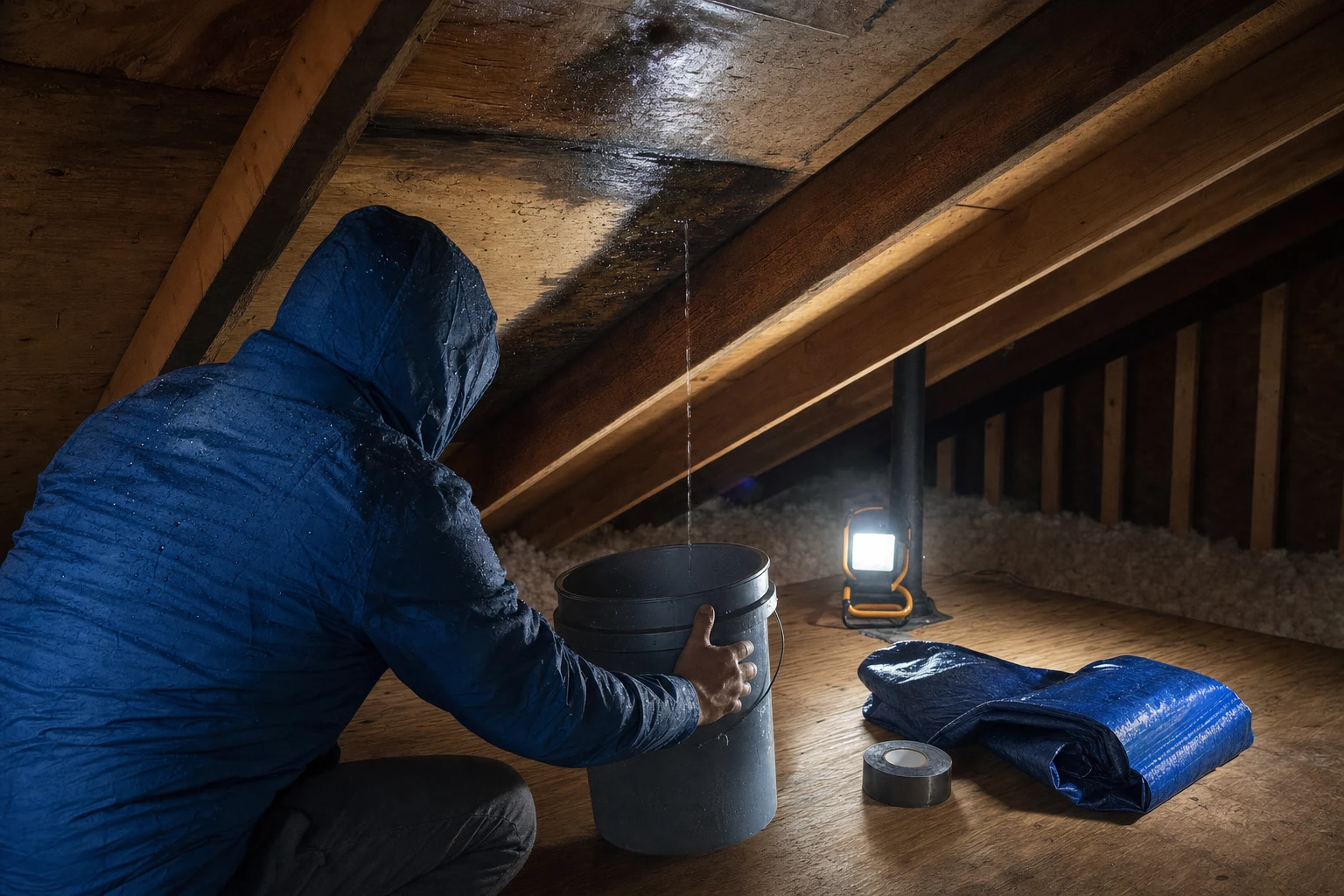
    • Contain it. A bucket, a bin, a cooler. Put an old towel in the bottom so the drip stops drumming and splashing.
    • Relieve a bulging ceiling. A sagging, heavy patch of drywall is holding pooled water. Puncture the low point with a screwdriver and catch it in the bucket. This feels wrong and is right: a controlled hole you can patch is better than a ceiling that lets go all at once.
    • Photograph before you clean up. Wide shot of the room, close-up of the stain, a photo of the bucket filling. Date-stamped photos are what an adjuster wants, and the mess is the evidence.
    • Get into the attic with a torch. Water travels along rafters and sheathing before it drops, so the wet spot on the ceiling is often not under the hole. Trace the water uphill to the highest wet point.
    • Mark the spot. A nail pushed up through the decking, or a chalk circle, tells a roofer in thirty seconds what might otherwise take an hour to find.

    That last step is worth more than any product in this article. The reason DIY roof patches so often fail is not bad sealant; it is sealing the wrong place, because the leak entered the roof several feet uphill of where it appeared.

    Does Flex Seal actually work on a roof?

    This is the question everyone asks, because you can buy it at any hardware store in Middle Tennessee on the way home. The fair answer is: yes, as a temporary measure, within limits the manufacturer states plainly on its own website.

    Flex Seal’s own product pages say Flex Seal products “can be used to seal minor roof leaks, especially for temporary or quick fixes,” and that Flex Tape “can help temporarily stop roof leaks.” They also say this, in a note on the same page:

    “Flex Seal products are not a permanent fix for significant structural damage or full-roof repairs. If your roof has significant wear or ongoing leaks, have a roofing professional assess the damage.”

    And on Flex Tape specifically: “While it’s a quick and effective solution, it’s recommended to follow up with a more permanent repair for long-term protection.”

    That is the manufacturer setting the expectation, not a roofer talking down a rival product. Read it that way and the product does exactly what this article is about: it buys you time. What it will not do is fix a roof.

    The catch nobody mentions: dry surfaces

    Here is the practical problem. Flex Seal says its spray “works best on clean, dry surfaces, but can be used on wet surfaces in emergency situations,” and that Flex Tape should be applied “to a clean, dry area” and pressed down firmly. Every adhesive product on that shelf says something similar.

    A roof leak announces itself during a rainstorm. The surface is wet, the shingles are slick, and the granules are loose. Applying tape or sealant to a wet, dirty, cold shingle is a common reason these products get blamed for failing: the product is being used outside the conditions its own label sets.

    So the honest sequence is: contain the water tonight, and put the patch on tomorrow when the surface is dry, if you can safely reach it at all.

    What about a hail hole?

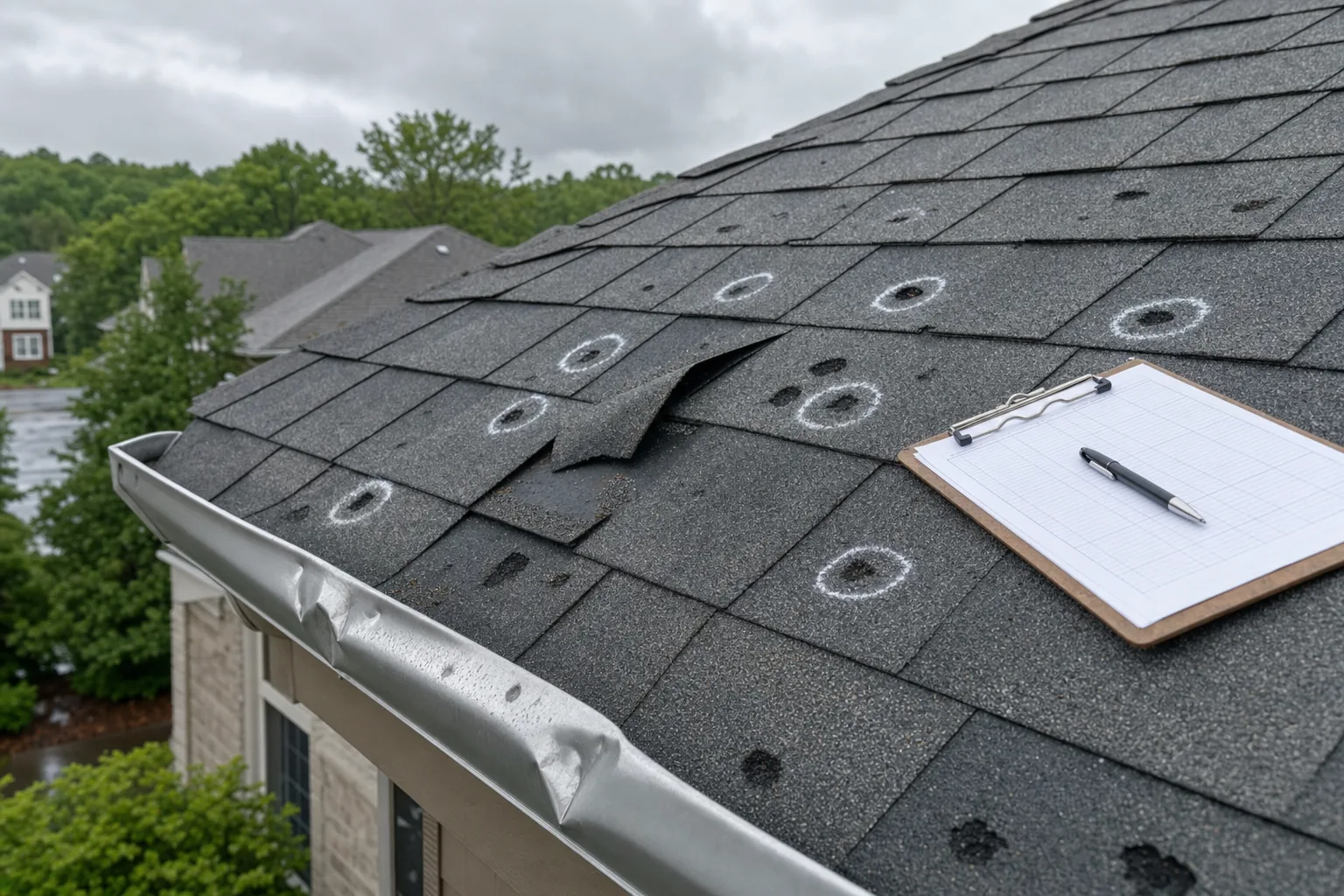
    For hail, the calculation changes completely, and not because of the product. Hail damage is an insurance claim, and your claim rests on an adjuster being able to see what the hail did. Sealing a punctured or bruised shingle with black rubberised paste before anyone has documented it makes the damage harder to assess and the claim harder to argue.

    If hail has holed your roof: photograph it, cover it (a tarp over the area, not sealant into the hole), and file the claim. Our guide to handling a storm damage insurance claim covers the order of operations, and the storm-chasing crews that follow every Middle Tennessee hail event are worth reading about before you answer the door.

    What the shingle warranty actually says

    You will read everywhere that a DIY sealant “voids your roof warranty.” We went and read the current GAF Shingle & Accessory Limited Warranty, the document itself, effective for products installed after 1 January 2025. It does not say that. Under What Is Not Covered, it opens:

    “Even if your GAF Products were not properly installed according to GAF’s application instructions or to standard good roofing practices, this limited warranty remains in effect.”

    It is a manufacturing defect warranty. It covers the shingle being faulty, not the roof being damaged. So a patch does not switch it off. But two other clauses matter far more to anyone standing in an attic with a bucket.

    First, hail is excluded outright. The warranty does not apply to “damage resulting from causes beyond normal wear and tear, such as: acts of nature, such as hail, fire, or winds (including gusts) over the applicable wind speed.” If hail broke your roof, the warranty was never the route; insurance is.

    Second, and this is the real trap:

    “If you repair or replace your GAF Products before you notify GAF about your claim or before GAF has completed its evaluation of your claim, your claim may be denied.”

    The warranty also requires you to notify GAF within 30 days of noticing a problem. So the risk from a DIY patch is not that it voids anything. It is that if you did have a genuine manufacturing defect, patching over it before telling the manufacturer can get that claim denied. Photograph first, notify, then patch.

    Scope note: we read GAF’s current shingle warranty because GAF describes itself in that document as North America’s largest roofing manufacturer and publishes the full terms. We did not review the warranty terms of other manufacturers, and they differ: read the one that came with your roof before relying on any of this.

    The fixes that actually hold

    Temporary roof leak fixes, what each is for, and what it will not do
    Fix Best for Honest limit
    Bucket and attic sheeting Tonight, in any weather Contains water; does nothing to the roof
    Tarp over the area Holes, missing shingles, hail damage awaiting an adjuster Needs safe roof access and proper anchoring; will not survive high wind if loosely laid
    Roofing tape / Flex Tape A small, findable puncture on a dry day Manufacturer says follow up with a permanent repair
    Roof sealant or paste Small cracks, gaps around a vent or flashing Wants a clean dry surface; hides damage from an adjuster
    Roofing cement over a patch A lifted or cracked shingle Messy, hard to remove, a roofer will cut it out anyway

    Flex Seal’s own guidance for bigger openings is worth repeating because it is more sensible than the adverts suggest: for larger holes, it recommends pairing Flex Paste with wire mesh so the mesh bridges the gap and the paste has something to grab. That is genuinely how a patch spans a hole rather than sagging into it.

    Tarping, and the free option after a declared disaster

    A tarp laid loosely over a roof and weighted with bricks is a sail. It lifts in the first gust and can take shingles with it. A tarp that holds runs from above the damage all the way over the ridge, is wrapped around a length of timber at each end, and is fastened so water runs over it rather than under it.

    After a federally declared disaster, there is a free alternative worth knowing about. Operation Blue Roof, run by the U.S. Army Corps of Engineers for FEMA, installs temporary blue sheeting at no cost to eligible homeowners in declared areas. The eligibility rules are specific: primary residences with standard shingled roofs, a signed Right of Entry form, and roofs with more than 50 percent structural damage are not eligible, because at that point the building needs more than a cover. Middle Tennessee has had federal disaster declarations before, so it is worth checking whether one is active before you pay someone to tarp your roof.

    Sixteen years of storms over Middle Tennessee

    We pulled the NOAA National Centers for Environmental Information Storm Events Database, the public record that hail-map products are built on, for the three counties that contain Nashville, Franklin, Brentwood, Murfreesboro and Smyrna. Between 2010 and 2025 it records 1,556 hail, damaging-wind and tornado reports across Davidson, Williamson and Rutherford counties.

    Line chart of NOAA storm reports per year from 2010 to 2025 for Davidson, Williamson and Rutherford counties, showing damaging wind reports peaking at 148 in 2016 and hail reports spiking to 60 in 2025, with the March 2020 tornado annotated.
    Severe weather reports by year. Source: NOAA NCEI Storm Events Database, retrieved 21 September 2026.
    Severe weather reports by county, 2010–2025
    County Cities covered Reports
    Davidson Nashville 784
    Williamson Franklin, Brentwood 445
    Rutherford Murfreesboro, Smyrna 327

    Two things stand out, and both are recent.

    2025 was an extraordinary hail year. The database records 60 hail reports across the three counties, against a median of 16 a year over the period. Only 2012, with 74, was higher.

    The afternoon of 20 May 2025 was the worst of it, and it landed on Williamson County. Between 15:20 and 15:49, under half an hour, NOAA logged 3.00-inch hail at Douglas and Peytonsville, 2.75-inch at Franklin, and 2.00-inch stones at Leiper’s Fork, Mudsink and again at Douglas. Three inches is roughly a baseball. If you own a roof in Franklin or Brentwood and have not had it looked at since that afternoon, that is the date to mention.

    Williamson County has had a run of these: 3.00-inch hail at Leiper’s Fork on 26 May 2024, 2.50-inch at Craigfield on 3 April 2025, and 2.00-inch at Nolensville on 30 March 2025, the same system that dropped 2.00-inch hail on La Vergne in Rutherford County. Further back, Rutherford took 2.75-inch hail at Rucker on 18 October 2011.

    Nashville’s worst entry is of a different kind. The EF-3 tornado that crossed Davidson County in the early hours of 3 March 2020 accounts for $1.09 billion in property damage in this dataset, with 2 direct deaths and 170 injuries. It is a single event worth more than every other storm in the sixteen-year window combined.

    One caveat on reading any of this: these are storm reports, not damaged roofs. A single storm generates many reports, and reports cluster where people are to see them. The counts say when severe weather crossed these counties, not how many roofs it broke.

    What not to do

    • Do not go onto a wet or icy roof. Nothing in this article is worth a fall. If it is raining, everything outside waits.
    • Do not seal over hail damage before it is documented. You are covering the evidence your claim depends on.
    • Do not patch a suspected manufacturing defect before notifying the manufacturer. GAF’s warranty says that alone can get the claim denied.
    • Do not pour sealant into a leak you have not traced. Water runs along framing; the entry point is usually uphill of the stain.
    • Do not let anyone who knocked on your door climb up to “take a look.” Choose your own contractor.

    Common questions

    Does Flex Seal work on a roof leak?

    As a temporary fix on a small leak, yes, within the limits its maker sets. Flex Seal’s own site says its products “can be used to seal minor roof leaks, especially for temporary or quick fixes” but “are not a permanent fix for significant structural damage or full-roof repairs.” It also asks for a clean, dry surface, which a roof in a rainstorm is not. Treat it as a way to buy time until a roofer arrives.

    Will Flex Tape stop a hail hole in my roof?

    It may stop water in the short term, but it is the wrong move for hail. Hail damage is an insurance claim, and covering the damage before an adjuster has seen it makes the claim harder to prove. Photograph the damage, tarp over the area rather than sealing into it, and file the claim first.

    Does a DIY roof patch void my shingle warranty?

    Not according to GAF’s current shingle warranty, which states it “remains in effect” even where products were not installed according to instructions or good roofing practice. The real risk is a different clause: repairing before you notify GAF of a claim can cause that claim to be denied, and notice is required within 30 days. Other manufacturers’ terms differ; read yours.

    Should I put a bucket under the leak or make a hole in the ceiling?

    Both, in that order, if the ceiling is bulging. A sagging patch of drywall is holding pooled water and can fail all at once. Puncturing the low point with a screwdriver and catching the water in a bucket turns an unpredictable collapse into a small hole you can patch later.

    Can I get a free tarp for my roof after a storm?

    Sometimes. Operation Blue Roof, run by the U.S. Army Corps of Engineers for FEMA, installs temporary sheeting free for eligible homeowners in federally declared disaster areas. It covers primary residences with standard shingled roofs, requires a signed Right of Entry form, and excludes roofs with more than 50 percent structural damage.

    How long can a temporary roof fix last?

    Plan in weeks, not seasons. Flex Seal recommends following up a tape repair with a permanent one, and a properly anchored tarp is generally treated as a stopgap until the roof is repaired. Middle Tennessee’s heat and freeze-thaw cycling are hard on any adhesive left exposed; see what this climate does to roofing materials.

    Getting a roofer there

    A temporary fix is a countdown, not a solution. Once the water is contained and the damage is documented, the next call is to someone licensed. Our Nashville roofing directory lists every company we track with its state license number and expiry date, and you can request a free quote from our sponsor, a licensed Nashville contractor. If you want to know what the eventual bill might look like, we have guides to repair versus replacement and what a roof inspection costs.

    Sources

    This article is general information, not legal, insurance or engineering advice, and it is not a substitute for a professional inspection. Do not go onto a roof you cannot access safely. Warranty terms are quoted from the published document named above and vary by manufacturer and installation date; confirm the terms that apply to your roof. Last updated 26 September 2026.
  • How Much Does a Roof Inspection Cost, and When Is It Free?

    How Much Does a Roof Inspection Cost, and When Is It Free?

    A roof inspection costs $100 to $400 for most Middle Tennessee homes, and the national average is $280. It is genuinely free in three situations: when a roofer folds it into a repair or replacement estimate, when your insurer sends an adjuster after you file a claim, and when it rides along inside a home inspection you are already paying for during a sale. What you are buying, or being given, is not the same product in each case.

    The short version

    • Paid inspections run $75 to $600 depending on type. A physical walk-the-roof inspection is the cheap end; thermal imaging is the expensive end.
    • A free inspection is almost always a sales visit. That is not a scandal; it is the business model. But the person deciding whether you need a new roof is the person who would sell it to you.
    • An unsolicited free inspection after a storm is the opening move in a storm-chasing scam that Tennessee has written statutes to address.
    • Tennessee licenses home inspectors by statute, and a home inspection report is a regulated document with required contents. A roofer’s free look is not that document.
    • A roof certification ($75–$200) is a different product again: a written opinion on remaining life, usually for an insurer or a buyer.

    How much does a roof inspection cost?

    A roof inspection costs $100 to $400 on average nationally, with reported prices running from $75 at the low end to about $1,200 for large or complicated roofs. The national average sits at $280. Those are HomeGuide’s figures, last updated in December 2025, and they track what we hear from homeowners across Davidson, Williamson, Rutherford and Sumner counties.

    The average is a poor guide on its own, because the spread is driven almost entirely by which kind of inspection you are buying.

    Horizontal bar chart comparing roof inspection price ranges: physical $75 to $200, roof certification $75 to $200, drone $100 to $450, commercial roof $200 to $600, infrared or thermal $400 to $600, against a national average of $280.
    Price ranges by inspection type. Source: HomeGuide, updated 8 December 2025.
    Roof inspection cost by type
    Type Typical cost What it is
    Physical $75–$200 Someone climbs the roof and checks the attic. The most common kind.
    Drone $100–$450 Camera equipment instead of a ladder. Safer on steep or multi-storey roofs; needs decent weather.
    Infrared / thermal $400–$600 Thermal scanning that finds trapped moisture, because wet areas hold heat longer than dry ones.
    Roof certification $75–$200 An add-on: a written opinion on how much life the roof has left.
    Commercial roof $200–$600 Or roughly $0.05–$0.10 per square foot on larger buildings.

    A separate attic inspection, if you want the structure, insulation and ventilation looked at properly rather than glanced at, runs $200 to $500. Given that ventilation is the single biggest lever on how long a roof lasts in Tennessee heat, that is not the worst money a homeowner ever spends.

    When is a roof inspection free?

    Three situations, and they are genuinely free, with no catch on the price.

    • Bundled into an estimate. Most residential roofers will look at your roof at no charge when you ask for a repair or replacement quote. They are absorbing an hour of labour to win a job worth thousands.
    • An insurance claim inspection. Once you file, your insurer sends an adjuster at no cost to you. That adjuster works for the insurer.
    • Inside a home inspection during a sale. A home inspection costs $250 to $400 and includes the roof covering. The buyer normally pays, and the roof portion is not billed separately.

    There is a fourth kind you should treat differently: the unsolicited free inspection, where someone knocks on your door after a hailstorm and offers to get up on your roof. Consumer-protection guidance on this subject, HomeGuide’s own cost guide included, says the same thing: be careful with free inspections you did not ask for. We wrote up how that specific scam runs in Nashville and what Tennessee law says about it, because the state has statutes aimed squarely at it.

    Free does not mean neutral

    This is the part worth sitting with. A free inspection is paid for by the possibility of selling you a roof. As HomeGuide puts it plainly: a certified home inspector has no financial interest in roof repair, while a roofing contractor benefits from finding damage.

    That does not make roofers dishonest. It makes the incentive worth naming. If a contractor tells you the roof is finished and the number is $18,000, a $200 second opinion from someone with nothing to sell is cheap insurance, and it is one of the most useful things you can do before signing. Our guide to deciding between a repair and a full replacement covers what that second opinion should actually be looking at.

    What Tennessee actually regulates

    Tennessee licenses home inspectors under the Home Inspector License Act of 2005. The requirement itself is blunt. Under T.C.A. § 62-6-304:

    “It is unlawful for any person, directly or indirectly, to engage in or conduct or to advertise or claim to be engaging in or conducting the business or acting in the capacity of a home inspector as defined in this chapter, within this state, without first obtaining a home inspector license as provided in this part.”

    The Act defines a “home inspection” as a visual analysis of a residential building covering nine groups of components: heating, cooling, electrical, plumbing, structural components, foundations, roof coverings, exterior and interior components, and other site aspects affecting the dwelling (§ 62-6-302(3)(A)).

    The deliverable is regulated too. A “home inspection report” is a written document prepared for compensation that must report any system the inspector considers significantly deficient and the reason why, list anything the standards of practice called for that was not inspected and why it was skipped, and state in writing that it does not cover environmental hazards, wood-destroying insects, or subterranean systems (§ 62-6-302(4)).

    That is a real, enforceable specification. It is why a home inspection report reads the way it does, and it is a clear difference between a document you paid for and a free opinion given by someone holding a quote.

    Scope note: we verified the licensing requirement, the statutory definition of a home inspection, and the required contents of a home inspection report against the current Tennessee Code. We did not attempt to determine whether a roof-only inspection falls inside or outside that definition. That is a question for the Department of Commerce and Insurance, not for a blog post.

    What we see across Middle Tennessee

    We track 27 roofing companies serving this metro. Fourteen of them advertise roof inspection as a service line, and every one of those fourteen is a commercial roofer. None of the thirteen residential-only roofers in our directory sells an inspection as its own product.

    That is not a gap in the market. It is the market telling you how it works. On the commercial side, where a facilities manager has a maintenance budget and a flat roof with a service history, an inspection is a billable service. On the residential side it is a lead-generation cost, bundled into the free estimate, which is exactly why it is free.

    Based on the services these companies advertise in our directory as of September 2026, not a survey of what they will do on request. Plenty of residential roofers will inspect a roof for a fee if you ask; they just do not market it.

    A roof certification is a different product

    A roof certification costs $75 to $200 and is a written opinion on the roof’s condition and remaining life, issued for an insurer or a property sale. A roof generally has to be leak-free with two to five years of useful life left to be certified at all, and the certificate is only issued after any necessary repairs are done. The inspection behind it takes 30 minutes to an hour.

    This matters if you are buying, selling, or switching insurers. Many mortgage lenders want to see at least three years of useful life on the roof, and many insurers will not write a policy until a failing roof is repaired or replaced. If your roof is near the end of its range, and in this climate that arrives sooner than the packaging promises, a certification is where the transaction either clears or stalls.

    When is it worth paying for one?

    • You are buying a house and the home inspector flagged the roof. A roof-specific opinion is worth the few hundred dollars before you inherit a five-figure problem.
    • A contractor says you need a full replacement. An independent opinion costs a fraction of one percent of the job.
    • You are switching insurers or the carrier is asking questions about roof age. If the same visit turns up fogged or draughty windows, here is what replacing those costs.
    • The roof is approaching the end of its expected life and you want to plan the spend rather than react to a leak. Our Middle Tennessee shingle cost guide has the numbers to budget against.
    • After a significant storm, if you want documentation from someone who is not also bidding the repair. If it is actively leaking, stop the water first.

    How often should a roof be inspected?

    The general guidance is a professional inspection every three years for a shingle roof and every five for tile, plus a homeowner’s own look twice a year and immediately after any significant weather. In Middle Tennessee, where spring hail and 49 days a year above 90°F do most of the ageing, the post-storm check is the one that earns its keep.

    You do not need to climb up to do your half of it. Granules collecting in the gutters, dented gutter faces or downspouts, shingle debris in the yard, and new stains on an upstairs ceiling all show from the ground.

    Common questions

    Are roof inspections free in Nashville?

    Often, yes. Most residential roofers include one with a repair or replacement estimate, and your insurer’s adjuster inspects at no cost after you file a claim. A standalone paid inspection runs $100 to $400. Be cautious about free inspections offered by someone who turned up uninvited after a storm.

    How much does a roof inspection cost?

    $100 to $400 on average, with a national average of $280. A physical inspection is $75 to $200, a drone inspection $100 to $450, and infrared or thermal imaging $400 to $600. Commercial roofs run $200 to $600, or about $0.05 to $0.10 per square foot.

    Does a home inspection include the roof?

    Yes. A home inspection costs $250 to $400 and covers the roof covering, and in Tennessee the statutory definition of a home inspection lists roof coverings as one of the nine component groups an inspection addresses. It is a visual analysis, though, not a roof-specific deep dive.

    What is the difference between a roof inspection and a roof certification?

    An inspection finds problems. A certification is a written opinion on how much life the roof has left, usually required by an insurer or a buyer, and it is only issued after any needed repairs are complete. Certification costs $75 to $200 on top of the inspection.

    Who pays for a roof inspection when buying a house?

    The buyer normally pays for the home inspection, which includes the roof. If that inspection raises roof concerns, a separate roof inspection or certification is also usually the buyer’s cost, though it can become a negotiating point.

    Should I let someone inspect my roof after they knock on my door?

    Be careful. An unsolicited free inspection after a storm is a standard opening for storm-chasing crews, and Tennessee has statutes specifically regulating residential roofing work paid for through insurance. If you want the roof looked at, call a licensed contractor you chose yourself.

    Getting it looked at

    If you want a roof inspected in Middle Tennessee, start with someone whose license you can check. Our Nashville roofing directory lists every company we track with its state license number and expiry date, or you can request a free quote from our sponsor, a licensed Nashville contractor. If you would rather start from a shortlist, we also keep a ranked list of Nashville roofing companies.

    Sources

    • HomeGuide: Roof inspection cost guide, last updated 8 December 2025. Cost ranges, national average, certification pricing, report contents and inspection frequency. Retrieved 21 September 2026.
    • T.C.A. § 62-6-304: home inspector license requirement (2025 Tennessee Code). Retrieved 21 September 2026.
    • T.C.A. § 62-6-302: definitions of “home inspection” and “home inspection report” (2025 Tennessee Code). Retrieved 21 September 2026.
    • Tennessee Home Inspector Licensing Program, Department of Commerce and Insurance.
    • Middle Tennessee contractor figures are Nashville Builders Pro’s own directory data, September 2026.

    This article is general information, not legal, insurance or engineering advice. Statutory provisions are quoted from the 2025 Tennessee Code as published; confirm current text and how it applies to your situation with a licensed professional. Cost figures are national ranges from the source cited above and will vary with your roof. Last updated 24 September 2026.

  • How Long Does a Roof Last in Tennessee Heat and Humidity?

    How Long Does a Roof Last in Tennessee Heat and Humidity?

    In Middle Tennessee, plan on 15 to 20 years from a 3-tab asphalt roof and 20 to 25 from an architectural one, the lower end of what the same shingles are rated for nationally. Metal runs 40 years and up. The reason is not one extreme season but two: Nashville averages 49 days a year at or above 90°F and 67 days at or below freezing, so a roof here is cooked and then flexed, year after year.

    Manufacturers rate shingles under laboratory conditions. Tennessee is not laboratory conditions. This is what the heat and the humidity actually do, how long each material realistically lasts here, and why two roofs on the same street can age a decade apart.

    The published numbers, before climate

    InterNACHI’s life expectancy chart is the standard reference and gives these figures for roof coverings:

    Horizontal bar chart of expected roof covering service life: 3-tab asphalt 20 years, wood shingle 25, architectural asphalt 30, metal 40 to 80 years
    National expectations by covering type, before any local climate is applied.
    Expected service life by roof covering, national figures and a Middle Tennessee planning range
    Covering Published expectation Realistic Middle TN planning range
    3-tab asphalt shingle 20 years 15–20
    Wood shingle or shake 25 years 20–25
    Architectural asphalt 30 years 20–25
    Metal 40–80 years 40+

    The middle column is published and citable. The right-hand column is our planning estimate, not a measured figure, and we want to be straight about that: it reflects the direction every degradation mechanism below pushes in, applied to the published life. We did not find published research assigning a specific percentage reduction to this climate, and we are not going to invent one.

    Why Middle Tennessee is hard on a roof

    Line chart of Nashville average monthly high and low temperatures showing summer highs reaching 91F above the 90 degree line and winter lows dropping below the 32 degree freezing line
    The gap between the two lines is the daily expansion and contraction a shingle absorbs. Nashville crosses both thresholds every year.

    Heat drives the volatiles out

    Asphalt shingles stay flexible and waterproof because of volatile compounds in the asphalt. Heat accelerates the rate at which those evaporate. As InterNACHI puts it, shingles “become more brittle as volatiles, which keep them flexible, dissipate,” and that loss “can degrade the bond between the asphalt and the granules.”

    Once the bond weakens, granules wash off. Granules are the shingle’s sunscreen, so losing them exposes the asphalt to more UV, which drives off more volatiles. It is a loop that accelerates rather than a steady decline, which is why roofs here often look fine for years and then deteriorate noticeably fast.

    Air temperature understates it. A dark roof in direct July sun runs far hotter than the 91°F on the thermometer, and InterNACHI notes that “darker roofs absorb more heat, which shortens shingle lifespan by accelerating the loss of volatiles and increasing thermal cycling.”

    Then the cold flexes what the heat made brittle

    This is the part people miss about Tennessee. We are not Phoenix. Nashville has 67 days a year at or below freezing alongside those 49 days above 90°F, and InterNACHI is explicit that “climates with large daily temperature swings shorten roof lifespans because they cause greater amounts of expansion and contraction.”

    A shingle that has lost volatiles to summer heat is less able to absorb that movement. Brittle material plus repeated flexing is how you get the splitting and cracking that shows up on older Middle Tennessee roofs, often before anything leaks.

    Humidity brings something that eats the shingle

    Dark vertical algae streaks running down the shaded portion of a grey asphalt shingle roof, with a cleaner lighter section where sunlight reaches and moss forming in the gutter
    Gloeocapsa magma. It starts where the roof stays damp longest, which in this hemisphere usually means the north slope and anywhere shaded.

    Those black streaks on roofs all over Middle Tennessee are not dirt. They are Gloeocapsa magma, a cyanobacteria, and the Asphalt Roofing Manufacturers Association identifies it as the common cause of the discolouration. The Southeast is among the highest-risk regions precisely because humidity spikes alongside summer heat.

    It matters beyond appearance. The organism feeds on the limestone filler that gives an asphalt shingle its weight, and as it does, surface granules loosen and wash away with rainfall, the same granule loss that heat causes, arriving by a different route. It takes hold first where the roof gets least sun and stays damp longest, which is why it shows up on north-facing slopes and under tree cover.

    The two slopes of the same roof age differently

    A roof ridge where a faded sun-exposed south-facing slope with granule thinning meets a darker better-preserved shaded north-facing slope
    South slope cooked, north slope damp. The same roof, installed the same day, ageing by two different mechanisms.

    InterNACHI notes that “south-facing roof slopes have shorter lifespans due to increased thermal cycling and UV exposure.” In Middle Tennessee you often get the worst of both on one house: the south slope bakes, and the north slope, cooler and damper, grows algae. When a roofer says your roof needs work but only points at one elevation, this is usually why.

    Ventilation is the variable you can actually control

    Of everything on this page, attic ventilation is the factor most within a homeowner’s control. Poor ventilation, in InterNACHI’s words, “shortens shingle lifespan by failing to keep shingles cool, resulting in accelerated loss of volatiles and greater amounts of thermal cycling.” A badly ventilated attic in a Tennessee August is an oven pressed against the underside of the roof for weeks at a time.

    Does it differ across Middle Tennessee?

    Less than people expect. The communities below sit within roughly 40 miles of each other and share the same climate profile, so the material lifespans above apply across all of them. What varies is the housing stock and the tree cover, and those change what you should be watching for.

    What tends to drive roof ageing across the Middle Tennessee communities we cover
    Community County What to watch
    Nashville Davidson The widest mix of roof ages in the metro; heavy tree canopy in older neighbourhoods drives algae and debris
    East Nashville Davidson Older housing stock and mature shade trees: algae streaking and aged decking are the recurring themes
    Green Hills Davidson Dense mature canopy; shaded slopes stay damp and stain early
    Bellevue Davidson Wooded lots west of the city; overhanging limbs and gutter debris hold moisture against the roof edge
    Antioch Davidson Large 1990s and 2000s subdivisions now reaching the end of first-generation shingles
    Brentwood Williamson Larger roof areas with complex hips and valleys; more flashing detail to fail before the field does
    Franklin Williamson A wide span of build dates, from historic to new-build, so roof age varies street to street
    Nolensville Williamson Mostly newer construction; roofs still inside warranty, where ventilation quality shows up first
    Spring Hill Williamson / Maury Rapid recent growth means large numbers of roofs of near-identical age, ageing together
    Murfreesboro Rutherford Open, less-shaded subdivisions: sun exposure and hail matter more than algae here
    Smyrna Rutherford Similar exposure to Murfreesboro; watch south and west slopes first
    Hendersonville Sumner Lakeside humidity adds to the algae picture on shaded elevations
    Gallatin Sumner Mixed older and new stock; storm exposure on the northern side of the metro
    Mt. Juliet Wilson Fast-growing newer housing; ventilation and installation quality are the differentiators

    The column on the right reflects the character of the housing stock rather than a measured difference in roof life. A shingle in Gallatin and a shingle in Spring Hill are rated the same and will last about the same. Where your roof sits on a street, how much shade it gets, which way the slopes face and how well the attic breathes will move the number far more than which of these towns you live in.

    Getting to the top of the range instead of the bottom

    1. Fix the ventilation. Ridge and soffit venting that actually moves air keeps shingle temperature down, which slows volatile loss and reduces thermal cycling. It is the highest-leverage thing on this list.
    2. Keep the roof clear. Leaf litter in valleys and gutters holds moisture against the roof, which is what algae and moss want.
    3. Cut back overhanging limbs. Shade keeps slopes damp and drops debris. It also gives squirrels a bridge.
    4. Consider algae-resistant shingles when you re-roof. In this climate the copper-bearing granule types are addressing a problem you are likely to get, not a hypothetical one.
    5. Look after a storm, not just after a leak. Hail damage frequently does not leak immediately; it bruises the mat and shortens the life quietly.
    6. Do not pressure-wash asphalt shingles. It strips the granules you are trying to keep. Algae treatment is a low-pressure chemical job.

    Common questions

    How long will my roof last in Nashville specifically?

    For asphalt shingles, plan on 15 to 20 years from a 3-tab roof and 20 to 25 from an architectural one. Metal runs 40 years and up. Where you land in those ranges depends more on attic ventilation, shade, slope orientation and installation quality than on anything else: two identical roofs installed the same week can differ by years.

    Do the black streaks mean I need a new roof?

    Not by themselves. The streaks are Gloeocapsa magma, and while it does feed on the shingle’s limestone filler and loosen granules, staining alone is not a replacement trigger. What matters is whether granules are actually going (check the gutters for granule accumulation) and whether the shingles are curling or cracking. Streaking on an otherwise sound roof is a cleaning question.

    Does a lighter-coloured roof really last longer here?

    Darker roofs absorb more heat, and InterNACHI links that directly to faster volatile loss and increased thermal cycling. So the direction is real. We did not find a figure quantifying how many extra years a lighter roof buys in this climate, so we are not going to put a number on it. If you are choosing anyway, lighter is the direction that helps.

    Why does one side of my roof look so much worse?

    Because it is being aged by a different mechanism. South-facing slopes take more sun and more thermal cycling, so they fade, dry and lose granules first. North-facing slopes stay cooler and damper, so they grow algae and moss. Same roof, same install date, two different failure paths.

    My roof is 18 years old and looks fine. Should I be worried?

    Not worried, but you are inside the window where it is worth an inspection rather than a glance from the driveway. Asphalt tends to look acceptable from the ground well past the point where granule loss and brittleness have set in. Check the gutters for granules and look at the south and west slopes first.

    Is metal worth it in Tennessee heat?

    On lifespan alone, the published range is 40 to 80 years against 20 to 30 for asphalt, so it lasts considerably longer. It costs correspondingly more up front, and whether that trade works depends on how long you plan to own the house. It is not affected by the algae problem at all.

    The short version

    Tennessee ages a roof from two directions. Summer heat drives out the volatiles that keep shingles flexible and loosens the granules that shield them; winter cold then flexes what the heat made brittle, 67 days a year. Humidity adds an organism that eats the shingle’s filler from the shaded side. Expect the lower end of the published range, and expect the south and north slopes of the same roof to fail for opposite reasons.

    The one lever that genuinely moves the number is ventilation.

    When you want it looked at, our Nashville roofing directory lists every roofing company we track with its state license number and expiry, and you can browse roofers across Middle Tennessee or read our ranked list of Nashville roofing companies, work out whether you need a repair or a replacement, or see what a new roof costs here. The same heat and humidity works on your walls, which we cover in our guide to siding in Middle Tennessee.

    Sources

    Climate figures read 21 September 2026. Lifespan figures are published national expectations; the Middle Tennessee planning ranges are our estimate and are labelled as such above.

  • Roofing Scams in Nashville: The Tennessee Law Storm Chasers Hope You Have Not Read

    Roofing Scams in Nashville: The Tennessee Law Storm Chasers Hope You Have Not Read

    If a roofing contractor in Tennessee asks you for money up front on an insurance job, that is not just a warning sign; state law says they cannot do it. Under T.C.A. § 62-6-604, a residential roofing services provider cannot require any payment until your insurer has confirmed in writing that the claim is fully covered, or the three-business-day cancellation window has passed.

    Tennessee wrote an entire part of its code for this problem after a wave of storm-chasing roofers. Most homeowners have never heard of it, which is exactly why it keeps working on people. This is what those six sections actually say, what a storm chaser looks like in Middle Tennessee, and what to do in the days after a hailstorm when someone is already knocking.

    Why this happens here, in waves

    A suburban Middle Tennessee street the morning after a hailstorm, with damaged roofs, downed branches and shingle granules along the kerb
    Storm damage arrives street-wide, which is what makes the door-knocking crews economic.

    Roofing fraud in Middle Tennessee is not a steady background rate. It arrives with the weather. The Tennessee Attorney General issued scam warnings after the March 2020 Nashville tornado and again after the October 2024 flooding. Clarksville police warned residents about roofing and contractor scams following severe weather. The state runs a Contractor Fraud Awareness Week every year, held 19–23 May in 2025.

    We could not find reliable figures for how many Nashville homeowners are defrauded each year, and we are not going to invent one. What the public record does show is a repeating pattern of official warnings, local investigations and state law written specifically for this problem, including a NewsChannel 5 investigation into a roofer accused of home improvement fraud in the Nashville area who had a history of problems in other states. That last detail is the whole shape of it: the out-of-town crew that follows the storm.

    Five things Tennessee law already gives you

    Title 62, Chapter 6, Part 6 of the Tennessee Code is called Residential Roofing Services. It was passed in 2012 and it is short. Here is what is in it.

    1. They cannot take your money up front

    “No residential roofing services provider shall require any payments from a person pursuant to a contract until the person has received written notice from the insurer that the contract or claim is fully covered or the three-day cancellation period required pursuant to this part has expired.” (§ 62-6-604(a))

    This is the one to remember. The classic storm-chaser move is a deposit taken on the driveway, followed by silence. On an insurance roofing job in Tennessee, that deposit is not something to be wary of; it is something the provider is not permitted to require.

    There is one carve-out, and it is narrow: if the contractor performs emergency repairs that you have acknowledged in writing were necessary to prevent damage, they may collect for those at the time the work is done (§ 62-6-604(c)(1)). Tarping a hole at midnight can be paid for. A deposit toward the re-roof cannot.

    2. They cannot invent the emergency either

    “No residential roofing services provider shall misrepresent that emergency repairs are necessary to prevent damage to the residential real estate owned or possessed by such person.” (§ 62-6-604(c)(2))

    Since emergency repairs are the one payment a contractor can collect immediately, the statute closes the obvious loophole: manufacturing the emergency to unlock it.

    3. You can cancel if your insurer says no, or only partly yes

    Under § 62-6-602, once you receive written notice from your insurer that all or any part of the claim is not a covered loss, you may cancel the contract. You have until midnight on the third business day after receiving that notice.

    Note the words any part. This is not limited to a flat denial. A partial denial triggers the same right, which matters because partial coverage is the more common outcome and the one people assume they are stuck with.

    The cancellation notice needs no special wording. The statute says it need only be signed, dated, and indicate “by any form of written expression” that you do not intend to be bound. Mail it and it counts from the postmark; email or fax it and it counts from the moment you send it.

    Once you cancel, any payments you have made, other than for emergency repairs already performed, must be returned within ten business days.

    4. They must hand you their license number before you sign

    This is the provision most homeowners do not know exists, and it is the one that catches out-of-state storm chasers. Before entering a contract, § 62-6-603 requires a residential roofing services provider to give you, in writing:

    • A business mailing address for cancellation purposes, and a telephone number
    • The license or registration number of any contractor, home improvement contractor, or public adjuster license they hold, in this state or any other state
    • An email address or fax number for cancellation, if they have one
    • A detailed description of all damage or repairs to be claimed or covered by the contract, and the location of that damage
    • A written cancellation statement in boldface type of at least 10 points
    • A detachable “NOTICE OF CANCELLATION” form, in duplicate, also in 10-point boldface

    Two of those are quietly powerful. The license requirement covers other states, so a crew from out of state cannot simply say they are not licensed here and move on. And the written description of damage, with its location, gives you a dated record of what they claimed was wrong before any work started, which is the natural check on damage that grows between the inspection and the invoice.

    5. They cannot play insurance adjuster unless they are one

    “No residential roofing services provider shall act or hold out as being a public adjuster … unless licensed as a public adjuster in accordance with title 56, chapter 6, part 9.” (§ 62-6-605)

    “We’ll handle the whole claim for you, you don’t need to talk to your insurer” is a sales pitch that runs into this section. Negotiating your claim on your behalf is public adjusting, and it requires its own license.

    And there are teeth

    Under § 62-6-606, a violation of any of the above is an unfair or deceptive act under the Tennessee Consumer Protection Act of 1977. That statute carries a private right of action for anyone who suffers an ascertainable loss, meaning you are not limited to filing a complaint and hoping.

    An unsigned multi-page roofing contract and a pen resting on the open tailgate of a pickup truck on a storm-damaged street
    Nothing obliges you to sign on the tailgate. On an insurance job, no payment can be required of you until your insurer confirms coverage in writing or the cancellation window closes.

    The patterns, and which rule each one runs into

    Common storm-chaser tactics and the Tennessee provision each one meets
    What it looks like Where it runs into the law
    Large deposit requested on the spot § 62-6-604(a): no payment required before full-coverage notice or expiry of the cancellation window
    “This is an emergency, we need to start today” § 62-6-604(c)(2): misrepresenting that emergency repairs are necessary is prohibited
    Pressure to sign before the adjuster has seen the roof § 62-6-602: you keep a cancellation right once the insurer’s written decision arrives
    Vague about who they are or where they are based § 62-6-603(1): written address, phone and license numbers required before signing
    “We’ll deal with your insurance company directly” § 62-6-605: public adjusting requires a public adjuster license
    Damage that seems to grow after a “free inspection” § 62-6-603(2): the written description and location of damage is required up front

    One tactic on the usual list sits outside this Part: an offer to cover, waive or absorb your insurance deductible. We are not going to tell you what Tennessee law says about that, because we did not verify it, and unverified law is worse than none. Treat it as a straightforward red flag regardless: the deductible is the part of the loss your policy says you carry, and a contractor offering to make it disappear is describing something to your insurer that is not what is happening.

    Licensing, and why the answer depends on your county

    Tennessee’s Home Improvement license covers residential remodelling projects from $3,000 to $24,999, but only in counties that adopted the law. The Department of Commerce and Insurance lists those counties as Bradley, Davidson, Hamilton, Haywood, Knox, Marion, Robertson, Rutherford and Shelby.

    For Middle Tennessee that is worth reading twice. Davidson County (Nashville) and Rutherford County (Murfreesboro) are on that list. Williamson, Sumner and Wilson counties are not among the nine. A roofer working in Franklin, Hendersonville or Mt. Juliet is operating under different requirements from one working in Nashville, on the same size of job.

    Larger projects require a contractor license rather than a home improvement license. The state’s own page does not publish the dollar threshold for that, so we are not going to state a figure we cannot source. Ask the contractor which license they hold for the size of your job, and check it.

    Checking a license takes under a minute

    1. Ask for the number before the quote. On an insurance roofing job they are required to give it to you in writing before you sign anyway.
    2. Search it at search.cloud.commerce.tn.gov, the state’s public register.
    3. Check the expiry date, not just the status. A record can read “Active” while sitting past its expiry, because the status only reflects when the record was last touched.
    4. Check the name matches. Companies trade under one name and register under another. If the register shows a different entity, ask them to explain the connection.
    5. Match on name and city, not the number alone. License numbers are not unique across license types: searching one number we got a roofing company, a cosmetologist and a former motor vehicle salesman.

    The first 48 hours after a storm

    1. Stop the water, and nothing more. Emergency tarping is legitimate and payable on the spot. It commits you to nothing else.
    2. Photograph everything before anyone tidies up, including the temporary work.
    3. Call your own insurer first, not a number on a flyer.
    4. Do not sign anything on the driveway. No signature is required to get an inspection or a quote, and an inspection is free in three specific situations: none of which involve a stranger at your door.
    5. Get the written pack § 62-6-603 entitles you to: address, phone, license numbers, damage description, cancellation notice. A provider who cannot produce it has told you something useful.
    6. Get more than one quote. Urgency about a leak is real; urgency about a contract is a sales technique.

    If you have already signed

    You may still have a route out. If your insurer has sent written notice that all or part of the claim is not covered, the three-business-day cancellation clock under § 62-6-602 starts from when you received it. The notice needs no particular wording: signed, dated, and clear that you do not intend to be bound.

    If money has changed hands and the work has not been done, § 62-6-604(b) requires it returned within ten business days of your cancellation, except for emergency repairs already performed.

    Complaints go to the Tennessee Department of Commerce and Insurance, and to the Attorney General’s Division of Consumer Affairs. Because § 62-6-606 routes violations through the Consumer Protection Act, a private right of action is also available to someone who has suffered an ascertainable loss; that is a conversation for an attorney, not for us.

    Common questions

    A roofer knocked on my door after the storm. Is that itself illegal?

    No. Door-knocking after a storm is normal and plenty of legitimate local companies do it. What matters is what happens next: whether they hand you the written pack § 62-6-603 requires, whether they ask for money before your insurer has confirmed coverage, and whether their license checks out on the state register. Judge the conduct, not the knock.

    They want a deposit to “get me on the schedule”. Is that allowed?

    On a residential roofing contract tied to an insurance claim, § 62-6-604(a) says a provider cannot require any payment until your insurer has given written notice that the claim is fully covered, or the three-business-day cancellation period has expired. Scheduling pressure does not change that. Emergency repairs you have acknowledged in writing as necessary are the exception, and they are payable when the work is done.

    My claim was only partly approved. Can I still cancel?

    Yes. Section 62-6-602 applies when you receive written notice that “all or any part” of the claim is not a covered loss. Partial denial triggers the same three-business-day right as a full one.

    Does the contractor have to be licensed in Tennessee specifically?

    Section 62-6-603 requires them to give you, in writing before you sign, the license or registration number of any contractor, home improvement contractor or public adjuster license they hold in this state or any other. Whether a particular job needs a Tennessee home improvement license depends on project value and county: that license covers $3,000 to $24,999 and applies only in the nine counties that adopted it, which include Davidson and Rutherford. Ask which license they hold for your job, then verify it.

    The contractor offered to “take care of” my deductible. Should I be worried?

    Treat it as a red flag. Your deductible is the share of the loss your policy says you carry; a contractor making it disappear generally means the amount billed to your insurer does not match what you actually paid. We have not verified what Tennessee law specifically says about deductible waivers, so we are not going to characterise its legal status. Ask your insurer directly before agreeing to anything of the sort.

    How long do I have to file the insurance claim itself?

    That is set by your policy rather than by this Part of the code, and notice periods vary between insurers. Read your own policy or ask your agent. The three-business-day clock discussed here is about cancelling the roofing contract, not about filing the claim.

    The short version

    Tennessee already wrote the protections. No money up front on an insurance job. License numbers and a written damage description before you sign. Three business days to cancel once your insurer’s written decision lands, including a partial denial. Ten business days to get your money back. And a violation is an unfair or deceptive practice you can sue over.

    The storm chaser’s business model depends on none of that being known on the driveway at the moment of signing.

    When you are ready to compare, our Nashville roofing directory lists every roofing company we track with its state license number and expiry date, and you can browse roofers across Middle Tennessee or read our guide to telling a repair from a replacement.

    Sources and scope

    This article is informational and is not legal advice. Statutory text was read against the 2025 Tennessee Code on 21 September 2026. Laws change; verify before relying on any of it, and speak to an attorney about your own situation.

    Statutes read in full: T.C.A. §§ 62-6-601 through 62-6-606 (Title 62, Ch. 6, Part 6, Residential Roofing Services), all enacted by Acts 2012, ch. 821, § 2, with § 62-6-605 amended by Acts 2013, ch. 355, § 5. Our check covered the statutory text of those six sections only. Case law interpreting them, and any provision governing insurance deductible waivers, sat outside that scope.

  • Roof Repair or Replacement? How to Tell Which You Actually Need in Nashville

    Roof Repair or Replacement? How to Tell Which You Actually Need in Nashville

    Repair a roof when the damage is localised, the roof is still within roughly the first two-thirds of its expected life, and the deck underneath is sound. Replace it when problems appear across several slopes at once, when the deck is compromised, or when the roof already carries two layers of covering and cannot legally take a third.

    Those three tests, age, extent and deck, settle most cases before cost enters the conversation. Two building-code thresholds decide the rest, and they are different numbers doing different jobs: 25 percent of the roof covering replaced in any 12-month period forces the entire roof up to current code, and in Nashville a permit is required once you replace more than a third of the roof or add any new layer.

    Most roofs that get replaced could have been repaired. Most roofs that get repaired twice should have been replaced the first time. What follows is how to tell which side of that line you are on, and why an emergency at 11pm on a Tuesday almost never means you are buying a new roof.

    The three questions that decide it

    Before anyone quotes you anything, these are the questions a competent roofer is answering in their head while they walk your roof.

    1. How old is it?

    Guidance attributed to the National Roofing Contractors Association puts the design life of most new roofs at around 20 years, with actual lifespan governed by local climate, design, material quality, installation quality and maintenance. In practice, a three-tab asphalt roof in Middle Tennessee tends to run about 20 years, architectural shingles nearer 30, and premium laminated products longer again.

    The useful rule is not the number itself but where you sit against it. A roof in its first decade with a discrete problem is a repair. A roof past about 18 years showing problems in several places at once is telling you something systemic, and patching it buys months rather than years.

    2. How much of the roof is affected?

    This is where the widely-repeated “25% rule” comes from, and almost every article you will read gets it slightly wrong. It is not a contractor’s opinion. It is building code, and we will come to exactly what it says in a moment.

    3. Is the deck sound?

    The decking is the plywood or OSB under everything else. Shingles are replaceable; a rotted deck is a different job entirely. If a roofer puts a foot through a soft spot, or you have had a slow leak running for a season, the conversation changes from covering to structure, and structure wins that argument every time.

    What the code actually says about 25%

    The 25 percent rule does not mean a roof with more than 25 percent damage must be replaced. It means that replacing more than a quarter of the roof covering within any 12-month period requires the entire roof to be brought up to current building code.

    The “25% rule” is a provision of the International Residential Code, Section R908.4 in the 2024 edition Nashville enforces, numbered R908.3.1 in the 2018 and 2021 editions you will see cited elsewhere. The wording has been stable, and it matters:

    “Not more than 25 percent of the roof covering of any building or structure shall be removed and replaced in any 12-month period unless the entire roof covering is replaced and is made to conform to the requirements of this code.”

    Read that carefully, because it is not what people usually think it means. It does not say a roof with 26% damage must be replaced. It says that if more than a quarter of the covering is removed and replaced within any twelve months, the whole roof has to be brought up to current code: current fastening, current underlayment, current wind and energy requirements.

    That is why the economics flip at that point. Once you cross the threshold, you are not paying for a large repair; you are paying for a code-compliant roof either way. At that point replacement is usually cheaper per year of life than the repair that triggered it.

    It also means something useful for you as a homeowner: a contractor who tells you a roof with three damaged squares “has to be replaced by code” is misreading the provision. Under 25%, the code is not the reason.

    Nashville’s permit number is different, and it is not 25%

    Here is the part that trips people up locally. Nashville has its own threshold, it does a different job, and it is a different number.

    Metro Nashville’s permit schedule lists roofing as “roofing, new layer or replacing more than 1/3 of the roof”. Two things follow from that wording, and the second one catches people out:

    • Replacing more than a third of the roof puts you into permit territory. Below that, routine repair generally does not.
    • Adding a new layer puts you there regardless of area. Overlaying is not treated as maintenance no matter how small the section.

    Metro Nashville and Davidson County currently enforce the 2024 International Residential Code and 2024 International Building Code with local amendments, adopted under ordinance BL2025-898. Confirm anything borderline with the Department of Codes and Building Safety rather than with whoever is quoting the work.

    Two thresholds, two different jobs
    Threshold Where it comes from What it actually governs
    25% IRC R908.4 (2024); R908.3.1 in earlier editions Cross it in any 12 months and the entire roof must be brought to current code
    1/3 Metro Nashville permit schedule Replacing more than a third, or adding any new layer, requires a permit

    So a repair can be permit-exempt in Nashville and still trigger the code-compliance provision. They are not the same test, and a contractor who conflates them is either careless or hoping you will not check.

    The rule that quietly decides a lot of these

    There is a third code provision that settles more repair-or-replace arguments than either percentage: a roof recover is not permitted where the existing roof already has two or more applications of any type of roof covering. One existing layer can generally take a second. A roof already carrying two layers has to come off to the deck.

    If your house has been re-roofed twice without a tear-off, your next roof is a full replacement regardless of how localised the damage is. Ask any roofer quoting you how many layers are up there. If they have not looked, they are not quoting; they are guessing.

    When a repair is genuinely the right answer

    Repair is the right call when the roof is inside its expected life, the damage is confined to a small area, the cause was a discrete event rather than age, and the deck is sound. Most leaks are flashing failures rather than shingle failures, and flashing is a repair.

    In full, repair is usually the sound call when all of these are true:

    • The roof is comfortably inside its expected life, roughly the first two-thirds.
    • The damage is localised. A handful of missing shingles, one length of failed flashing, a single penetration around a vent or chimney.
    • The cause was an event, not age. A branch came down, a storm lifted a section, a previous repair was done badly. Discrete causes have discrete fixes.
    • The rest of the roof looks its age and no worse. Granules still in place, shingles lying flat, no widespread curling or cupping.
    • The deck is sound.

    The NRCA is explicit that not all leaks require complete replacement, and that flashings and small damaged sections are commonly repairable. Most leaks are flashing failures, not shingle failures, and flashing is a repair.

    When replacement stops being avoidable

    An aged asphalt shingle roof showing widespread granule loss, curling shingle edges and exposed bitumen across the whole surface
    Systemic rather than localised: granule loss and curling across the whole field. This is a roof ending, not a roof damaged.
    • The problems are everywhere rather than somewhere. Granule loss across whole slopes, shingles curling on multiple elevations, several leaks in unrelated places. That is the system ending, not a fault.
    • The deck is compromised. Soft spots, sagging between rafters, daylight visible from the attic.
    • You are already at two layers. See above.
    • You are repairing repeatedly. Three service calls in two years on an ageing roof is a replacement being paid for in instalments, at worse value.
    • Damage exceeds 25% and you are re-roofing to code anyway.

    Emergency repair is not the same conversation as replacement

    An emergency roof repair exists to stop water entering the building tonight. It is temporary, comparatively cheap, and commits you to nothing. A tarp fastened over a damaged section buys the week or two you need to get quotes in daylight. Needing an emergency repair does not mean needing a new roof.

    A blue emergency tarp fastened over a small damaged section of an otherwise intact shingle roof, battened down with timber and screws after a storm
    A properly battened tarp over a localised failure. This is a temporary measure that buys decision-making time, not a commitment to anything.

    This is the part worth being clear about, because it is where people get pushed into decisions at the worst possible moment.

    An emergency repair exists to stop water entering the building tonight. That is its entire job. It is temporary, it is comparatively cheap, and it does not commit you to anything. A tarp properly fastened over a damaged section, a section of underlayment tacked down, a failed flashing sealed: these buy you the week or two you need to get quotes in daylight from people who are not standing in your living room while the ceiling drips.

    A roofer who arrives for an emergency call and leads with a replacement contract has misread the assignment. The sequence should be:

    1. Stop the water. Tarp or temporary patch, same visit.
    2. Document everything. Photographs of the damage and of the temporary work, before anyone tidies up.
    3. Assess properly in daylight, ideally including the attic side.
    4. Then decide repair or replacement, with quotes, unhurried.

    Keep the receipt for the emergency work. Insurers generally expect you to take reasonable steps to prevent further damage, and temporary repairs are normally treated as part of the claim rather than something you have spent instead of it. Check your own policy for its notice requirements, because those vary and some are shorter than people assume.

    The pressure tell. Urgency about the leak is legitimate. Urgency about the contract is not. Nothing about a signed replacement agreement stops water coming in faster than a tarp does, and any roofer who cannot separate those two things is selling rather than fixing.

    What Middle Tennessee does to roofs specifically

    The failure pattern here is not gradual wear so much as repeated stress. Heavy spring rain, hail, summer heat that cooks asphalt, then freeze-thaw cycling through winter. That combination ages a roof unevenly: south and west elevations typically fail first, and the damage often shows up as granule loss and brittleness before anything actually leaks. We charted that cycle against expected lifespans city by city.

    After a hail event specifically, the useful thing to know is that hail damage is frequently not visible from the ground and frequently does not leak immediately. Bruised shingles shed granules, the mat underneath degrades, and the failure can surface seasons later rather than immediately. That is why post-storm inspections matter even when nothing is dripping, and why a roof that looks fine from the driveway can still have a legitimate claim.

    Questions worth asking before you agree to anything

    1. How many layers are on the roof now? If they have not checked, they have not assessed it.
    2. What percentage of the roof area is actually affected? Ask for the number, not an adjective.
    3. Did you inspect the decking, and from where? Attic access tells a different story than the surface does. If you want a second opinion from someone with nothing to sell, here is what a paid roof inspection costs.
    4. If you are recommending replacement, which of these is driving it: age, extent, deck condition, or the layer count?
    5. Will this need a permit? Over a third of the roof area in Nashville, it will.
    6. What does the repair option look like, and how long would you expect it to hold? Every honest roofer can answer this even when recommending replacement.
    7. Can I see your license number? Then check it yourself against the state register.

    Common questions

    Can I just repair part of my roof, or does it all have to match?

    You can repair part of it. Matching is the practical problem: shingles fade, product lines get discontinued, and a repair on a ten-year-old roof will usually be visible. That is a cosmetic consideration rather than a structural one, and it matters most on a front elevation. Ask to see the replacement shingle against the existing roof before work starts.

    Does a repair void my roof warranty?

    It depends what kind of warranty you have. A manufacturer’s material warranty generally covers the product, and a competent repair using compatible materials does not void it. A workmanship warranty from the original installer may be a different matter if someone else does the work. Ask both questions before the repair, not after.

    My roof is 15 years old and has one leak. Repair or replace?

    Almost certainly repair, unless the deck is wet or you are already at two layers. One leak on a fifteen-year-old roof is usually flashing, and flashing is a repair. Be more cautious if it is the second leak in two years, which suggests the roof is failing rather than damaged.

    Insurance is paying: should I just take the replacement?

    If the insurer has assessed the damage as warranting replacement, that is their determination to make and it is generally reasonable to accept it. What is worth resisting is a contractor encouraging you to claim for a replacement when the damage is a repair. That is the homeowner’s exposure, not theirs.

    How long can a tarp stay on?

    Weeks, not months. A properly fastened tarp is a genuine temporary measure and it will hold through normal weather, but it degrades in sun and can lift in wind. Treat it as buying decision-making time rather than as a solution, and get the permanent work scheduled while it is up.

    The short version

    Age, extent, deck. Under a quarter of the roof, inside its expected life, deck sound, one layer or two: that is a repair, and code is not an argument against it. Systemic problems, a compromised deck, or a third layer that cannot legally go on: that is a replacement.

    And if it is midnight and water is coming in: stop the water, photograph everything, and make the expensive decision in daylight.

    When you are ready to compare, our Nashville roofing directory lists every roofing company we track with its state license number and expiry, ranked on a published formula, and you can browse roofers across Middle Tennessee or read our breakdown of what an asphalt shingle roof costs here.

    Sources

    • International Residential Code: the 25 percent / 12-month provision (§R908.4 in the 2024 edition; §R908.3.1 in the 2018 and 2021 editions), and the requirement to strip to deck where the existing roof already carries two or more applications of roof covering.
    • Metro Nashville Department of Codes and Building Safety: permit schedule (“roofing, new layer or replacing more than 1/3 of the roof”) and adopted codes list (2024 IRC and 2024 IBC, ordinance BL2025-898).
    • National Roofing Contractors Association: expected service life guidance and repairability of flashings and localised damage.
    • Tennessee Department of Commerce and Insurance: contractor license register.
  • Best Roofers in Nashville, TN (2026): All 14 Ranked and License-Checked

    Best Roofers in Nashville, TN (2026): All 14 Ranked and License-Checked

    Fourteen roofing companies serve Nashville. Only 6 of them are actually headquartered here, and 13 hold a Tennessee contractor license that was active and unexpired when we checked the state register on 6 September 2026.

    This is the full list, ranked by a formula we publish below, with every license number included so you can verify any of it yourself. We are a directory: we do not do roofing work and we take no cut of any job.

    Best Roofers in Nashville, Ranked

    # Company HQ Score Rating Reviews License Expires
    1 Centennial Roofing Brentwood 93.3 5 992 #68585 03/31/2027
    2 Storm Guard Roofing (sponsor) Franklin 91.6 5 825 #77075 12/31/2027
    3 MidSouth Construction Nashville 91.5 4.9 1,070 #64545 05/31/2027
    4 Power Home Remodeling Nashville 88.4 4.6 1,693 #72827 01/31/2027
    5 SeekOne Roofing Company Brentwood 88.2 5 580 #79012 03/31/2027
    6 Don Kennedy Nashville 87.3 4.8 889 #50660 08/31/2028
    7 Tim Leeper Roofing Old Hickory 85.8 4.9 586 #54549 11/30/2027
    8 Music City Roofers Nashville 84.6 4.7 873 #67506 03/31/2027
    9 Three Stone Roofing and Exteriors Franklin 83.7 4.9 472 #80031 10/31/2027
    10 Best Choice Roofing Hendersonville 82.9 4.8 560 #83341 09/30/2027
    11 Trusted Roofing Hendersonville 82.8 4.9 427 #77423 02/29/2028
    12 Mr. Roof Nashville Nashville 82.2 4.7 677 #60782 03/31/2028
    13 Force Roofing Systems Franklin 81.1 4.9 359 #76184 04/30/2027
    14 Midtown Home Improvements Nashville 24.2 4.2 380 Not confirmed —

    About the one unconfirmed license. We could not match Midtown Home Improvements to an active Tennessee contractor license when we searched the register on 6 September 2026, and their own website publishes no license number. That is a statement about our search, not about the company: businesses register under legal names that differ from their trading names. Ask them directly, and check it yourself.

    How We Ranked These Nashville Roofing Companies

    An unexplained ranking is just an opinion. Here is the whole formula, so you can disagree with it.

    Factor Weight How it is measured
    Active state license 40% Whether the company holds a Tennessee contractor license that is both active and unexpired today. It carries the most weight because it is the one thing you cannot judge by looking.
    Review volume 35% Log-scaled between 50 and 2,000 reviews, so the biggest company does not simply win.
    Review rating 25% Scaled between 4.0 and 5.0 stars.

    Ties break on review count, then alphabetically.

    What we deliberately left out

    BBB grade. Thirteen of these fourteen companies hold an A+. A factor almost everyone ties on tells you nothing, and including it would only make the method look more thorough than it is.

    Years in business. We hold a verified founding date for one company out of fourteen. Scoring it would mean guessing about the other thirteen.

    Anything about workmanship. We have not been on these roofs, and neither has anyone else publishing a list like this. What we can check is licensing and what customers reported, so that is what we score.

    The Companies, One by One

    1. Centennial Roofing

    Brentwood · 5 stars from 992 reviews · License #68585, active to 03/31/2027

    Roofing only, with no siding or window work, which is unusual on this list. It holds the strongest combination of rating and review volume of any company serving Nashville.

    2. Storm Guard Roofing

    Franklin · 5 stars from 825 reviews · License #77075, active to 12/31/2027

    The broadest coverage here, listed in all fourteen communities we track, and one of only two companies carrying both a general contractor and a home improvement contractor license.

    3. MidSouth Construction

    Nashville · 4.9 stars from 1,070 reviews · License #64545, active to 05/31/2027

    The largest review count of any company still holding a 4.9, and one of only two that list masonry alongside roofing and siding.

    4. Power Home Remodeling

    Nashville · 4.6 stars from 1,693 reviews · License #72827, active to 01/31/2027

    By far the most-reviewed company at 1,693, and the lowest-rated of the licensed firms at 4.6. A large national operator accumulates both more praise and more complaints than a small local one, so read the distribution rather than the average.

    5. SeekOne Roofing Company

    Brentwood · 5 stars from 580 reviews · License #79012, active to 03/31/2027

    A 5.0 across 580 reviews, and like Storm Guard it carries both a general contractor and a home improvement contractor license rather than just one.

    6. Don Kennedy

    Nashville · 4.8 stars from 889 reviews · License #50660, active to 08/31/2028

    Trades as Don Kennedy Roofing LLC. Its license appeared lapsed in our records in July 2026; we re-checked the state register on 6 September 2026 and it is current through 31 August 2028.

    7. Tim Leeper Roofing

    Old Hickory · 4.9 stars from 586 reviews · License #54549, active to 11/30/2027

    Headquartered in Old Hickory rather than Nashville proper, and roofing only.

    8. Music City Roofers

    Nashville · 4.7 stars from 873 reviews · License #67506, active to 03/31/2027

    Nashville-headquartered and roofing only, with a high review count for a single-trade firm.

    9. Three Stone Roofing and Exteriors

    Franklin · 4.9 stars from 472 reviews · License #80031, active to 10/31/2027

    Franklin-based, and the only company here that pairs roofing with painting rather than with windows or gutters.

    10. Best Choice Roofing

    Hendersonville · 4.8 stars from 560 reviews · License #83341, active to 09/30/2027

    Hendersonville-headquartered but listed across all fourteen communities we track, the widest coverage of any single-trade roofer on this list.

    11. Trusted Roofing

    Hendersonville · 4.9 stars from 427 reviews · License #77423, active to 02/29/2028

    The most geographically focused company here, covering seven communities concentrated on the northern side of the metro. Trades as TrustedRoofing LLC.

    12. Mr. Roof Nashville

    Nashville · 4.7 stars from 677 reviews · License #60782, active to 03/31/2028

    Nashville-headquartered with metro-wide coverage, offering roofing, siding, windows, gutters and masonry.

    13. Force Roofing Systems

    Franklin · 4.9 stars from 359 reviews · License #76184, active to 04/30/2027

    The smallest review base on the list at 359, paired with a 4.9 rating. Fewer reviews is not the same as worse work, but it is less evidence to go on.

    14. Midtown Home Improvements

    Nashville · 4.2 stars from 380 reviews · License not confirmed

    The one company here we could not match to an active Tennessee contractor license, and whose own website publishes no license number. See the note under the table before reading anything into that.

    Where Nashville Roofers Are Actually Headquartered

    A contractor pickup truck with ladders on its rack driving an interstate approach into Nashville at sunrise, the downtown skyline on the horizon ahead
    Eight of the fourteen roofing companies serving Nashville are headquartered somewhere else in the metro.

    Search for a roofer in Nashville and every result will tell you it serves Nashville. Fewer than half are based here.

    Head office Companies
    Nashville 6
    Franklin 3
    Brentwood 2
    Hendersonville 2
    Old Hickory 1

    This matters less than it sounds for planned work and more than it sounds after a storm. Williamson County is a thirty-minute drive from most of Davidson County on a normal Tuesday. The morning after a hail event, when every roofer in the region is triaging calls, a company two exits away tends to reach you before one that has to cross the city. If you are booking a replacement months out, base location is close to irrelevant. If your ceiling is wet right now, ask where the crew is coming from.

    How to Check a Nashville Roofing Contractor Yourself

    A homeowner at a kitchen table with a laptop, a printed roofing estimate, a business card and reading glasses, checking a contractor before hiring
    Checking a license number against the state register takes under a minute and costs nothing.

    You do not have to take our word for any of this. Tennessee publishes its contractor register free, and a license number takes under a minute to check. It is also the fastest way to spot the storm-chasing crews that work this metro after a hail event.

    1. Ask for the license number before the quote, not after. A licensed contractor will give it without hesitation. Reluctance is itself an answer.
    2. Search the state register at search.cloud.commerce.tn.gov.
    3. Check the expiry date, not just the status. This is the step almost everyone skips. A record can read “Active” while sitting past its expiry date, because the status only reflects when the record was last touched.
    4. Check the name matches. Companies trade under one name and register under another. If the register shows a different legal entity, ask them to explain the connection.
    5. Confirm the license covers the work. In Tennessee a Contractor license and a Home Improvement Contractor license cover different project values. Ask which one applies to your job.

    One caution worth stating plainly, because we ran into it ourselves: license numbers are not unique across license types. Searching number 81906 returned a roofing company, a cosmetologist and a former motor vehicle salesman. Match on the name and the city as well as the number.

    Compare These Roofers Side by Side

    This article is a snapshot taken on 6 September 2026. Our Nashville roofing directory carries the same ranking, kept current, with filters for license status and rating and free quote requests. You can also browse every roofer we list across Middle Tennessee, or read our breakdown of what an asphalt shingle roof costs here. Several of the companies above do siding as well as roofing, and if that is the job you are pricing, start with our guide to siding in Middle Tennessee.

  • How Much Does an Asphalt Shingle Roof Cost in Middle Tennessee? (2026)

    How Much Does an Asphalt Shingle Roof Cost in Middle Tennessee? (2026)

    An asphalt shingle roof typically costs $13,500 to $27,000 installed in Middle Tennessee in 2026, or $450 to $900 per roofing square. Architectural shingles, the mid-range grade, run $15,000 to $21,000 on a typical home, and the full span from economy to designer is $12,000 to $30,000. A repair costs a few hundred to a few thousand dollars, depending on whether water has reached the decking.

    Three numbers most cost guides leave out, and this one does not. A residential re-roof permit in Davidson County costs $135 on a $20,000 job. Williamson County charges $110 on the same job. Nashville requires no permit at all for a repair covering 33% or less of the roof.

    Those figures come from the Metro Nashville and Williamson County fee schedules, wage data from the U.S. Bureau of Labor Statistics, lifespan ratings from InterNACHI, and national price benchmarks from This Old House. Everything below is current as of September 2026.

    Quotes across the metro genuinely span that full range, and any guide that hands you one tidy number is hiding the parts that move it. This page does the opposite. Every line item that lands on a Middle Tennessee roofing bid, what each costs, and which ones you can actually control.

    What an asphalt shingle roof costs in Middle Tennessee right now

    Asphalt shingle pricing in the Nashville metro sorts cleanly into three grades, and the grade you pick moves the total more than any other single decision. Roofers price by the square. One square equals 100 square feet of roof surface, and it is the unit worth learning before you read a bid.

    Installed asphalt shingle cost by grade, Middle Tennessee, 2026
    Shingle grade Per square Per sq ft Typical 30-square roof Expected life
    Economy (3-tab) $400–$500 $4.00–$5.00 $12,000–$15,000 20 years
    Mid-range (architectural / dimensional) $500–$700 $5.00–$7.00 $15,000–$21,000 30 years
    Premium (designer / luxury) $800–$1,000 $8.00–$10.00 $24,000–$30,000 Longest (compare warranties)

    Those are our own Middle Tennessee figures, the same per-square pricing that drives our roof cost calculator, set from what quotes in this metro actually come in at. Expected lifespans are the standard ones published by InterNACHI, the home-inspector association, which rates 3-tab asphalt at 20 years and architectural at 30.

    It is worth knowing how that compares to the national picture, because the gap is real. This Old House, in a guide updated March 12, 2026, puts asphalt shingle installation at $3.44 to $12.00 per square foot nationally: $8,419 to $11,665 for standard asphalt on a 2,000 square foot house, and $11,914 to $16,436 for architectural. Middle Tennessee quotes routinely land above those national midpoints, and a Nashville homeowner who budgets from a national average is the one who gets sticker shock when the bids arrive.

    Both are right, and the gap between them is the real lesson. Premium-service contractors carrying full crews, manufacturer certifications, and long workmanship warranties price at the top of those bands. Volume operators and storm-chasers price at the bottom. The same house can draw bids thousands of dollars apart depending on which end of that market you call, which is exactly why comparing three written bids matters more here than picking a number off a chart.

    A flat three-tab asphalt shingle beside a thicker laminated architectural shingle, showing the difference in build and shadow line
    Left, three-tab. Right, architectural. That extra laminated layer is the difference between a roof InterNACHI rates at 20 years and one it rates at 30.

    Why “per square” beats “per square foot” when you read a bid

    Your roof is bigger than your house. A 2,000 square foot single-story home with a moderate 6/12 pitch has roughly 2,240 square feet of roof surface before waste, and a steeper or more cut-up roof pushes that higher still. Contractors then add a waste allowance on top, commonly around a tenth of the total, to cover cuts, valleys, and starter courses. That is why a “2,000 square foot house” quote and a “30 square roof” quote can describe the same job. When you compare bids, confirm every one of them is priced on the same square count.

    You can get your own square count in about two minutes with our roof cost calculator. Outline your roof on the satellite map and it applies the pitch and waste math for you.

    The complete line-item breakdown: what you’re actually paying for

    A roof replacement is not one product, it is roughly a dozen. Here is every component that shows up on a Middle Tennessee bid, with what each typically costs.

    Most of what you are paying for is labor, and the U.S. Bureau of Labor Statistics explains why the crew rate on your bid looks nothing like a wage. The median roofer earned $55,440 a year as of May 2025, about $26.65 an hour, with the top 10% above $81,720. The hourly figure a contractor bills is several times that wage, and the difference is not profit: it covers payroll taxes, workers’ compensation, general liability, vehicles, equipment, warranty reserve, and the crew’s unbillable hours. Roofing carries one of the highest injury and fatality rates of any occupation in the country, which is exactly why insurance is such a large share of a legitimate roofer’s overhead, and why the bid from an uninsured crew is cheaper.

    Roof replacement components and typical costs, 2026 (national figures from This Old House unless noted)
    Line item Typical cost Is it optional?
    Tear-off and removal of old shingles $1.00–$5.00 per sq ft No, unless a layover is allowed
    Flashing replacement $200–$500 No
    Skylight installation or replacement $1,600–$4,200 each Only if you have them
    Attic fan / added ventilation $300–$900 Often the best-value upgrade
    Gutters, if replaced at the same time $1,000–$6,500 Optional, but cheaper done together
    Underlayment (felt or synthetic) Included; synthetic is the upgrade No
    Decking repair (rotted sheathing) Priced per sheet, found after tear-off Unknown until the roof is open
    Building permit (Davidson County, $20k job) $135 No (see the permit section)

    Tear-off and disposal: the line most homeowners try to skip

    Tearing off and hauling away the old roof runs $1.00 to $5.00 per square foot, per This Old House’s 2026 figures. On a 30-square roof that is a meaningful chunk of the bid, and it is the first thing a cut-rate quote quietly removes by proposing to shingle over your existing layer instead.

    A layover is cheaper today and more expensive over the life of the roof. It traps heat against the old shingles, shortens the new roof’s life, hides any rotted decking underneath, and doubles the tear-off cost next time. The model residential code that Metro Nashville enforces also limits a roof to two layers of shingles, so a second layover is generally off the table. Confirm the current limit with your jurisdiction. If a bid is unusually low, check whether it includes a full tear-off before you assume you found a bargain.

    Decking: the one number nobody can quote honestly up front

    Nobody knows the condition of your roof deck until the shingles come off. Reputable Middle Tennessee contractors handle this with a written per-sheet allowance in the contract: a set price per sheet of replacement OSB or plywood, with the count settled after tear-off. A bid with no decking clause at all is not a cheaper bid; it is an unpriced change order waiting to happen.

    Ask every bidder the same two questions: what is your per-sheet price, and how many sheets are included before it starts costing extra? The difference between contractors on this single line has settled more Nashville-area disputes than any other.

    Underlayment, flashing, and the parts that keep water out

    Underlayment is bundled into the per-square price, but the type is not. Traditional 30-lb felt is the default; synthetic resists tearing, holds up if the roof is left dry-in for a few days, and handles Middle Tennessee’s summer heat load better. On a 30-square roof the upgrade is a few hundred dollars, and it is one of the better-value line items on the whole bid. Ask which one the bid assumes, by product name.

    Flashing is where roofs actually fail. Valleys, sidewalls, chimneys, and pipe penetrations leak long before the field shingles wear out, and This Old House puts flashing replacement at $200 to $500. Reusing old flashing to save money is a false economy. If a bid mentions “reuse existing flashing,” price the alternative before you sign.

    Roofing permits in Middle Tennessee: the real fees, by county

    Permit costs are usually waved off with a vague range. The actual fees are published, they are formulas, and they are lower than most people expect. Here is the arithmetic for the two largest Middle Tennessee jurisdictions, straight from the fee schedules.

    Davidson County (Metro Nashville)

    Metro Nashville requires a building permit to install roofing. It is item 8 on the department’s list of work requiring a permit, per the Residential Building Permit Procedures page, last updated October 31, 2025. The 2025 Building Permit Fee Schedule (ordinance BL2022-1215) builds a residential permit from three parts:

    • Zoning examination fee: $25
    • Building valuation fee: $5.00 per $1,000 of total job valuation for one- and two-family homes and townhouses
    • Codes tech fee: 10% of the building valuation fee

    Plan review is not charged: one- and two-family dwelling permits are explicitly exempt from the plans examination fee. So the math on a real job is simple:

    Davidson County residential re-roof permit cost by job value
    Job valuation Valuation fee Codes tech fee Zoning exam Total permit
    $15,000 $75.00 $7.50 $25 $107.50
    $20,000 $100.00 $10.00 $25 $135.00
    $25,000 $125.00 $12.50 $25 $162.50
    $30,000 $150.00 $15.00 $25 $190.00

    Williamson County (Franklin, Brentwood, Nolensville area)

    Williamson County’s Schedule of Permit Fees uses a different formula: $15.00 for the first $1,000 of valuation, plus $5.00 for each additional $1,000 or fraction of it, up to $50,000. A $20,000 roof therefore costs $15 + (19 × $5) = $110. A $25,000 roof costs $135.

    One clause in that schedule is worth more than the fee itself. Under Section B104, if work starts before the permit is pulled, the fees are doubled, and paying the double fee does not excuse you from complying with the code anyway. If a contractor offers to start Monday and “sort the permit out later,” that is your cue to ask why.

    Check your jurisdiction, not just your county. Incorporated cities frequently run their own codes departments with their own fee schedules, so a Franklin address and an unincorporated Williamson County address can be permitted by different offices. Rutherford County (Murfreesboro, Smyrna) publishes its own schedule as well; confirm the current figure with the county before you budget it.

    Roof repair costs in Middle Tennessee, and when repair is the wrong call

    Most roof repairs in the Nashville metro land somewhere between a few hundred dollars and a few thousand, and where you fall depends almost entirely on whether water has reached the structure. A pipe boot replacement or a handful of blown-off shingles sits at the bottom. Flashing work, the most common real repair, runs $200 to $500 on This Old House’s 2026 figures. Once a leak has been running long enough to saturate decking and insulation, you are into four figures, because the job is no longer roofing alone. Our repair-versus-replacement guide works through where that line falls on your roof.

    There is also a permit line worth knowing, because it is the cleanest rule in Metro’s code. Nashville does not require a permit for “repairs to an existing roof not to exceed 33 percent of the roof area,” which it classifies as normal maintenance. Cross that third-of-the-roof threshold and you are in permit territory. It is a useful sanity check on a contractor’s framing: a job described as a simple repair that happens to cover half your roof is a partial replacement, and should be permitted and priced like one.

    The math that decides repair vs. replace

    Compare cost per year of remaining life, not sticker price. A $1,500 repair that buys three more years costs $500 a year. An $18,000 architectural roof, rated by InterNACHI at 30 years, costs about $600 a year, and it resets your storm exposure, your warranty, and your insurability at the same time. Once a roof is past roughly 70% of its rated life, repair money is usually rent, not investment.

    What drives price up in Middle Tennessee specifically

    Four local factors show up on Nashville-area bids more than they do elsewhere:

    • Pitch and complexity. Steeper roofs need staging and fall protection, and cut-up roofs with dormers, multiple planes, and long valleys burn labor hours. Pitch, existing layers, roof penetrations, and site access are the four multipliers that move a Middle Tennessee bid most.
    • Storm season demand. Middle Tennessee’s spring hail and straight-line wind events spike demand across the metro at once. Prices and lead times both move when every crew in three counties is booked.
    • Heat and humidity load. Summer attic temperatures are what age a Middle Tennessee roof from underneath, which is why ventilation and underlayment quality matter more here than in a milder climate.
    • Where you are in the metro. Crew travel time, local demand, and what the surrounding market will bear all move the number. The same roof does not cost the same in Green Hills and in Dickson, which is why a quote sourced from one city is a poor guide to another.

    How to compare three roofing bids without getting fooled

    The cheapest bid and the best value are rarely the same document. Put all three side by side and check these seven lines before you look at the total:

    • Square count. Are all three pricing the same roof size?
    • Tear-off vs. layover. A layover bid is not comparable to a tear-off bid.
    • Decking allowance. Per-sheet price and included sheet count, in writing.
    • Underlayment type. Felt or synthetic, named by product.
    • Flashing. New, or reused?
    • Warranty. Manufacturer material warranty and the contractor’s separate workmanship warranty. They are two different things, and the second is the one that fails you.
    • Permit. Who pulls it, and is the fee in the price?

    Then verify the license. Tennessee licenses contractors through the state Board for Licensing Contractors, and license status is publicly searchable. Licensing thresholds vary by project value and by county, so check the roofer’s number against the state registry rather than taking a card at face value. A contractor who cannot produce a license number and a certificate of insurance has told you what you need to know.

    Frequently asked questions

    How much does a new roof cost in Nashville in 2026?

    Most Nashville-area asphalt shingle replacements run $13,500 to $27,000 installed, or $450 to $900 per roofing square, with architectural shingles on an average home landing between $15,000 and $21,000. National benchmarks sit lower. This Old House puts architectural asphalt at $11,914 to $16,436 on a 2,000 square foot house, so budget from local numbers, not national ones.

    How much is a roofing permit in Nashville?

    For a $20,000 residential re-roof in Davidson County, $135: a $100 building valuation fee ($5 per $1,000), a $10 codes tech fee (10% of that), and a $25 zoning examination fee. One- and two-family homes are exempt from the plan review fee. Williamson County charges $110 on the same job.

    Do I need a permit to repair my roof in Nashville?

    Not if the repair covers 33% or less of the roof area, which Metro Nashville classifies as normal maintenance. Anything larger requires a building permit.

    How long does an asphalt shingle roof last in Tennessee?

    InterNACHI, the home-inspector association, rates 3-tab asphalt at 20 years and architectural at 30. Middle Tennessee’s summer heat and humidity push real-world lifespans toward the lower end, and attic ventilation is the single biggest factor in whether you reach the rated life or fall short of it. Designer shingles are built to outlast architectural; compare the manufacturer’s warranty term rather than a rule of thumb. We went through what heat, freeze-thaw and humidity actually do to those numbers across Middle Tennessee.

    Is it cheaper to repair or replace a roof?

    A repair runs a few hundred to a few thousand against $13,500 or more for a replacement, so a repair is almost always cheaper today. Compare cost per year of remaining life instead: past roughly 70% of a roof’s rated lifespan, about 21 years into a 30-year architectural roof, repairs stop being an investment.

    Does insurance cover a roof replacement in Tennessee?

    Homeowners policies generally cover sudden storm damage (hail, wind, impact) and generally exclude wear-out and age. Whether you are paid actual cash value or replacement cost depends on your specific policy language, so read your declarations page and confirm the terms with your carrier or adjuster before you assume a number.

    Get real numbers for your roof

    A guide gives you the range. Only a contractor on your roof gives you the price. Nashville Builders Pro matches you with licensed, insured Middle Tennessee roofers so you can compare written bids side by side. Free, no obligation, about 60 seconds to start.

    Get a free quote from our sponsor, a licensed Nashville roofer →

    Browsing by city? Start with roofers in Nashville, Murfreesboro, Franklin, Hendersonville, or Gallatin. If the walls need attention at the same time, we costed every material the same way in our Middle Tennessee siding guide. If a storm caused the damage, read our guide to handling a Nashville roof insurance claim first.

    Cost figures current as of September 2026. Per-square pricing is Nashville Builders Pro’s own Middle Tennessee model; national benchmarks from This Old House (updated March 2026); shingle lifespans from InterNACHI; wage data from the U.S. Bureau of Labor Statistics (May 2025); permit fees from the Metro Nashville 2025 Building Permit Fee Schedule and the Williamson County Schedule of Permit Fees. Verify current permit fees with your jurisdiction before budgeting.

  • Storm Damage to Your Nashville Roof? How to Handle the Insurance Claim

    Storm Damage to Your Nashville Roof? How to Handle the Insurance Claim

    Short answer: after a hail or wind storm, work the calendar, not the roof. Document the damage, file your homeowners claim promptly, get an independent inspection from a licensed local roofer, and have that contractor meet your insurance adjuster on site. Most sudden storm damage in Tennessee is covered; the money homeowners lose is usually lost to slow filing, thin documentation, or signing with the wrong crew.

    What to do in the first 48 hours

    Move fast, but stay off the roof. Insurers pay for sudden, storm-caused damage, and the clearest way to prove “sudden” is a tight timeline. Note the storm date, photograph what you can see from the ground (dented gutters, shingle debris in the yard, water stains on ceilings), and stop active leaks inside with a bucket and a tarp so a small problem doesn’t turn into a claim-sinking one.

    Does homeowners insurance cover storm roof damage in Tennessee?

    Usually, yes. Standard Tennessee homeowners policies cover sudden damage from hail, wind, and fallen limbs, the storms Middle Tennessee sees every spring. What they don’t cover is wear and tear or deferred maintenance. That’s the line an adjuster looks for, which is why an older roof needs careful documentation to show the failure came from this storm, not from age. Knowing how long a roof actually lasts in Tennessee heat and humidity tells you what an adjuster is likely to write off as normal wear for a roof your age.

    Know your deductible before you file

    Many Tennessee policies carry a separate wind/hail deductible, often 1–2% of the home’s insured value rather than a flat dollar amount. On a $400,000 home, a 2% deductible is $8,000. If a repair is close to your deductible, a claim may not be worth filing; if it’s a full replacement, it almost always is.

    The claim process, step by step

    • Document everything. Photos, dates, and a written list of damage, inside and out — before you put any kind of temporary patch over it.
    • File promptly. Call your insurer or file online right after the storm; delay is the most common reason a valid claim gets questioned.
    • Get an independent inspection. Have a licensed local roofer inspect before the adjuster visits, so you know what real damage exists: what that costs, and when it is free.
    • Meet the adjuster together. A good contractor walks the roof with your adjuster and points out damage that’s easy to miss from the ground.
    • Review the scope. Compare the insurer’s estimate against the contractor’s. If line items are missing, your roofer can file a supplement.

    Mistakes that get claims denied or underpaid

    Two things sink good claims: waiting too long, and thin paperwork. A roof that sat with an obvious leak for months reads as neglect, not storm damage, and so does a claim with three blurry photos and no dates. The fix is boring but powerful: file quickly, and back the claim with clear, dated evidence and a professional inspection report.

    Watch out for storm chasers

    After every big Nashville storm, out-of-town crews flood the metro knocking on doors and promising to “waive your deductible.” Be careful with that offer: it usually means billing your insurer for money you never actually paid, and knowingly submitting an inflated insurance claim is an unlawful act under Tennessee’s insurance-fraud law. Those crews are also usually gone long before a warranty ever matters. Stick with a licensed local roofer who carries insurance, has real reviews, and will still be here next spring. We set out the specific scams these crews run in Middle Tennessee and the state laws that protect you in a separate guide.

    Getting honest local help

    You don’t have to handle the roof and the insurance company alone. The right contractor runs the storm inspection, documents damage the way adjusters expect, and manages the claim from the first photo to the final shingle.

    Compare licensed, well-reviewed storm-restoration roofers in our Nashville roofing directory, or request a free quote from our sponsor, a licensed Nashville contractor who handles insurance work.

    This article is general information, not legal or insurance advice. Coverage, deductibles, and claim rules depend on your specific policy; confirm the details with your insurer or a licensed professional. Last updated July 2026.