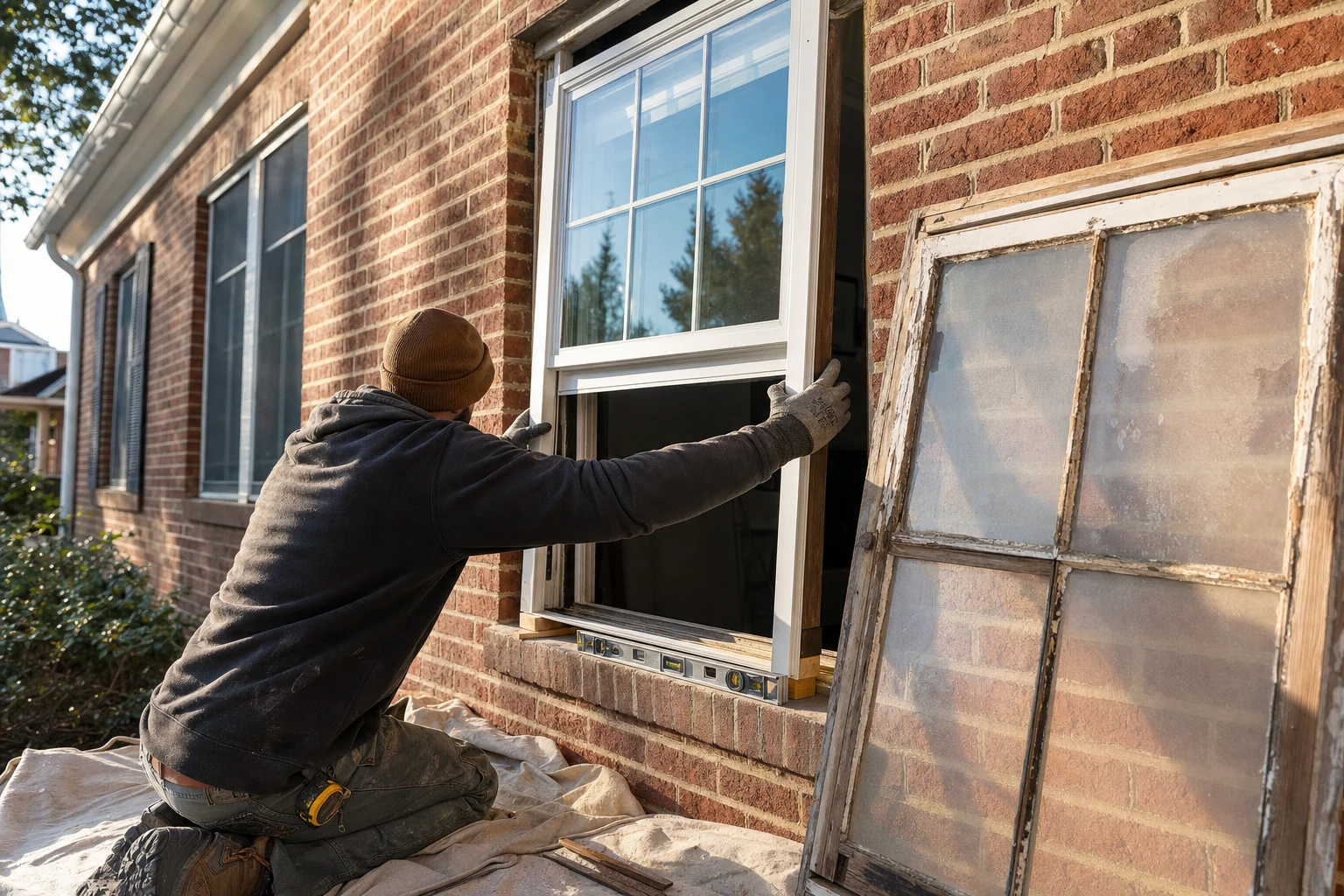
Replacement windows cost $450 to $1,500 per window installed, and $4,500 to $22,500 for a typical Nashville house of 10 to 15 windows. The national average is $900 a window. Brand drives less of that number than most homeowners expect: the material, the window type, and whether the installer keeps your existing frame or tears it out move the price far more than the badge on the sash.
The short version
- The window is 65% to 75% of the cost; labour is the rest. That ratio is why a cheap install of an expensive window is still expensive.
- Full-frame or pocket matters more than brand. A pocket window drops into the existing frame; full-frame replacement tears back to the opening and costs accordingly.
- Nashville is climate zone 3A, and that changes the storm-window answer. The Department of Energy recommends solar-control low-e here, not the regular low-e it recommends further north.
- Any window work on a pre-1978 home pulls in the federal lead rule. The firm has to be EPA lead-certified, and you can check that in a minute.
- Fog between the panes may be a warranty claim. Andersen warrants its glass against seal failure for 20 years and that cover transfers with the house. Check before you pay anyone.
What window replacement costs
The figures below are HomeGuide’s national cost model, updated 5 February 2026. They match what we hear from homeowners across Davidson, Williamson and Rutherford counties, though a specific quote depends on your openings more than on any average.
| Windows replaced | Typical installed cost |
|---|---|
| 1 | $450 to $1,500 |
| 5 | $2,250 to $7,500 |
| 10 | $4,500 to $15,000 |
| 15 | $6,750 to $22,500 |
| 25 | $11,250 to $37,500 |
The national average is $900 per window, with a reported floor around $300 and a ceiling around $8,000 for large or custom units. The split between product and labour is consistent: the window itself is 65% to 75% of the total, labour the remaining 25% to 35%, which works out at roughly $100 to $500 a window to install.
Comparing the major brands

| Brand | Installed cost per window |
|---|---|
| Window World | $300 to $1,300 |
| Pella | $300 to $3,500 |
| Alside | $400 to $2,300 |
| Andersen | $400 to $4,000 |
| Champion | $450 to $2,100 |
| Feldco | $500 to $1,800 |
| Harvey | $700 to $1,800 |
| Milgard | $700 to $2,000 |
| Marvin | $800 to $2,000 |
Read that table with care, because it is the most misused chart in the window business. Those ranges span every product line and window size a brand sells. Andersen’s range runs to $4,000 because Andersen sells an architectural wood window as well as a builder-grade vinyl one; it does not mean an Andersen double-hung costs four times a Harvey. A like-for-like comparison is three quotes on the same opening, the same window type, the same glass package, and the same installation method. Anything else compares a brand’s cheapest product to another brand’s dearest.
One practical note on Window World: it sells in packages of 6, 8 or 12 retrofit windows rather than single units, so its low per-window figure assumes you are doing most of the house.
What actually drives the price
1. Frame material
| Material | Installed cost | Notes |
|---|---|---|
| Aluminium | $175 to $1,000 | Cheapest; conducts heat, so the worst insulator of the group |
| Vinyl | $200 to $1,500 | The common Middle Tennessee choice |
| Fiberglass | $400 to $2,000 | Tends to outlast the other frame materials |
| Composite | $400 to $2,300 | Wood look, vinyl-like performance |
| Wood | $800 to $3,800 | Historic districts; needs maintenance and can rot |
2. Window type
A single-hung is $300 to $2,100 installed and a double-hung $350 to $2,500. A bay window is $2,000 to $6,000 and a bow $3,000 to $8,000 or more, because you are buying three to six units and a structural head. An egress window for a basement bedroom is its own project at $3,000 to $7,000, or $6,000 to $8,000 once excavation and a window well are included.
3. Pocket versus full-frame
This is the line item homeowners least often ask about and it can swing a quote by thousands. A pocket or insert replacement drops a new window inside your existing frame; it is faster, cheaper and keeps your interior trim. A full-frame replacement removes the frame back to the rough opening. Full-frame is the honest answer when the frame is rotten, when the opening is out of square, or when you want to see what the siding and sheathing are doing. Quotes that look wildly different on the same house are often quoting these two different jobs, so ask which one you are being sold.
4. Glass package
Double-pane is the standard at $400 to $2,000 installed; triple-pane is $450 to $3,000. A low-e coating adds 10% to 20% to the window price. In a cooling-dominated climate the coating you choose matters as much as the pane count, which brings us to the storm-window question.
Can a storm window save the window you have?
Sometimes, and the evidence is better than the reputation. The Department of Energy and Pacific Northwest National Laboratory modelled low-e storm windows across all eight climate zones, running roughly 4,240 simulations across 39 model homes. Their finding:
“In climate zones 3 through 8, low-e storm windows are always cost effective (SIR >1) when installed over single-pane windows and double-pane, metal-framed windows. The SIR values range from 1.2 to 3.2 across the different locations analyzed.”
Nashville and Davidson County sit in IECC climate zone 3A, which puts this metro squarely inside that finding. Two details from the same report matter locally:
- Choose solar-control low-e, not regular low-e. The report recommends solar-control low-e glass specifically in zone 3, because here the cooling load is doing as much work as the heating load. Regular low-e is the recommendation for zones 4 through 8.
- The low-e upgrade pays for itself anywhere. The incremental cost of low-e glass over clear glass was cost effective in every climate zone with a payback of two to five years. So if you are fitting a storm window for quieter rooms or draught control rather than energy, the report still recommends paying for the low-e version.
Storm windows also cut air leakage, which is half of what makes an old window feel cold: the study notes whole-home air leakage falls 10% to 15% from adding storm windows alone. They run $150 to $400 each installed, against $450 to $1,500 to replace the window outright, and the study assumed a 20-year service life.
Where a storm window is not the answer: a rotten frame, a window that no longer operates or latches, a sash that has been painted shut for decades, or an opening that fails egress requirements for a bedroom. A storm window is an energy and comfort retrofit, not a structural repair.
Lead paint: the rule that applies to most older Nashville homes
If your house was built before 1978, window work is federally regulated, and this catches a lot of people out.
Under the EPA’s Renovation, Repair and Painting (RRP) rule, firms performing renovation for compensation in pre-1978 housing must be EPA lead-certified and must assign a certified renovator to the job. The EPA’s guidance is explicit that firms may not even advertise covered renovation work without that certification. Window replacement is specifically named as covered work, and the usual square-footage thresholds do not get you out of it: the rule catches interior work disturbing six square feet or more, exterior work disturbing twenty square feet or more, and window replacement.
There is a genuine exception, and the EPA states it plainly: if the work disturbs no painted surface at all, the RRP requirements do not apply. The EPA’s own worked example is replacing mil-finish aluminium windows, which carry no paint to disturb.
What to do with this: ask any window contractor bidding a pre-1978 house whether the firm is EPA lead-certified, and verify rather than take the answer on trust. The EPA publishes a public lookup of certified firms. This is the same habit we recommend for checking a contractor’s state license, and it applies to siding work on the same housing stock: it takes a minute and it is the cheapest due diligence available.
Scope note: we verified the certification requirement, the coverage of window replacement, and the no-painted-surface exception against the EPA’s published RRP guidance. We did not review Tennessee-specific lead rules or local Metro requirements, which may add to the federal baseline rather than replace it.
Fog between the panes: what it means and what to do
Moisture between the panes is not condensation you can wipe off. It means the insulated glass unit has lost its seal, the inert gas fill has escaped, and humid air is now moving in and out of a cavity that was meant to be sealed. The window still keeps weather out. What it has lost is most of its insulating value, and it will keep getting cloudier.
Check the warranty first
Before you price a repair, find out whether someone already owes you one. Andersen warrants its factory-glazed glass against material obstruction of vision and premature failure of the glass or organic seal for 20 years from purchase, and that glass warranty is transferable to a subsequent owner for the remainder of the term. Terms vary by manufacturer and by product line, and there are exclusions for things like art glass and impact-resistant glass, but a twenty-year transferable seal warranty means a fogged window on a house you bought ten years ago can still be a live claim.
Does defogging work?
Defogging services drill the glass or spacer, flush and vacuum out the moisture, and reseal the holes. Be clear about what that buys: it is a cosmetic fix. It clears the haze; it does not rebuild the seal or restore the gas fill, so the thermal performance of the original sealed unit does not come back. Industry sources also report that moisture commonly returns and that some manufacturers treat a drilled unit as voiding the glass warranty.
We could not find independent, peer-reviewed testing of defogging durability. The claims above come from window manufacturers and glazing companies, who are not disinterested. Treat the specific timeframes you see quoted with that in mind, and note that the underlying physics is not in dispute: you cannot re-establish a factory gas fill through a drilled hole.
The durable options are replacing the insulated glass unit in your existing frame, which is the cheaper route when the frame is sound (glass-only replacement runs $300 to $650), or replacing the whole window.
When you actually need new windows
The honest signs, as opposed to the ones a salesperson leads with:
- Visible damage: cracked glass, a rotting or soft frame, rusted hardware
- Fog or moisture between the panes
- A window that no longer opens, closes or latches properly
- Draughts you can feel at the sash or the frame perimeter
- Single-pane glass, which is where storm windows and full replacement both pay best
- Age past 20 years, at which point seals are typically at the end of their service life
Things that are not on their own a reason to replace every window in the house: a single failed seal, condensation on the inside of the glass in winter (usually an indoor humidity problem, not a window problem), or an unsolicited quote that arrived with a door knock. That last one should sound familiar if you read our piece on how storm-chasing crews work this metro; the pattern is the same trade to trade.
Commercial windows and storefront glazing
Commercial glazing is priced by the square foot rather than by the unit, and it is a different trade from residential window replacement.
| System | Installed cost |
|---|---|
| Storefront glazing, standard thermally broken aluminium | $50 to $150 per sq ft |
| Upgraded glass packages (laminated, spectrally selective low-e) | $130 to $180 per sq ft |
| Curtain wall (multi-storey systems) | $200 to $400 per sq ft |
These commercial figures come from industry pricing guides rather than from a primary cost database, and commercial glazing varies more by access, height and specification than almost any other trade. Treat them as an order of magnitude for budgeting and get a real bid. Volume matters: multi-unit projects commonly attract meaningful discounts.
If you are specifying for a commercial building, the two questions that move the number most are access (upper floors and interior-only access add substantially) and the glass specification, which is where the security, acoustic and solar-control requirements land.
Common questions
How much does it cost to replace all the windows in a Nashville house?
$4,500 to $22,500 for the 10 to 15 windows in a typical home, with a national average of $900 per window. The spread depends on frame material, window type, and whether the job is a pocket replacement into the existing frames or a full-frame tear-out.
Are storm windows worth it instead of replacing?
In Nashville’s climate zone, the Department of Energy’s modelling found low-e storm windows are always cost effective over single-pane windows and double-pane metal-framed windows, with a savings-to-investment ratio of 1.2 to 3.2. In zone 3 the recommendation is solar-control low-e specifically. At $150 to $400 per window installed against $450 to $1,500 to replace, they are worth pricing before you commit to replacement, unless the frames are rotten or the windows no longer operate.
Do I need a lead-certified contractor to replace windows?
If the home was built before 1978, yes. The EPA’s Renovation, Repair and Painting rule requires firms doing covered renovation for compensation in pre-1978 housing to be lead-certified, and window replacement is specifically covered. The exception is work that disturbs no painted surface at all. Ask for the firm’s EPA certification and verify it.
Can a foggy double-pane window be repaired?
The haze can be cleared by a defogging service, but that is cosmetic: it does not rebuild the seal or restore the gas fill, so the insulating performance does not come back, and some manufacturers treat a drilled unit as voiding the glass warranty. Check your warranty first, because seal failure is often covered. Andersen, for example, warrants its factory-glazed glass against seal failure for 20 years and the cover transfers with the house.
Which window brand is best value?
The published brand ranges overlap so heavily that they cannot answer this on their own, because each range spans a manufacturer’s builder-grade and architectural lines. Get three quotes on the same opening, the same window type and the same glass package, and compare those. The installation method matters as much as the badge.
Does replacing windows need a permit in Nashville?
Replacing windows with the same size and type generally does not, while changing the size of an opening involves reframing and generally does. Because that is structural work, confirm with Metro Codes before the job starts rather than after.
Getting quotes worth comparing
Ask every bidder for the same four things and the quotes become comparable: the window brand and product line, pocket or full-frame, the glass package including whether low-e is solar-control, and the EPA lead certification if the house predates 1978. Our Nashville window contractor directory lists the companies we track with their state license numbers and expiry dates, and you can request a free quote from our sponsor, a licensed Nashville contractor.
Sources
- HomeGuide: Window replacement cost guide, updated 5 February 2026. Cost ranges by number, material, type, pane count and brand; the product-versus-labour split. Retrieved 21 September 2026.
- PNNL-22864 Rev. 2, Database of Low-e Storm Window Energy Performance across U.S. Climate Zones, Pacific Northwest National Laboratory for the U.S. Department of Energy, September 2014. Climate-zone cost effectiveness, savings-to-investment ratios, the zone 3 solar-control recommendation, and air-leakage reduction. Retrieved 21 September 2026.
- U.S. EPA: Renovation, Repair and Painting Program, Contractors, and the EPA’s published RRP guidance on window replacement in pre-1978 housing. Retrieved 21 September 2026.
- Andersen Limited Warranty: 20-year transferable glass warranty covering premature failure of the glass or organic seal.
- Nashville and Davidson County energy code climate-zone designation (IECC zone 3A).
- Commercial glazing figures are from industry pricing guides and are labelled as such above.
This article is general information, not legal, engineering or construction advice. Cost figures are national ranges from the sources cited and will vary with your openings, your home and your specification. Warranty and regulatory terms are quoted from the published documents named above; confirm the terms that apply to your windows and your property before relying on them. Last updated 22 September 2026.