Author: Nashville Builders Pro

  • Roof Repair or Replacement? How to Tell Which You Actually Need in Nashville

    Roof Repair or Replacement? How to Tell Which You Actually Need in Nashville

    Repair a roof when the damage is localised, the roof is still within roughly the first two-thirds of its expected life, and the deck underneath is sound. Replace it when problems appear across several slopes at once, when the deck is compromised, or when the roof already carries two layers of covering and cannot legally take a third.

    Those three tests — age, extent, deck — settle most cases before cost enters the conversation. Two building-code thresholds decide the rest, and they are different numbers doing different jobs: 25 percent of the roof covering replaced in any 12-month period forces the entire roof up to current code, and in Nashville a permit is required once you replace more than a third of the roof or add any new layer.

    Most roofs that get replaced could have been repaired. Most roofs that get repaired twice should have been replaced the first time. What follows is how to tell which side of that line you are on, and why an emergency at 11pm on a Tuesday almost never means you are buying a new roof.

    The three questions that decide it

    Before anyone quotes you anything, these are the questions a competent roofer is answering in their head while they walk your roof.

    1. How old is it?

    Guidance attributed to the National Roofing Contractors Association puts the design life of most new roofs at around 20 years, with actual lifespan governed by local climate, design, material quality, installation quality and maintenance. In practice, a three-tab asphalt roof in Middle Tennessee tends to run about 20 years, architectural shingles nearer 30, and premium laminated products longer again.

    The useful rule is not the number itself but where you sit against it. A roof in its first decade with a discrete problem is a repair. A roof past about 18 years showing problems in several places at once is telling you something systemic, and patching it buys months rather than years.

    2. How much of the roof is affected?

    This is where the widely-repeated “25% rule” comes from, and almost every article you will read gets it slightly wrong. It is not a contractor’s opinion. It is building code, and we will come to exactly what it says in a moment.

    3. Is the deck sound?

    The decking is the plywood or OSB under everything else. Shingles are replaceable; a rotted deck is a different job entirely. If a roofer puts a foot through a soft spot, or you have had a slow leak running for a season, the conversation changes from covering to structure, and structure wins that argument every time.

    What the code actually says about 25%

    The 25 percent rule does not mean a roof with more than 25 percent damage must be replaced. It means that replacing more than a quarter of the roof covering within any 12-month period requires the entire roof to be brought up to current building code.

    The “25% rule” is a provision of the International Residential Code — Section R908.4 in the 2024 edition Nashville enforces, numbered R908.3.1 in the 2018 and 2021 editions you will see cited elsewhere. The wording has been stable, and it matters:

    “Not more than 25 percent of the roof covering of any building or structure shall be removed and replaced in any 12-month period unless the entire roof covering is replaced and is made to conform to the requirements of this code.”

    Read that carefully, because it is not what people usually think it means. It does not say a roof with 26% damage must be replaced. It says that if more than a quarter of the covering is removed and replaced within any twelve months, the whole roof has to be brought up to current code — current fastening, current underlayment, current wind and energy requirements.

    That is why the economics flip at that point. Once you cross the threshold, you are not paying for a large repair; you are paying for a code-compliant roof either way. At that point replacement is usually cheaper per year of life than the repair that triggered it.

    It also means something useful for you as a homeowner: a contractor who tells you a roof with three damaged squares “has to be replaced by code” is misreading the provision. Under 25%, the code is not the reason.

    Nashville’s permit number is different, and it is not 25%

    Here is the part that trips people up locally. Nashville has its own threshold, it does a different job, and it is a different number.

    Metro Nashville’s permit schedule lists roofing as “roofing, new layer or replacing more than 1/3 of the roof”. Two things follow from that wording, and the second one catches people out:

    • Replacing more than a third of the roof puts you into permit territory. Below that, routine repair generally does not.
    • Adding a new layer puts you there regardless of area. Overlaying is not treated as maintenance no matter how small the section.

    Metro Nashville and Davidson County currently enforce the 2024 International Residential Code and 2024 International Building Code with local amendments, adopted under ordinance BL2025-898. Confirm anything borderline with the Department of Codes and Building Safety rather than with whoever is quoting the work.

    Two thresholds, two different jobs
    Threshold Where it comes from What it actually governs
    25% IRC R908.4 (2024); R908.3.1 in earlier editions Cross it in any 12 months and the entire roof must be brought to current code
    1/3 Metro Nashville permit schedule Replacing more than a third, or adding any new layer, requires a permit

    So a repair can be permit-exempt in Nashville and still trigger the code-compliance provision. They are not the same test, and a contractor who conflates them is either careless or hoping you will not check.

    The rule that quietly decides a lot of these

    There is a third code provision that settles more repair-or-replace arguments than either percentage: a roof recover is not permitted where the existing roof already has two or more applications of any type of roof covering. One existing layer can generally take a second. A roof already carrying two layers has to come off to the deck.

    If your house has been re-roofed twice without a tear-off, your next roof is a full replacement regardless of how localised the damage is. Ask any roofer quoting you how many layers are up there. If they have not looked, they are not quoting; they are guessing.

    When a repair is genuinely the right answer

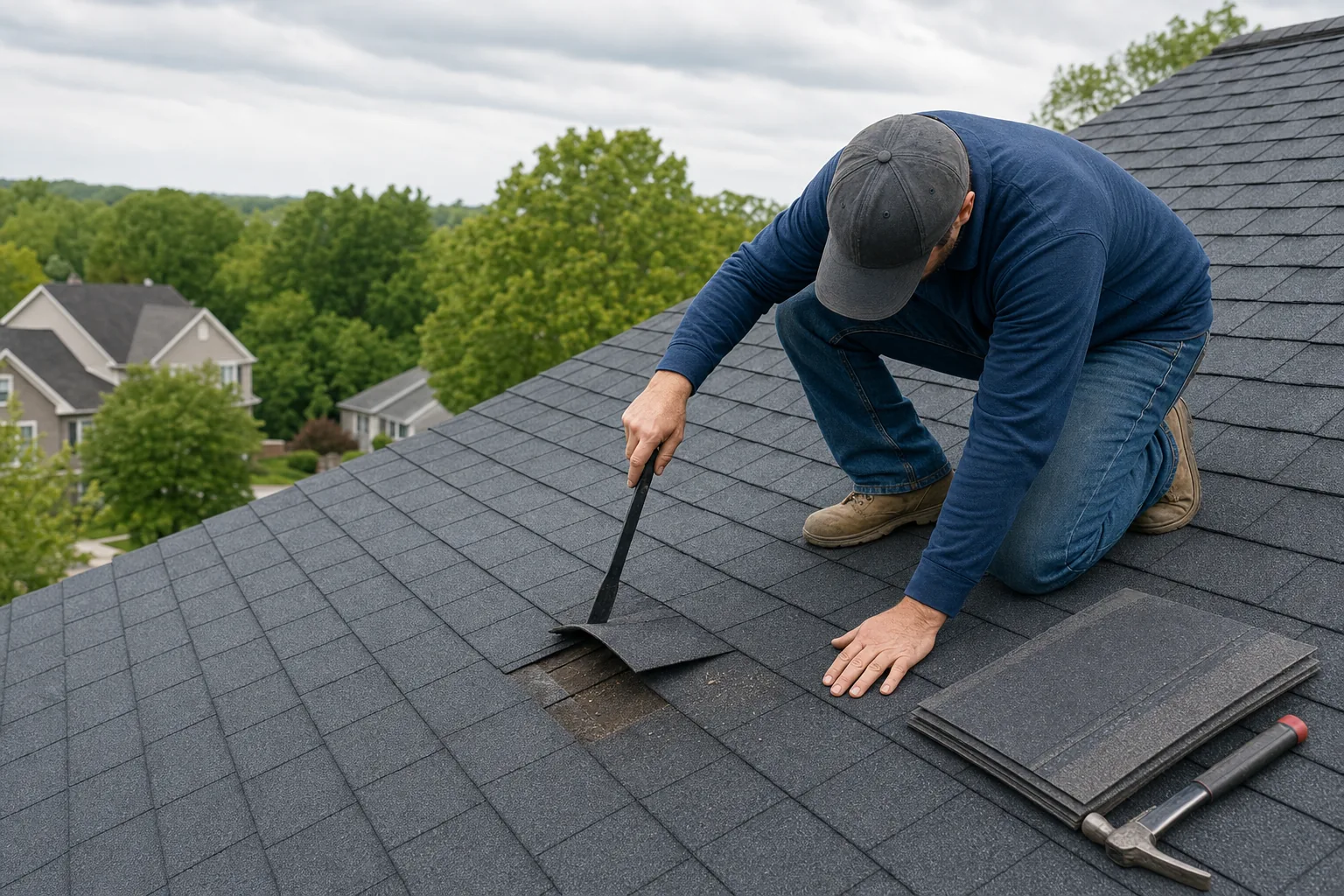
    Repair is the right call when the roof is inside its expected life, the damage is confined to a small area, the cause was a discrete event rather than age, and the deck is sound. Most leaks are flashing failures rather than shingle failures, and flashing is a repair.

    In full, repair is usually the sound call when all of these are true:

    • The roof is comfortably inside its expected life — roughly the first two-thirds.
    • The damage is localised. A handful of missing shingles, one length of failed flashing, a single penetration around a vent or chimney.
    • The cause was an event, not age. A branch came down, a storm lifted a section, a previous repair was done badly. Discrete causes have discrete fixes.
    • The rest of the roof looks its age and no worse. Granules still in place, shingles lying flat, no widespread curling or cupping.
    • The deck is sound.

    The NRCA is explicit that not all leaks require complete replacement, and that flashings and small damaged sections are commonly repairable. Most leaks are flashing failures, not shingle failures — and flashing is a repair.

    When replacement stops being avoidable

    An aged asphalt shingle roof showing widespread granule loss, curling shingle edges and exposed bitumen across the whole surface
    Systemic rather than localised: granule loss and curling across the whole field. This is a roof ending, not a roof damaged.
    • The problems are everywhere rather than somewhere. Granule loss across whole slopes, shingles curling on multiple elevations, several leaks in unrelated places. That is the system ending, not a fault.
    • The deck is compromised. Soft spots, sagging between rafters, daylight visible from the attic.
    • You are already at two layers. See above.
    • You are repairing repeatedly. Three service calls in two years on an ageing roof is a replacement being paid for in instalments, at worse value.
    • Damage exceeds 25% and you are re-roofing to code anyway.

    Emergency repair is not the same conversation as replacement

    An emergency roof repair exists to stop water entering the building tonight. It is temporary, comparatively cheap, and commits you to nothing. A tarp fastened over a damaged section buys the week or two you need to get quotes in daylight. Needing an emergency repair does not mean needing a new roof.

    A blue emergency tarp fastened over a small damaged section of an otherwise intact shingle roof, battened down with timber and screws after a storm
    A properly battened tarp over a localised failure. This is a temporary measure that buys decision-making time, not a commitment to anything.

    This is the part worth being clear about, because it is where people get pushed into decisions at the worst possible moment.

    An emergency repair exists to stop water entering the building tonight. That is its entire job. It is temporary, it is comparatively cheap, and it does not commit you to anything. A tarp properly fastened over a damaged section, a section of underlayment tacked down, a failed flashing sealed — these buy you the week or two you need to get quotes in daylight from people who are not standing in your living room while the ceiling drips.

    A roofer who arrives for an emergency call and leads with a replacement contract has misread the assignment. The sequence should be:

    1. Stop the water. Tarp or temporary patch, same visit.
    2. Document everything. Photographs of the damage and of the temporary work, before anyone tidies up.
    3. Assess properly in daylight, ideally including the attic side.
    4. Then decide repair or replacement, with quotes, unhurried.

    Keep the receipt for the emergency work. Insurers generally expect you to take reasonable steps to prevent further damage, and temporary repairs are normally treated as part of the claim rather than something you have spent instead of it. Check your own policy for its notice requirements, because those vary and some are shorter than people assume.

    The pressure tell. Urgency about the leak is legitimate. Urgency about the contract is not. Nothing about a signed replacement agreement stops water coming in faster than a tarp does, and any roofer who cannot separate those two things is selling rather than fixing.

    What Middle Tennessee does to roofs specifically

    The failure pattern here is not gradual wear so much as repeated stress. Heavy spring rain, hail, summer heat that cooks asphalt, then freeze-thaw cycling through winter. That combination ages a roof unevenly: south and west elevations typically fail first, and the damage often shows up as granule loss and brittleness before anything actually leaks.

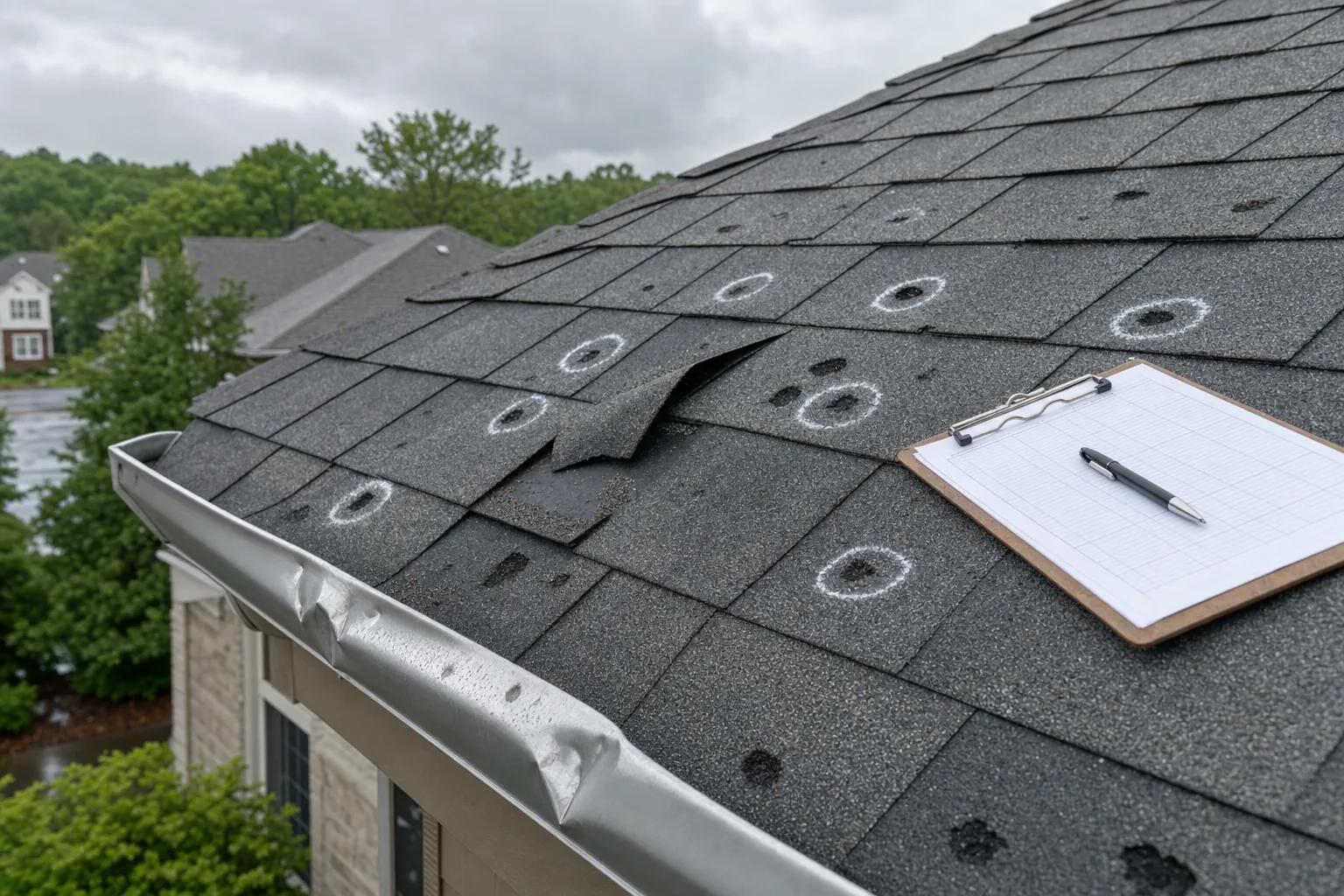
    After a hail event specifically, the useful thing to know is that hail damage is frequently not visible from the ground and frequently does not leak immediately. Bruised shingles shed granules, the mat underneath degrades, and the failure can surface seasons later rather than immediately. That is why post-storm inspections matter even when nothing is dripping, and why a roof that looks fine from the driveway can still have a legitimate claim.

    Questions worth asking before you agree to anything

    1. How many layers are on the roof now? If they have not checked, they have not assessed it.
    2. What percentage of the roof area is actually affected? Ask for the number, not an adjective.
    3. Did you inspect the decking, and from where? Attic access tells a different story than the surface does.
    4. If you are recommending replacement, which of these is driving it — age, extent, deck condition, or the layer count?
    5. Will this need a permit? Over a third of the roof area in Nashville, it will.
    6. What does the repair option look like, and how long would you expect it to hold? Every honest roofer can answer this even when recommending replacement.
    7. Can I see your licence number? Then check it yourself against the state register.

    Common questions

    Can I just repair part of my roof, or does it all have to match?

    You can repair part of it. Matching is the practical problem: shingles fade, product lines get discontinued, and a repair on a ten-year-old roof will usually be visible. That is a cosmetic consideration rather than a structural one, and it matters most on a front elevation. Ask to see the replacement shingle against the existing roof before work starts.

    Does a repair void my roof warranty?

    It depends what kind of warranty you have. A manufacturer’s material warranty generally covers the product, and a competent repair using compatible materials does not void it. A workmanship warranty from the original installer may be a different matter if someone else does the work. Ask both questions before the repair, not after.

    My roof is 15 years old and has one leak. Repair or replace?

    Almost certainly repair, unless the deck is wet or you are already at two layers. One leak on a fifteen-year-old roof is usually flashing, and flashing is a repair. Be more cautious if it is the second leak in two years, which suggests the roof is failing rather than damaged.

    Insurance is paying — should I just take the replacement?

    If the insurer has assessed the damage as warranting replacement, that is their determination to make and it is generally reasonable to accept it. What is worth resisting is a contractor encouraging you to claim for a replacement when the damage is a repair. That is the homeowner’s exposure, not theirs.

    How long can a tarp stay on?

    Weeks, not months. A properly fastened tarp is a genuine temporary measure and it will hold through normal weather, but it degrades in sun and can lift in wind. Treat it as buying decision-making time rather than as a solution, and get the permanent work scheduled while it is up.

    The short version

    Age, extent, deck. Under a quarter of the roof, inside its expected life, deck sound, one layer or two — that is a repair, and code is not an argument against it. Systemic problems, a compromised deck, or a third layer that cannot legally go on — that is a replacement.

    And if it is midnight and water is coming in: stop the water, photograph everything, and make the expensive decision in daylight.

    When you are ready to compare, our Nashville roofing directory lists every roofing company we track with its state licence number and expiry, ranked on a published formula, and you can browse roofers across Middle Tennessee or read our breakdown of what an asphalt shingle roof costs here.

    Sources

    • International Residential Code — the 25 percent / 12-month provision (§R908.4 in the 2024 edition; §R908.3.1 in the 2018 and 2021 editions), and the requirement to strip to deck where the existing roof already carries two or more applications of roof covering.
    • Metro Nashville Department of Codes and Building Safety — permit schedule (“roofing, new layer or replacing more than 1/3 of the roof”) and adopted codes list (2024 IRC and 2024 IBC, ordinance BL2025-898).
    • National Roofing Contractors Association — expected service life guidance and repairability of flashings and localised damage.
    • Tennessee Department of Commerce and Insurance — contractor licence register.
  • Best Roofers in Nashville, TN (2026): All 14 Ranked and Licence-Checked

    Best Roofers in Nashville, TN (2026): All 14 Ranked and Licence-Checked

    Fourteen roofing companies serve Nashville. Only 6 of them are actually headquartered here, and 13 hold a Tennessee contractor licence that was active and unexpired when we checked the state register on 6 September 2026.

    This is the full list, ranked by a formula we publish below, with every licence number included so you can verify any of it yourself. We are a directory: we do not do roofing work and we take no cut of any job.

    Best Roofers in Nashville, Ranked

    # Company HQ Score Rating Reviews Licence Expires
    1 Centennial Roofing Brentwood 93.3 5 992 #68585 03/31/2027
    2 Storm Guard Roofing (sponsor) Franklin 91.6 5 825 #77075 12/31/2027
    3 MidSouth Construction Nashville 91.5 4.9 1,070 #64545 05/31/2027
    4 Power Home Remodeling Nashville 88.4 4.6 1,693 #72827 01/31/2027
    5 SeekOne Roofing Company Brentwood 88.2 5 580 #79012 03/31/2027
    6 Don Kennedy Nashville 87.3 4.8 889 #50660 08/31/2028
    7 Tim Leeper Roofing Old Hickory 85.8 4.9 586 #54549 11/30/2027
    8 Music City Roofers Nashville 84.6 4.7 873 #67506 03/31/2027
    9 Three Stone Roofing and Exteriors Franklin 83.7 4.9 472 #80031 10/31/2027
    10 Best Choice Roofing Hendersonville 82.9 4.8 560 #83341 09/30/2027
    11 Trusted Roofing Hendersonville 82.8 4.9 427 #77423 02/29/2028
    12 Mr. Roof Nashville Nashville 82.2 4.7 677 #60782 03/31/2028
    13 Force Roofing Systems Franklin 81.1 4.9 359 #76184 04/30/2027
    14 Midtown Home Improvements Nashville 24.2 4.2 380 Not confirmed

    About the one unconfirmed licence. We could not match Midtown Home Improvements to an active Tennessee contractor licence when we searched the register on 6 September 2026, and their own website publishes no licence number. That is a statement about our search, not about the company: businesses register under legal names that differ from their trading names. Ask them directly, and check it yourself.

    How We Ranked These Nashville Roofing Companies

    An unexplained ranking is just an opinion. Here is the whole formula, so you can disagree with it.

    Factor Weight How it is measured
    Active state licence 40% Whether the company holds a Tennessee contractor licence that is both active and unexpired today. It carries the most weight because it is the one thing you cannot judge by looking.
    Review volume 35% Log-scaled between 50 and 2,000 reviews, so the biggest company does not simply win.
    Review rating 25% Scaled between 4.0 and 5.0 stars.

    Ties break on review count, then alphabetically.

    What we deliberately left out

    BBB grade. Thirteen of these fourteen companies hold an A+. A factor almost everyone ties on tells you nothing, and including it would only make the method look more thorough than it is.

    Years in business. We hold a verified founding date for one company out of fourteen. Scoring it would mean guessing about the other thirteen.

    Anything about workmanship. We have not been on these roofs, and neither has anyone else publishing a list like this. What we can check is licensing and what customers reported, so that is what we score.

    The Companies, One by One

    1. Centennial Roofing

    Brentwood · 5 stars from 992 reviews · Licence #68585, active to 03/31/2027

    Roofing only, with no siding or window work, which is unusual on this list. It holds the strongest combination of rating and review volume of any company serving Nashville.

    2. Storm Guard Roofing

    Franklin · 5 stars from 825 reviews · Licence #77075, active to 12/31/2027

    The broadest coverage here, listed in all fourteen communities we track, and one of only two companies carrying both a general contractor and a home improvement contractor licence.

    3. MidSouth Construction

    Nashville · 4.9 stars from 1,070 reviews · Licence #64545, active to 05/31/2027

    The largest review count of any company still holding a 4.9, and one of only two that list masonry alongside roofing and siding.

    4. Power Home Remodeling

    Nashville · 4.6 stars from 1,693 reviews · Licence #72827, active to 01/31/2027

    By far the most-reviewed company at 1,693, and the lowest-rated of the licensed firms at 4.6. A large national operator accumulates both more praise and more complaints than a small local one, so read the distribution rather than the average.

    5. SeekOne Roofing Company

    Brentwood · 5 stars from 580 reviews · Licence #79012, active to 03/31/2027

    A 5.0 across 580 reviews, and like Storm Guard it carries both a general contractor and a home improvement contractor licence rather than just one.

    6. Don Kennedy

    Nashville · 4.8 stars from 889 reviews · Licence #50660, active to 08/31/2028

    Trades as Don Kennedy Roofing LLC. Its licence appeared lapsed in our records in July 2026; we re-checked the state register on 6 September 2026 and it is current through 31 August 2028.

    7. Tim Leeper Roofing

    Old Hickory · 4.9 stars from 586 reviews · Licence #54549, active to 11/30/2027

    Headquartered in Old Hickory rather than Nashville proper, and roofing only.

    8. Music City Roofers

    Nashville · 4.7 stars from 873 reviews · Licence #67506, active to 03/31/2027

    Nashville-headquartered and roofing only, with a high review count for a single-trade firm.

    9. Three Stone Roofing and Exteriors

    Franklin · 4.9 stars from 472 reviews · Licence #80031, active to 10/31/2027

    Franklin-based, and the only company here that pairs roofing with painting rather than with windows or gutters.

    10. Best Choice Roofing

    Hendersonville · 4.8 stars from 560 reviews · Licence #83341, active to 09/30/2027

    Hendersonville-headquartered but listed across all fourteen communities we track, the widest coverage of any single-trade roofer on this list.

    11. Trusted Roofing

    Hendersonville · 4.9 stars from 427 reviews · Licence #77423, active to 02/29/2028

    The most geographically focused company here, covering seven communities concentrated on the northern side of the metro. Trades as TrustedRoofing LLC.

    12. Mr. Roof Nashville

    Nashville · 4.7 stars from 677 reviews · Licence #60782, active to 03/31/2028

    Nashville-headquartered with metro-wide coverage, offering roofing, siding, windows, gutters and masonry.

    13. Force Roofing Systems

    Franklin · 4.9 stars from 359 reviews · Licence #76184, active to 04/30/2027

    The smallest review base on the list at 359, paired with a 4.9 rating. Fewer reviews is not the same as worse work, but it is less evidence to go on.

    14. Midtown Home Improvements

    Nashville · 4.2 stars from 380 reviews · Licence not confirmed

    The one company here we could not match to an active Tennessee contractor licence, and whose own website publishes no licence number. See the note under the table before reading anything into that.

    Where Nashville Roofers Are Actually Headquartered

    A contractor pickup truck with ladders on its rack driving an interstate approach into Nashville at sunrise, the downtown skyline on the horizon ahead
    Eight of the fourteen roofing companies serving Nashville are headquartered somewhere else in the metro.

    Search for a roofer in Nashville and every result will tell you it serves Nashville. Fewer than half are based here.

    Head office Companies
    Nashville 6
    Franklin 3
    Brentwood 2
    Hendersonville 2
    Old Hickory 1

    This matters less than it sounds for planned work and more than it sounds after a storm. Williamson County is a thirty-minute drive from most of Davidson County on a normal Tuesday. The morning after a hail event, when every roofer in the region is triaging calls, a company two exits away tends to reach you before one that has to cross the city. If you are booking a replacement months out, base location is close to irrelevant. If your ceiling is wet right now, ask where the crew is coming from.

    How to Check a Nashville Roofing Contractor Yourself

    A homeowner at a kitchen table with a laptop, a printed roofing estimate, a business card and reading glasses, checking a contractor before hiring
    Checking a licence number against the state register takes under a minute and costs nothing.

    You do not have to take our word for any of this. Tennessee publishes its contractor register free, and a licence number takes under a minute to check.

    1. Ask for the licence number before the quote, not after. A licensed contractor will give it without hesitation. Reluctance is itself an answer.
    2. Search the state register at search.cloud.commerce.tn.gov.
    3. Check the expiry date, not just the status. This is the step almost everyone skips. A record can read “Active” while sitting past its expiry date, because the status only reflects when the record was last touched.
    4. Check the name matches. Companies trade under one name and register under another. If the register shows a different legal entity, ask them to explain the connection.
    5. Confirm the licence covers the work. In Tennessee a Contractor licence and a Home Improvement Contractor licence cover different project values. Ask which one applies to your job.

    One caution worth stating plainly, because we ran into it ourselves: licence numbers are not unique across licence types. Searching number 81906 returned a roofing company, a cosmetologist and a former motor vehicle salesman. Match on the name and the city as well as the number.

    Compare These Roofers Side by Side

    This article is a snapshot taken on 6 September 2026. Our Nashville roofing directory carries the same ranking, kept current, with filters for licence status and rating and free quote requests. You can also browse every roofer we list across Middle Tennessee, or read our breakdown of what an asphalt shingle roof costs here.

  • How Much Does an Asphalt Shingle Roof Cost in Middle Tennessee? (2026)

    How Much Does an Asphalt Shingle Roof Cost in Middle Tennessee? (2026)

    An asphalt shingle roof typically costs $13,500 to $27,000 installed in Middle Tennessee in 2026, or $450 to $900 per roofing square. Architectural shingles, the mid-range grade, run $15,000 to $21,000 on a typical home, and the full span from economy to designer is $12,000 to $30,000. A repair costs a few hundred to a few thousand dollars, depending on whether water has reached the decking.

    Three numbers most cost guides leave out, and this one does not. A residential re-roof permit in Davidson County costs $135 on a $20,000 job. Williamson County charges $110 on the same job. Nashville requires no permit at all for a repair covering 33% or less of the roof.

    Those figures come from the Metro Nashville and Williamson County fee schedules, wage data from the U.S. Bureau of Labor Statistics, lifespan ratings from InterNACHI, and national price benchmarks from This Old House. Everything below is current as of September 2026.

    Quotes across the metro genuinely span that full range, and any guide that hands you one tidy number is hiding the parts that move it. This page does the opposite. Every line item that lands on a Middle Tennessee roofing bid, what each costs, and which ones you can actually control.

    What an asphalt shingle roof costs in Middle Tennessee right now

    Asphalt shingle pricing in the Nashville metro sorts cleanly into three grades, and the grade you pick moves the total more than any other single decision. Roofers price by the square. One square equals 100 square feet of roof surface, and it is the unit worth learning before you read a bid.

    Installed asphalt shingle cost by grade, Middle Tennessee, 2026
    Shingle grade Per square Per sq ft Typical 30-square roof Expected life
    Economy (3-tab) $400–$500 $4.00–$5.00 $12,000–$15,000 20 years
    Mid-range (architectural / dimensional) $500–$700 $5.00–$7.00 $15,000–$21,000 30 years
    Premium (designer / luxury) $800–$1,000 $8.00–$10.00 $24,000–$30,000 Longest (compare warranties)

    Those are our own Middle Tennessee figures, the same per-square pricing that drives our roof cost calculator, set from what quotes in this metro actually come in at. Expected lifespans are the standard ones published by InterNACHI, the home-inspector association, which rates 3-tab asphalt at 20 years and architectural at 30.

    It is worth knowing how that compares to the national picture, because the gap is real. This Old House, in a guide updated March 12, 2026, puts asphalt shingle installation at $3.44 to $12.00 per square foot nationally: $8,419 to $11,665 for standard asphalt on a 2,000 square foot house, and $11,914 to $16,436 for architectural. Middle Tennessee quotes routinely land above those national midpoints, and a Nashville homeowner who budgets from a national average is the one who gets sticker shock when the bids arrive.

    Both are right, and the gap between them is the real lesson. Premium-service contractors carrying full crews, manufacturer certifications, and long workmanship warranties price at the top of those bands. Volume operators and storm-chasers price at the bottom. The same house can draw bids thousands of dollars apart depending on which end of that market you call, which is exactly why comparing three written bids matters more here than picking a number off a chart.

    A flat three-tab asphalt shingle beside a thicker laminated architectural shingle, showing the difference in build and shadow line
    Left, three-tab. Right, architectural. That extra laminated layer is the difference between a roof InterNACHI rates at 20 years and one it rates at 30.

    Why “per square” beats “per square foot” when you read a bid

    Your roof is bigger than your house. A 2,000 square foot single-story home with a moderate 6/12 pitch has roughly 2,240 square feet of roof surface before waste, and a steeper or more cut-up roof pushes that higher still. Contractors then add a waste allowance on top, commonly around a tenth of the total, to cover cuts, valleys, and starter courses. That is why a “2,000 square foot house” quote and a “30 square roof” quote can describe the same job. When you compare bids, confirm every one of them is priced on the same square count.

    You can get your own square count in about two minutes with our roof cost calculator. Outline your roof on the satellite map and it applies the pitch and waste math for you.

    The complete line-item breakdown: what you’re actually paying for

    A roof replacement is not one product, it is roughly a dozen. Here is every component that shows up on a Middle Tennessee bid, with what each typically costs.

    Most of what you are paying for is labor, and the U.S. Bureau of Labor Statistics explains why the crew rate on your bid looks nothing like a wage. The median roofer earned $55,440 a year as of May 2025, about $26.65 an hour, with the top 10% above $81,720. The hourly figure a contractor bills is several times that wage, and the difference is not profit: it covers payroll taxes, workers’ compensation, general liability, vehicles, equipment, warranty reserve, and the crew’s unbillable hours. Roofing carries one of the highest injury and fatality rates of any occupation in the country, which is exactly why insurance is such a large share of a legitimate roofer’s overhead, and why the bid from an uninsured crew is cheaper.

    Roof replacement components and typical costs, 2026 (national figures from This Old House unless noted)
    Line item Typical cost Is it optional?
    Tear-off and removal of old shingles $1.00–$5.00 per sq ft No, unless a layover is allowed
    Flashing replacement $200–$500 No
    Skylight installation or replacement $1,600–$4,200 each Only if you have them
    Attic fan / added ventilation $300–$900 Often the best-value upgrade
    Gutters, if replaced at the same time $1,000–$6,500 Optional, but cheaper done together
    Underlayment (felt or synthetic) Included; synthetic is the upgrade No
    Decking repair (rotted sheathing) Priced per sheet, found after tear-off Unknown until the roof is open
    Building permit (Davidson County, $20k job) $135 No (see the permit section)

    Tear-off and disposal: the line most homeowners try to skip

    Tearing off and hauling away the old roof runs $1.00 to $5.00 per square foot, per This Old House’s 2026 figures. On a 30-square roof that is a meaningful chunk of the bid, and it is the first thing a cut-rate quote quietly removes by proposing to shingle over your existing layer instead.

    A layover is cheaper today and more expensive over the life of the roof. It traps heat against the old shingles, shortens the new roof’s life, hides any rotted decking underneath, and doubles the tear-off cost next time. The model residential code that Metro Nashville enforces also limits a roof to two layers of shingles, so a second layover is generally off the table. Confirm the current limit with your jurisdiction. If a bid is unusually low, check whether it includes a full tear-off before you assume you found a bargain.

    Decking: the one number nobody can quote honestly up front

    Nobody knows the condition of your roof deck until the shingles come off. Reputable Middle Tennessee contractors handle this with a written per-sheet allowance in the contract: a set price per sheet of replacement OSB or plywood, with the count settled after tear-off. A bid with no decking clause at all is not a cheaper bid; it is an unpriced change order waiting to happen.

    Ask every bidder the same two questions: what is your per-sheet price, and how many sheets are included before it starts costing extra? The difference between contractors on this single line has settled more Nashville-area disputes than any other.

    Underlayment, flashing, and the parts that keep water out

    Underlayment is bundled into the per-square price, but the type is not. Traditional 30-lb felt is the default; synthetic resists tearing, holds up if the roof is left dry-in for a few days, and handles Middle Tennessee’s summer heat load better. On a 30-square roof the upgrade is a few hundred dollars, and it is one of the better-value line items on the whole bid. Ask which one the bid assumes, by product name.

    Flashing is where roofs actually fail. Valleys, sidewalls, chimneys, and pipe penetrations leak long before the field shingles wear out, and This Old House puts flashing replacement at $200 to $500. Reusing old flashing to save money is a false economy. If a bid mentions “reuse existing flashing,” price the alternative before you sign.

    Roofing permits in Middle Tennessee: the real fees, by county

    Permit costs are usually waved off with a vague range. The actual fees are published, they are formulas, and they are lower than most people expect. Here is the arithmetic for the two largest Middle Tennessee jurisdictions, straight from the fee schedules.

    Davidson County (Metro Nashville)

    Metro Nashville requires a building permit to install roofing. It is item 8 on the department’s list of work requiring a permit, per the Residential Building Permit Procedures page, last updated October 31, 2025. The 2025 Building Permit Fee Schedule (ordinance BL2022-1215) builds a residential permit from three parts:

    • Zoning examination fee: $25
    • Building valuation fee: $5.00 per $1,000 of total job valuation for one- and two-family homes and townhouses
    • Codes tech fee: 10% of the building valuation fee

    Plan review is not charged: one- and two-family dwelling permits are explicitly exempt from the plans examination fee. So the math on a real job is simple:

    Davidson County residential re-roof permit cost by job value
    Job valuation Valuation fee Codes tech fee Zoning exam Total permit
    $15,000 $75.00 $7.50 $25 $107.50
    $20,000 $100.00 $10.00 $25 $135.00
    $25,000 $125.00 $12.50 $25 $162.50
    $30,000 $150.00 $15.00 $25 $190.00

    Williamson County (Franklin, Brentwood, Nolensville area)

    Williamson County’s Schedule of Permit Fees uses a different formula: $15.00 for the first $1,000 of valuation, plus $5.00 for each additional $1,000 or fraction of it, up to $50,000. A $20,000 roof therefore costs $15 + (19 × $5) = $110. A $25,000 roof costs $135.

    One clause in that schedule is worth more than the fee itself. Under Section B104, if work starts before the permit is pulled, the fees are doubled, and paying the double fee does not excuse you from complying with the code anyway. If a contractor offers to start Monday and “sort the permit out later,” that is your cue to ask why.

    Check your jurisdiction, not just your county. Incorporated cities frequently run their own codes departments with their own fee schedules, so a Franklin address and an unincorporated Williamson County address can be permitted by different offices. Rutherford County (Murfreesboro, Smyrna) publishes its own schedule as well; confirm the current figure with the county before you budget it.

    Roof repair costs in Middle Tennessee, and when repair is the wrong call

    Most roof repairs in the Nashville metro land somewhere between a few hundred dollars and a few thousand, and where you fall depends almost entirely on whether water has reached the structure. A pipe boot replacement or a handful of blown-off shingles sits at the bottom. Flashing work, the most common real repair, runs $200 to $500 on This Old House’s 2026 figures. Once a leak has been running long enough to saturate decking and insulation, you are into four figures, because the job is no longer roofing alone.

    There is also a permit line worth knowing, because it is the cleanest rule in Metro’s code. Nashville does not require a permit for “repairs to an existing roof not to exceed 33 percent of the roof area,” which it classifies as normal maintenance. Cross that third-of-the-roof threshold and you are in permit territory. It is a useful sanity check on a contractor’s framing: a job described as a simple repair that happens to cover half your roof is a partial replacement, and should be permitted and priced like one.

    The math that decides repair vs. replace

    Compare cost per year of remaining life, not sticker price. A $1,500 repair that buys three more years costs $500 a year. An $18,000 architectural roof, rated by InterNACHI at 30 years, costs about $600 a year, and it resets your storm exposure, your warranty, and your insurability at the same time. Once a roof is past roughly 70% of its rated life, repair money is usually rent, not investment.

    What drives price up in Middle Tennessee specifically

    Four local factors show up on Nashville-area bids more than they do elsewhere:

    • Pitch and complexity. Steeper roofs need staging and fall protection, and cut-up roofs with dormers, multiple planes, and long valleys burn labor hours. Pitch, existing layers, roof penetrations, and site access are the four multipliers that move a Middle Tennessee bid most.
    • Storm season demand. Middle Tennessee’s spring hail and straight-line wind events spike demand across the metro at once. Prices and lead times both move when every crew in three counties is booked.
    • Heat and humidity load. Summer attic temperatures are what age a Middle Tennessee roof from underneath, which is why ventilation and underlayment quality matter more here than in a milder climate.
    • Where you are in the metro. Crew travel time, local demand, and what the surrounding market will bear all move the number. The same roof does not cost the same in Green Hills and in Dickson, which is why a quote sourced from one city is a poor guide to another.

    How to compare three roofing bids without getting fooled

    The cheapest bid and the best value are rarely the same document. Put all three side by side and check these seven lines before you look at the total:

    • Square count. Are all three pricing the same roof size?
    • Tear-off vs. layover. A layover bid is not comparable to a tear-off bid.
    • Decking allowance. Per-sheet price and included sheet count, in writing.
    • Underlayment type. Felt or synthetic, named by product.
    • Flashing. New, or reused?
    • Warranty. Manufacturer material warranty and the contractor’s separate workmanship warranty. They are two different things, and the second is the one that fails you.
    • Permit. Who pulls it, and is the fee in the price?

    Then verify the license. Tennessee licenses contractors through the state Board for Licensing Contractors, and license status is publicly searchable. Licensing thresholds vary by project value and by county, so check the roofer’s number against the state registry rather than taking a card at face value. A contractor who cannot produce a license number and a certificate of insurance has told you what you need to know.

    Frequently asked questions

    How much does a new roof cost in Nashville in 2026?

    Most Nashville-area asphalt shingle replacements run $13,500 to $27,000 installed, or $450 to $900 per roofing square, with architectural shingles on an average home landing between $15,000 and $21,000. National benchmarks sit lower. This Old House puts architectural asphalt at $11,914 to $16,436 on a 2,000 square foot house, so budget from local numbers, not national ones.

    How much is a roofing permit in Nashville?

    For a $20,000 residential re-roof in Davidson County, $135: a $100 building valuation fee ($5 per $1,000), a $10 codes tech fee (10% of that), and a $25 zoning examination fee. One- and two-family homes are exempt from the plan review fee. Williamson County charges $110 on the same job.

    Do I need a permit to repair my roof in Nashville?

    Not if the repair covers 33% or less of the roof area, which Metro Nashville classifies as normal maintenance. Anything larger requires a building permit.

    How long does an asphalt shingle roof last in Tennessee?

    InterNACHI, the home-inspector association, rates 3-tab asphalt at 20 years and architectural at 30. Middle Tennessee’s summer heat and humidity push real-world lifespans toward the lower end, and attic ventilation is the single biggest factor in whether you reach the rated life or fall short of it. Designer shingles are built to outlast architectural; compare the manufacturer’s warranty term rather than a rule of thumb.

    Is it cheaper to repair or replace a roof?

    A repair runs a few hundred to a few thousand against $13,500 or more for a replacement, so a repair is almost always cheaper today. Compare cost per year of remaining life instead: past roughly 70% of a roof’s rated lifespan, about 21 years into a 30-year architectural roof, repairs stop being an investment.

    Does insurance cover a roof replacement in Tennessee?

    Homeowners policies generally cover sudden storm damage (hail, wind, impact) and generally exclude wear-out and age. Whether you are paid actual cash value or replacement cost depends on your specific policy language, so read your declarations page and confirm the terms with your carrier or adjuster before you assume a number.

    Get real numbers for your roof

    A guide gives you the range. Only a contractor on your roof gives you the price. Nashville Builders Pro matches you with licensed, insured Middle Tennessee roofers so you can compare written bids side by side. Free, no obligation, about 60 seconds to start.

    Get free roofing quotes from vetted local pros →

    Browsing by city? Start with roofers in Nashville, Murfreesboro, Franklin, Hendersonville, or Gallatin. If a storm caused the damage, read our guide to handling a Nashville roof insurance claim first.

    Cost figures current as of September 2026. Per-square pricing is Nashville Builders Pro’s own Middle Tennessee model; national benchmarks from This Old House (updated March 2026); shingle lifespans from InterNACHI; wage data from the U.S. Bureau of Labor Statistics (May 2025); permit fees from the Metro Nashville 2025 Building Permit Fee Schedule and the Williamson County Schedule of Permit Fees. Verify current permit fees with your jurisdiction before budgeting.

  • Storm Damage to Your Nashville Roof? How to Handle the Insurance Claim

    Storm Damage to Your Nashville Roof? How to Handle the Insurance Claim

    Short answer: after a hail or wind storm, work the calendar — not the roof. Document the damage, file your homeowners claim promptly, get an independent inspection from a licensed local roofer, and have that contractor meet your insurance adjuster on site. Most sudden storm damage in Tennessee is covered; the money homeowners lose is usually lost to slow filing, thin documentation, or signing with the wrong crew.

    What to do in the first 48 hours

    Move fast, but stay off the roof. Insurers pay for sudden, storm-caused damage — and the clearest way to prove “sudden” is a tight timeline. Note the storm date, photograph what you can see from the ground (dented gutters, shingle debris in the yard, water stains on ceilings), and stop active leaks inside with a bucket and a tarp so a small problem doesn’t turn into a claim-sinking one.

    Does homeowners insurance cover storm roof damage in Tennessee?

    Usually, yes. Standard Tennessee homeowners policies cover sudden damage from hail, wind, and fallen limbs — the storms Middle Tennessee sees every spring. What they don’t cover is wear and tear or deferred maintenance. That’s the line an adjuster looks for, which is why an older roof needs careful documentation to show the failure came from this storm, not from age.

    Know your deductible before you file

    Many Tennessee policies carry a separate wind/hail deductible — often 1–2% of the home’s insured value rather than a flat dollar amount. On a $400,000 home, a 2% deductible is $8,000. If a repair is close to your deductible, a claim may not be worth filing; if it’s a full replacement, it almost always is.

    The claim process, step by step

    • Document everything. Photos, dates, and a written list of damage, inside and out.
    • File promptly. Call your insurer or file online right after the storm — delay is the most common reason a valid claim gets questioned.
    • Get an independent inspection. Have a licensed local roofer inspect before the adjuster visits, so you know what real damage exists.
    • Meet the adjuster together. A good contractor walks the roof with your adjuster and points out damage that’s easy to miss from the ground.
    • Review the scope. Compare the insurer’s estimate against the contractor’s. If line items are missing, your roofer can file a supplement.

    Mistakes that get claims denied or underpaid

    Two things sink good claims: waiting too long, and thin paperwork. A roof that sat with an obvious leak for months reads as neglect, not storm damage — and so does a claim with three blurry photos and no dates. The fix is boring but powerful: file quickly, and back the claim with clear, dated evidence and a professional inspection report.

    Watch out for storm chasers

    After every big Nashville storm, out-of-town crews flood the metro knocking on doors and promising to “waive your deductible.” Be careful with that offer: it usually means billing your insurer for money you never actually paid — and knowingly submitting an inflated insurance claim is an unlawful act under Tennessee’s insurance-fraud law. Those crews are also usually gone long before a warranty ever matters. Stick with a licensed local roofer who carries insurance, has real reviews, and will still be here next spring.

    Getting honest local help

    You don’t have to handle the roof and the insurance company alone. The right contractor runs the storm inspection, documents damage the way adjusters expect, and manages the claim from the first photo to the final shingle.

    Compare licensed, well-reviewed storm-restoration roofers in our Nashville roofing directory, or request free quotes and we’ll match you with vetted local pros who handle insurance work.

    This article is general information, not legal or insurance advice. Coverage, deductibles, and claim rules depend on your specific policy — confirm the details with your insurer or a licensed professional. Last updated July 2026.